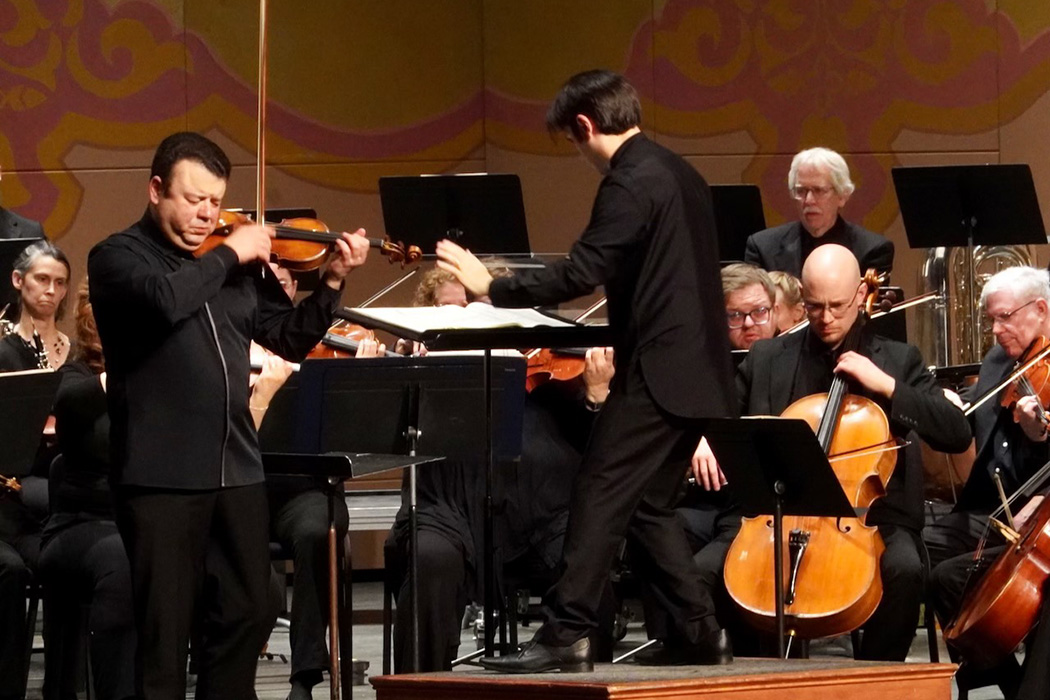
For a variety of reasons, the January Masterworks concerts of the Knoxville Symphony Orchestra always seem to acquire a disproportionate amount of unforeseen drama. For example, it was ten years ago this month that Aram Demirjian was vying for the then vacant Music Director position with the orchestra and conducted an energized audition concert, one in which attendance had been severely reduced by the fear of a catastrophic snowstorm that never materialized. The result, though, was a performance that was described as “…the most articulate and impassioned Masterworks Series performance by the orchestra so far this season” in my review in The Knoxville Mercury.
Thankfully, other than some tolerably chilly temperatures, no such weather catastrophe threatened the KSO this week. But, that doesn’t mean there wasn’t drama to be had and savored. On hand was violinist Vadim Gluzman as guest soloist in the Brahms Violin Concerto offering a performance that defined the idea of seasoned virtuosity. While Gluzman exudes an aura of confident intensity, technical prowess, and musical maturity, his playing went even beyond that to the rarified air evocative of a great artist who is absolutely one with the Brahms concerto and with his exquisite instrument—the 1690 ex-Leopold Auer Stradivari.
The Brahms concerto is an obstacle course of technical challenges that Gluzman handled with an unbelievable effortlessness, coupling those gestures of perfectly rendered double and triple stops with a beautifully painted lyrical Romanticism. The cadenza of the opening movement kept the audience in rapt attention, while Gluzman and Maestro Demirjian offered up a slow movement that was achingly beautiful in both tone and timing. Sadly, that magical interval of tranquil silence that is the end result of the beautifully rendered Adagio was lessened by a gratuitous smattering of unnecessary applause from a few in the audience.
Interestingly, the musical dynamic between Gluzman and the orchestra, a natural product of the give and take between guest soloist and conductor, lent a charming degree of expectation to the performance— an enjoyable freshness in a work that is otherwise very familiar. Given the Tennessee Theatre’s warm resonance and the KSO’s familiarity with it, one couldn’t help wondering how Gluzman’s Strad might handle Brahms and the balance of soloist versus orchestra in other concert halls.
The extended ovation for the violinist brought him back on stage for an encore, but for one that was quite unexpected. After remarking “…it takes a village,” five KSO violinists—Concertmaster William Shaub, Gordon Tsai, I-Pei Lin, Zofia Glashauser, and Tobias Elser—joined Gluzman in a touching arrangement of Danny Boy. [Read the account of this encore in violinist.com]
Demirjian opened the concert with Iranian composer Niloufar Nourbakhsh’s Knell. The composer was present at the Thursday evening performance and offered an emotional description of her work’s original conception in 2018 and its context today. The work startles with its harmonic richness and suggestiveness, questions/answers made a bit eerie by percussion effects. While the work was intended to suggest the tolling of a bell, its assumed context given the current humanitarian/political protests in her native Iran was inescapably even more somber.
Separated by the intermission, the closing work of the evening, the Symphony No. 2 in D Major of Jean Sibelius, was a feast of tasteful eccentricities and surprises. In his prefatory remarks on the work, Maestro Demirjian admitted that one might feel a bit lost in the Allegretto, with listeners being led off on little tangents only to be returned unharmed. This proved to be true, but the journey was worth the effort, not unlike the energy expended in treading water in an ocean of waves.
There were many particularly notable moments, including trumpet work by Principal Trumpet Kole Pantuso and the lovely oboe solo by Principal Oboe Claire Chenette.
While charming in its lyrical inventiveness and storytelling throughout, the fourth movement (Finale, Allegro moderato) probed deeper into the composer’s bag of delights. Ultimately, no matter whether you follow Sibelius’ death and salvation path, or the Finish national pride concept, one can always fall back on the uplifting and glorious Finale and its equally uplifting string motif, played lusciously here by the KSO, that simply screams Romanticism.