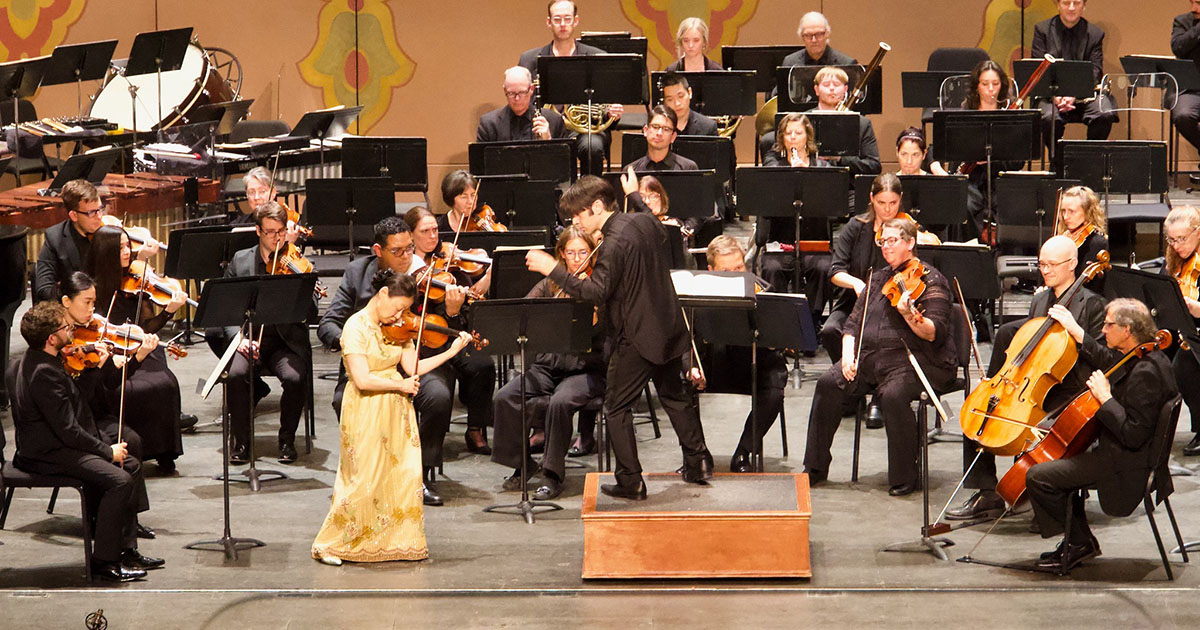
It is an inarguable truth that every concert comes with its own set of expectations, a delicious combination of factors—conductor, orchestra, soloists—that ideally turn the “merely intrigued” into “definitely compelled” ticket buyers. Clearly, concert expectations were running high for the Knoxville Symphony Orchestra’s Masterworks pair this past weekend as a trinity of events made the concerts a “can’t miss” event. First, as part of the “9 for 90” commissioning project, the KSO offered the World Premiere of Jonathan Leshnoff’s Quilts, a work with multiple local connections. Secondly, the orchestra welcomed the storytelling opportunity of Richard Strauss’ tone poem, Don Juan. And, in a rare celebrity/soloist moment for the KSO, the expectations were maxed out with the violinist Midori on hand as soloist in the Beethoven Violin Concerto.
Maestro Aram Demirjian began the evening with a short, but surprisingly intriguing opener, Bravado, by the young contemporary Gala Flagello. The work, written for the 2023 Tanglewood Music Festival, exuded an infectious driving energy that hid a neat little melodic transformation.
With the running leap afforded by the Flagello piece, Demirjian and the orchestra flew into Richard Strauss’ tone poem Don Juan, a work that basked in its majestic themes from the horns and in beautifully descriptive melodies from the oboe. Important too, were the narrative moods in which both lightness and darkness in textural density parallel each other in the storytelling. It is in pieces like this that KSO audiences should thank appropriate deities for the marvelously warm resonance of the Tennessee Theatre that makes Strauss a rich tonal experience to be savored.

Composer Jonathan Leshnoff should be familiar to KSO audiences, since his Piano Concerto was performed by Demirjian and the orchestra only two years ago. From my Arts Knoxville review: “I instantly found myself drawn to the work, its tonal orchestral style and variety had a pleasant persistence and romance. Its repeated phrases made both rhythmic and textural statements, but ones that did not overwhelm or make undue demands.”
The KSO commission to Leshnoff for Quilts came about as part of the “9 for 90” commissioning project in celebration of the orchestra’s 90th season. [The Arts Knoxville preview here details the background of the work and its local connection.] This unabashedly tonal work in three movements features a melodic current that meanders lyrically through it. Also featured is a chorale of sorts that solemnly opens the work, suggests itself in the middle movement, then returns in the closing. Although the composer’s notes call it the “Knoxville Chorale,” listeners will find its sympathies soothing, but pleasantly non-provincial.

At intermission, while a vocal crowd was taking in the quilts on display in the Tennessee Theatre lobby, the real buzz was for the pending performance by Midori of the Beethoven Violin Concerto. And, she didn’t disappoint.
Demirjian and the orchestra made the three-plus minute orchestral introduction seem to fly by, not a small feat in a concerto that can seem long in average hands. Fortunately, all hands were firmly dedicated to this performance which featured an easy tempo overall and a subtle display of phrasing and cleverly detailed articulation by the soloist. Avoiding anything heavy-handed, Midori turned phrases with varying degrees of softness, inducing listeners to subconsciously lean forward in their seats to absorb the subtle touches.
As it should be, the second movement (Larghetto) questions the very meaning of time and space in music and enchants with beautiful solo melodies that feel like a revealing look at the violinists personality. In a sense, the finale expands and sums up the emotional center that seemed to be at the heart of the Larghetto.
As the audience rewarded the performance with several boisterous ovations following the work, I couldn’t shake the realization that one was seeing the results of a true artist’s transformation. The drama, volume, and body language of a teenage prodigy had been smoothed over and refined by cautious introspection. Of course, such a transformation of style requires patience and commitment and a willingness to look in the mirror and see the big picture—something that few attempt and even fewer accomplish.