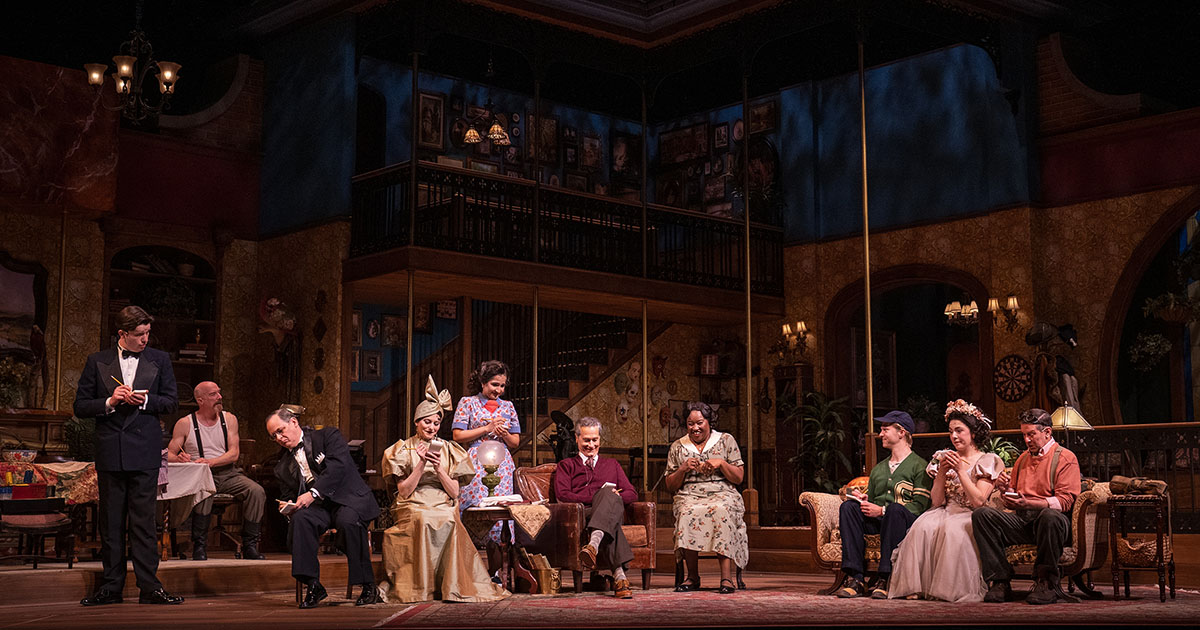
From Shakespeare to TV sitcoms, the trials and travails of eccentric families are a common theme of comic and tragic literature. One would be hard pressed, though, to find a more perfect example in the theatre than the Moss Hart and George S. Kaufman comic masterpiece, You Can’t Take It With You that first opened on Broadway in 1936. Winner of the Pulitzer Prize for Drama, it later inspired a 1938 film version by Frank Capra that featured Jimmy Stewart and Lionel Barrymore. Since that time, hilarity has ensued in countless productions of You Can’t Take It With You, including the current one by the Clarence Brown Theatre that opened last Friday and continues through May 3.
Directed with non-stop energy and a knack for comic timing by CBT first-timer Melissa Rain Anderson, this wildly attractive and hilarious production features a return of a number of actors familiar to CBT audiences for brilliant performances, as well as some delightful newcomers.
The eccentric family of You Can’t Take It With You is the wildly extended Vanderhof/Sycamore clan that “peacefully” resides in a home on the comfortably residential New York City Upper West Side of 1936. Terry Weber is Martin Vanderhof (aka Grandpa), a man who made the decision some 35 years ago to give up his high-pressure job and simply live a carefree life doing what he wants with a variety of eclectic interests—such as attending college commencements for the fun of it and raising snakes, neither of which are generally considered fun by the average person. No, Grandpa is not average.
Vanderhof’s daughter is Penelope Sycamore (Shinnerrie Jackson) who has devoted her time over the last eight years to writing plays, an activity triggered when a typewriter was delivered to the house by mistake. Of course, the plays are eminently un-produceable, but that doesn’t prevent her from bringing home a drunk actress, Gay Wellington (Cortney Jo Sandidge), to read her work.

Penny’s husband is Paul Sycamore (David Brian Alley), who is fully engrossed in his love of manufacturing fireworks for sale in the basement, helped by a partner in crime, a former ice deliveryman, Mr. DePinna (Doug James). Of course, where that leads should be comically obvious.
The Sycamore’s daughter is Essie (Gabrielle Fernandes), consumed by the dual activities of ballet dancing and candy making. On the ballet side, her life is devoted to rehearsing with every possible move and pose while anticipating her next lesson with Russian exile choreographer Boris Kolenkov (Jed Diamond). Essie is married to Ed (Steve Sherman), a comically and marginally proficient xylophone player who also enjoys a small printing press on which he creates family dinner menus and random phrases to accompany Essie’s candy sales. Part of the extended family is the cook, Rheba (Amanda King), whose boyfriend is the sometimes useful Donald (Parker Rawlins). And, guess who’s coming to dinner? None other than an exiled Russian grand duchess Olga (the always remarkable Carol Mayo Jenkins).

And then, there is the traditionally “normal” other daughter of the Sycamores, Alice (Yashshavi Choudhary) whose real desire is simply to marry her boyfriend Tony Kirby (Clay Cooper) and lead a normal life in a normal family. Tony, though is the son of a Wall Street executive (Jim Poulos) and his frustrated wife (Laura Beth Wells). A dinner meeting for the two families leads to one of the most classic comedy scenes in all of theatre—certainly a scene to look forward to in this production.

One of the most interesting features of this production is that director Anderson has managed a really remarkable degree of ensemble performance from actors accustomed to bearing the weight of starring roles. The script allows “moments” for almost all the cast, then permits them to step back to observe and react. For example, Laura Beth Wells painted her Mrs. Kirby with facial reactions that were priceless. Diamond sold his character through posture and delivery. Alley wore his Paul Sycamore like a costume. Of course, it’s Weber’s Grandpa that carries the theme idea of “do what makes you happy” in a delivery that is beautifully calm and understated.
Visual metaphors of both tension and relaxation abound in the scenic design by Alondra Castro and CBT artistic director Kenneth Martin. Miguel Santiago’s lighting design provided depth and dimension to that set while also directing focus of the madcap action. Lauren T. Roark’s costumes seemed to define the characters. Chance Beck’s sound effects supported the on and offstage action, not the least of which is the infamous fireworks explosion. I wondered, though, about voice reinforcement at moments when actors delivered lines upstage.
The beauty of You Can’t Take It With You and its continuing appeal is that it asks us to imagine what living a life free of cares and social rules, oblivious to what others may say, is really like. Is it right or wrong, or even possible? Ultimately, things haven’t really changed that much in 90 years.
By Moss Hart and George S. Kaufman
April 15 – May 3, 2026
TICKETS AND INFORMATION
Clarence Brown Theatre on the University of Tennessee Campus