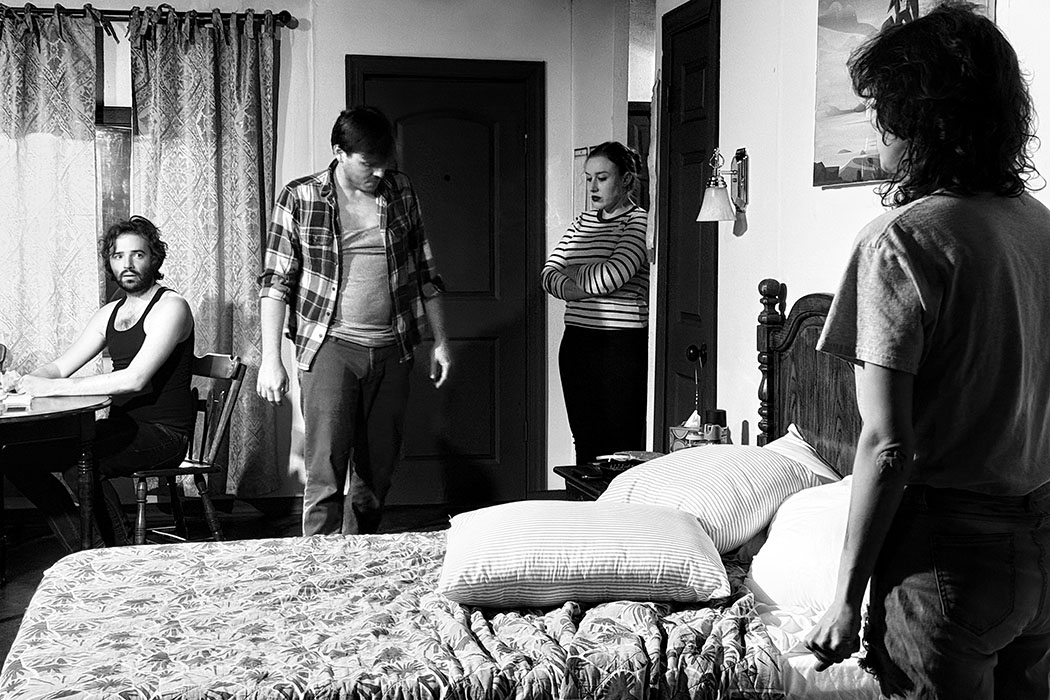
Paranoia can feel like an infestation, a slow and subtle creeping until you’re overwhelmed by racing thoughts like scuttering insects. Director Joseph Johnson knows just what it takes to get audiences’ skin crawling with his production of Tracy Letts’ 1996 Bug, a heady play about love, trauma, paranoia, and of course lots of creepy crawlies. As TKD’s annual adults-only performance, Bug is a slow-burning, drug-fueled descent into the deep recesses of the human psyche. From start to finish, Bug keeps you on edge, and content warning: this show portrays domestic violence, drug and alcohol use, and some sexual content.
Audiences enter into a haze-filled auditorium, and the cause is ambiguous: is it shower steam? Cigarette smoke? Fumigation? All three? An eerie red light flickers outside the window at stage right, a simulation of a distant vacancy sign that shifts from a glowing neon set piece to a reflection of the psychological unease as the narrative dips and swells through our character’s shifting mental states; it blinks faster and slower and at times washes stage in a menacing red glow. This, and other well-timed shifts between realism and surrealism in lighting design, were noteworthy in this production.
The set choices for Bug are some of the most impressive I’ve seen from TKD to date. Johnson, set designer Seth Reilly, and the construction crew made the most of the venue’s new extended stage (4 feet closer to the audience) by angling the set to give a more three-dimensional feel to the motel room setting as opposed to previous flat set pieces. The Oklahoma motel room in which the entire play is set is angled at a roughly 30 degree dutch angle, adding to the unsettling vibe of the production. Set decor is a gritty coziness, a home made out of transient trappings and held together as best as the protagonist, Agnes, can. From the simple wooden table laden with liquor bottles and drug paraphernalia to the dated 80s bedspread, the set captured that gritty, post-millenium sluminess of economy motor inns.
We first meet our protagonist, Agnes White (Shelby Frye) storming into the motel room after her shift as a waitress, and the wall phone is ringing off the hook, her abusive ex husband Jerry Gross (Josh Bigwood) on the other end of the line. Jerry’s now out on parole and looking to weasel his way back into Agnes’s life. Agnes’s friend R.C. (Emma Potter) introduces Agnes to Peter (Ben Park), a homeless Gulf War veteran, who then crashes in Agnes’s hotel room. As Agnes and Peter grow closer, he grows increasingly paranoid about government conspiracies and experiments on soldiers, believing himself to be a victim of such secret testing involving bugs—and that military doctors, including Dr. Sweet (Bill Howard), are spying on him. Agnes must confront her own abusive relationship, her traumatic past, and her own climactic descent into insanity.
Frye as Agnes delivers an impeccable monologue at the climax, not missing a single beat of the paranoia-driven conspiratorial drivel. They are keyed up to the max and sustain that frantic turmoil for what seems like an eternity as Agnes reaches a final breaking point. Park is also stellar as Peter, who works a shy innocence into a commanding misplaced self-assuredness, tearing the motel room apart in his incessant search of an infestation. His physical performance is notable in this production—his command of small, nervous tics convey an infectious anxiety, and his physical presence in general is unnerving. He’s captivating, and the final trance dance moment with Frye during their monologue sucks you in and doesn’t let go (any and all bug puns intended).
Bigwood as Jerry transforms the emotional cadence of his scenes with the large, loud, anger-fueled delivery of a jealous man who knows he is slowly being replaced. His furious outbursts are startling, and he plays the bad guy so well. Potter’s role as R.C. is rather minor (she only appears in two scenes), but she is the calm voice of reason who gets in over her head by introducing Agnes to Peter. And Howard as Dr. Sweet meets a similar (well, actually worse) fate: he’s on stage for a whirlwind 10 minutes, a morally ambiguous character who either cares for Peter’s well being or views him as nothing more than an experiment. And with lots of other themes in this play, we will never know where the truth lies amid the speculation.
Bug runs until May 10 with showtimes on Thursdays, Fridays, and Saturdays at 7:30pm and matinees on Sunday at 3:00pm. Tickets are available at their box office, located at 800 S. Central Street, or online at https://theatreknoxville.com/bug/.