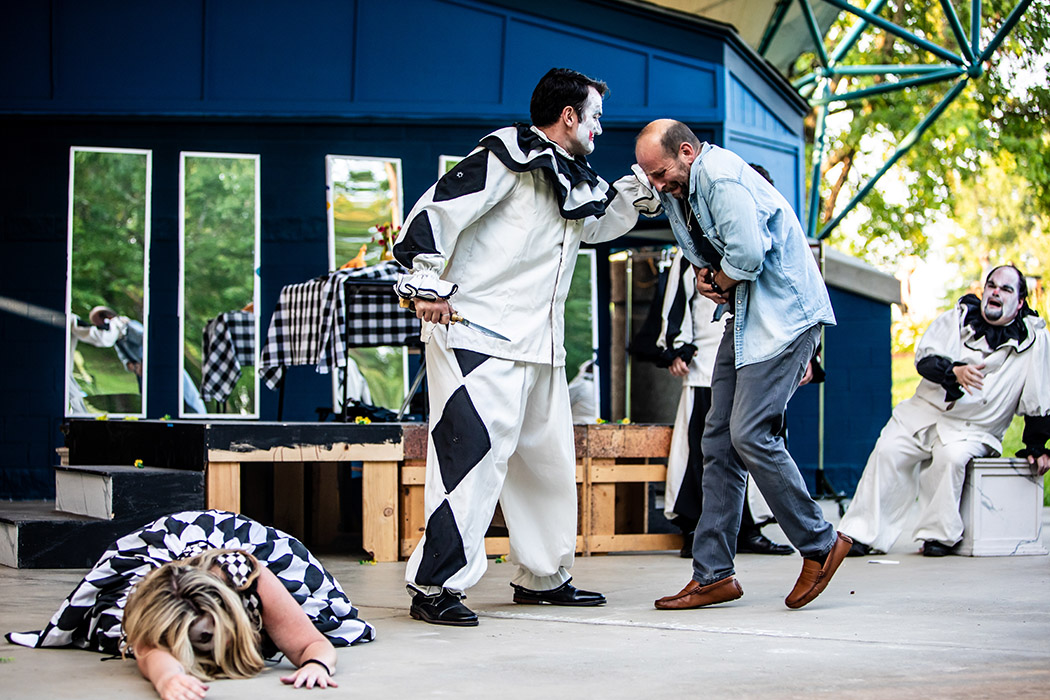
Since its founding in 2013, Marble City Opera has followed an intriguing evolutionary track, one that has embraced the concept of site-suggestive staging to offer both a fresh take on operatic classics as well as a no-holds-barred exploration of contemporary works. For the last several years, MCO has used a late springtime slot to venture into alternative outdoor locations, immersing audiences in environments that alter their perception of familiar narratives. In 2023, the company explored Carlisle Floyd’s atmospheric Susannah at Marble Springs State Historical Site in South Knox County. Last year, the choice was Puccini’s Il Tabarro (The Cloak) staged at two different spots on local rivers.
Building on the outdoor experience gained from those productions, the company had planned a trio of opera-related experiences for this past weekend centered around two performances of Ruggero Leoncavallo’s classic verismo vehicle, Pagliacci, at Oak Ridge’s A.K. Bissell Park, making use of its lawn and amphitheater-like pavilion. Plus, the two performances on Thursday and Saturday would bookend MCO’s first “Opera in the Park” awareness-raising sampler event at the open-air Marble Hall in Knoxville’s Lakeshore Park.
The first performance of Pagliacci on Thursday enjoyed a beautiful evening and gave the audience seated on lawn chairs and blankets on the pavilion’s sloping lawn a beautiful golden-hour experience. Ultimately though, “outdoor” means being susceptible to the forces of nature—the weekend’s force of nature fell from the sky on Friday and Saturday evenings in the form of drenching rains. In the spirit of “the show must go on…,” Friday’s “Opera in the Park” proceeded under cover despite the thunderstorm, albeit accompanied by percussion provided by Mother Nature. Having been warned of a serious thunderstorm on Saturday, MCO settled for a weather contingency plan—instead of the Oak Ridge park, the production would go indoors in the school gymnasium at Sacred Heart School, part of the Cathedral of the Most Sacred Heart of Jesus, one of the production’s sponsors.
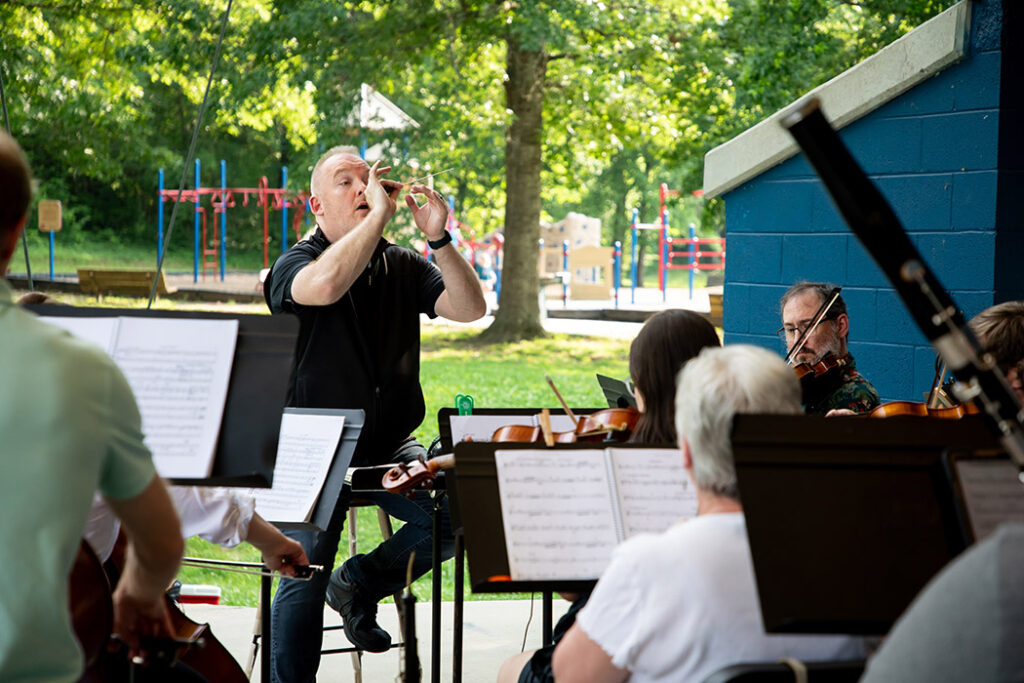
MCO artistic director Kathryn Frady had shouldered the responsibility of both directing the production of Pagliacci and singing the lead soprano role of Nedda. As evidence of the professionalism and abilities of Frady and the five-singer cast, the two performances in vastly different environments had different personalities but each exploded with marvelously devised characters and truly impressive vocal performances. Interestingly, one could even make a case for Saturday’s more intimate gymnasium performance being the stronger one musically both for singers and conductor Andy Anderson’s orchestral ensemble, despite the obvious and notable lack of theatrical atmosphere.
Frady’s outdoor staging plan was to blur the work’s period timeframe into a quasi-contemporary one, placing the opera’s villager chorus in regular street clothes in amongst the actual audience on the sloping lawn, ready to take the stage, thus removing the typical theatrical boundaries of the fourth wall. Of course, the opera’s narrative remained unchanged, with the performers donning their harlequinade-esque costumes and clown makeup for their commedia dell’arte performance. On Thursday, the Oak Ridge audience, having generally learned to expect anything in an MCO production, seemed to delight in the approach and accept the pastoral atmosphere.
As Nedda, Frady brought her considerable vocal and dramatic talents to bear in defining her character that not only must be believable as an abused wife having a love affair with the villager Silvio (Daniel Spiotta), but also be cute, charming, and playful in the “play within the play.” In the aforementioned love affair, Frady and Spiotta were sensational, managing to sell their characters’ attraction with an intensity and heat that was both lusciously lyrical and sensual in its raw physicality.
Returning to MCO from last season’s Il Tabarro was tenor Edward Brennan as Canio, the abusive and jealous manager that has chased his wife Nedda from their loveless marriage. With a marvelously clear, attractive, and powerfully expressive voice that opens eyes and ears, Brennan was able to handle with strength the three prongs of his character’s dramatic arc: the theatrically confident manager, a broken man that jealously concedes Nedda’s unfaithfulness in the sad and sorrowful “Vesti la giubba,” and the raging drunk that ends the opera in tragedy.
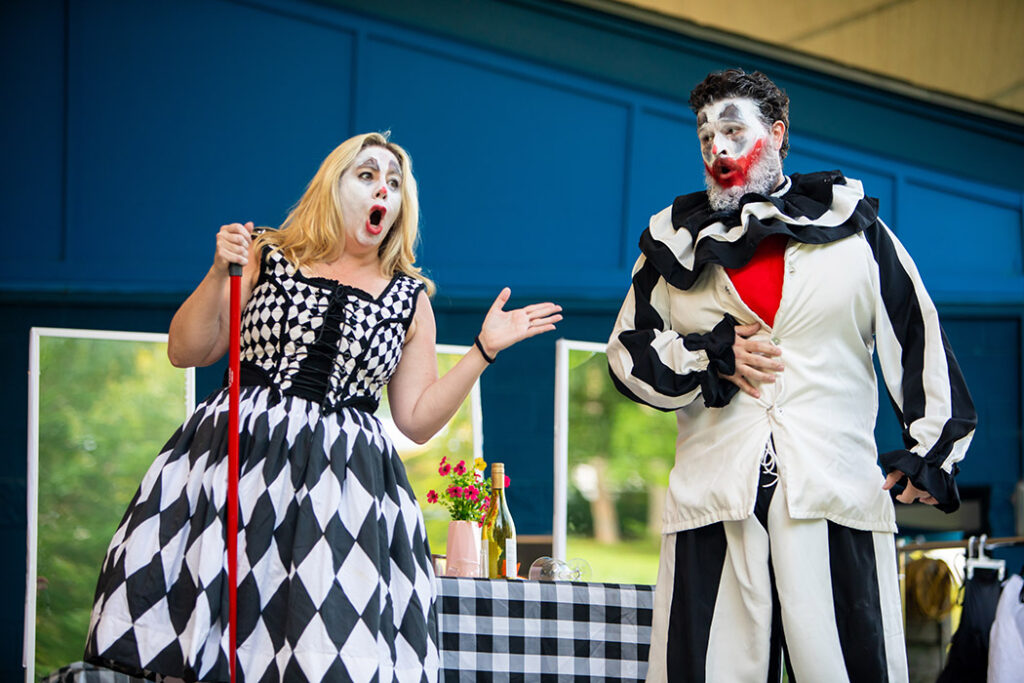
Also with a satisfying character arc was Brad Morrison’s Tonio, who has his own battle with jealousy and revenge. Making a case for verismo storytelling, his character’s prologue showed off a sensational depth of emotion, painted out in expressive vocal colors of bitterness and resignation.
A familiar face and welcome voice for Knoxville opera-goers was tenor Cody Boling in the role of Beppe, one of the troupe’s clowns. Boling’s clear expressive voice and dramatic ability created a perfect basis for his Beppe, who must act as mediator in the jealous feud that is consuming the other characters.
Admittedly, site-suggestive staging for opera, especially one in the outdoors, carries both risks and rewards. This fact was made abundantly clear to Marble City Opera and its supporters this past weekend. Ideally, the rewards of supporting novel and fresh approaches to the arts will out-weigh whatever cloudy skies may be in our future.