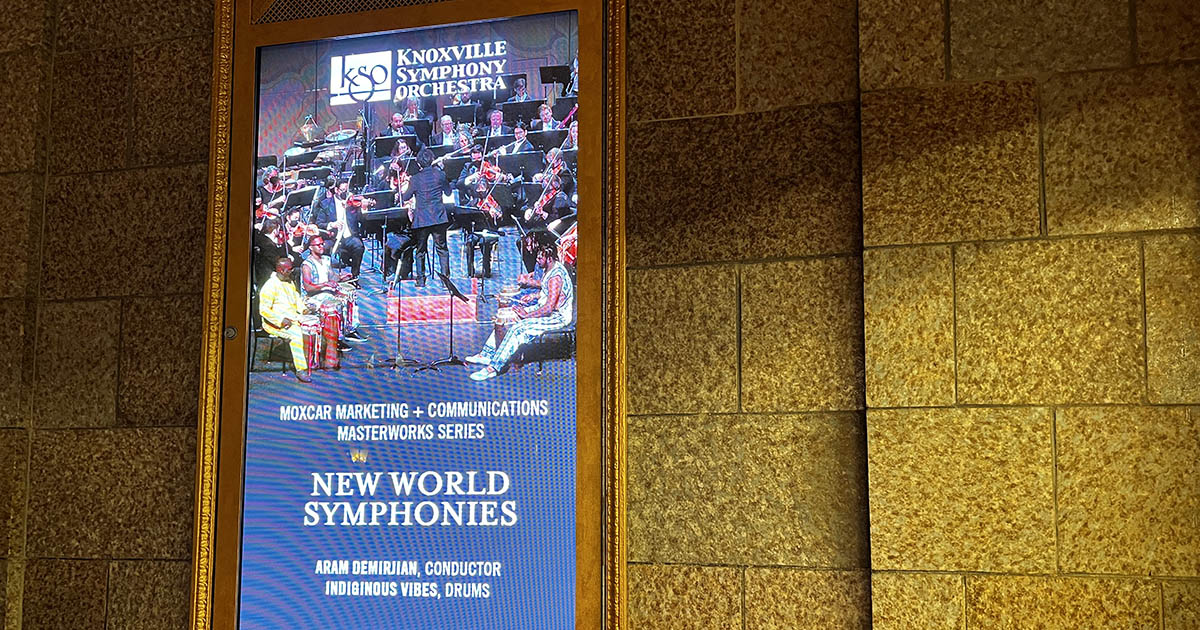
It was almost exactly three years ago that the Knoxville-based drum ensemble Indigenous Vibes first performed with the Knoxville Symphony Orchestra. They were back for this past weekend’s Masterworks concerts, this time performing the World Premiere of a work commissioned by the KSO from Los Angeles-based composer and conductor Derrick Skye—Between Suns: A Concerto for West African Drums and Orchestra.
“The solo drums and orchestra orbit a central pulse—the sun,” Skye offers in his program notes. “The work explores how rhythm constructs identity, memory, and interconnection across time and space.” Despite the fact that Skye uses the orchestra as yet another percussion instrument with variable qualities, and one untethered to western European tradition, the listener finds the perception of fixed time slipping away as rhythmical changes tug at one’s grasp of what is real or unreal. All the while throughout the five movements, the listener has to admit the distraction of admiration for the drum and percussion technique that the ensemble displays. Indigenous Vibes consists of founder Obayana Ajanaku, Willie (Ankinsola) Ervin, JaDarius “Dia” Fuller-James, KeShawn (Omitola) Mitchum, and Jamarr (Jaja) Underwood.
Interestingly, Maestro Aram Demirjian had titled the concert “New World Symphonies,” a playful allusion to the fact that all three works on the program represented different realities of a new world in some musical form, including Antonín Dvořák’s “Symphony From the New World,” his Symphony No. 9. Demirjian opened the evening, though, with Florence Price’s Colonial Dance, a work that, like Skye’s Between the Suns, is a display of energetic rhythms that call out African folk movement and dance. The difference, in this case, is that Price’s work has an inarguable connection to the classical tradition of European music which she embellishes with her own fresh and compelling point of view. Although Price died in 1953 with little of her music known or published, the discovery of a trove of works in the last two decades has provided new angles to our definition of American music.
One could easily imagine that Florence Price had been inspired—or at least, influenced—by Dvořák and the warm familiarity of his “New World Symphony,” the work that made up the second half of the concert. Composed for the most part during Dvořák’s initial visit to America, the work is infused with the composer’s impressions of melodies and themes from African American spirituals as well as flavors from his native Bohemia.
Demirjian excels at works like the “New World,” piling tension on top of tension and supporting moments of urgency with a carefully tuned balance. With the big picture still in mind, though, the orchestra did not forget the charming narrative moments that are at the heart of the piece.
Despite some soft entrances at particularly quiet moments, this was a beautifully played performance by the orchestra that was nicely infused with the “American” flavor and motifs. Demirjian kept the focus clean, interesting, and compelling, with intriguing variations of dynamics and colors. Of course, the second movement, the achingly poignant Largo, stands apart from the other movements in more ways than mere tempo. Following the introduction by the brass, this Largo was given a soft and gentle solo painting by KSO English horn Jessica Smithorn. Also important here was the orchestra’s deliciously subtle balance underneath that supports the movement’s poignant melody.
Impressive, too, was the Scherzo movement with its contrasting heat to the Largo. The finale had its contrasts as well, reminding us in intricate detail just why this symphony has been so popular—and continues to be.
No Pomp and Circumstance this year. This Masterworks concert was the final one of the 2024-25 season, a fact that concert-goers could have missed were it not for the listing of milepost achievements by KSO players. Notable here was an especially impressive 55-year mark by cellist Bruce Wilhite. The Masterworks concerts by the KSO return on September 18 -19 with a performance of Beethoven’s majestic and triumphant Ninth Symphony.