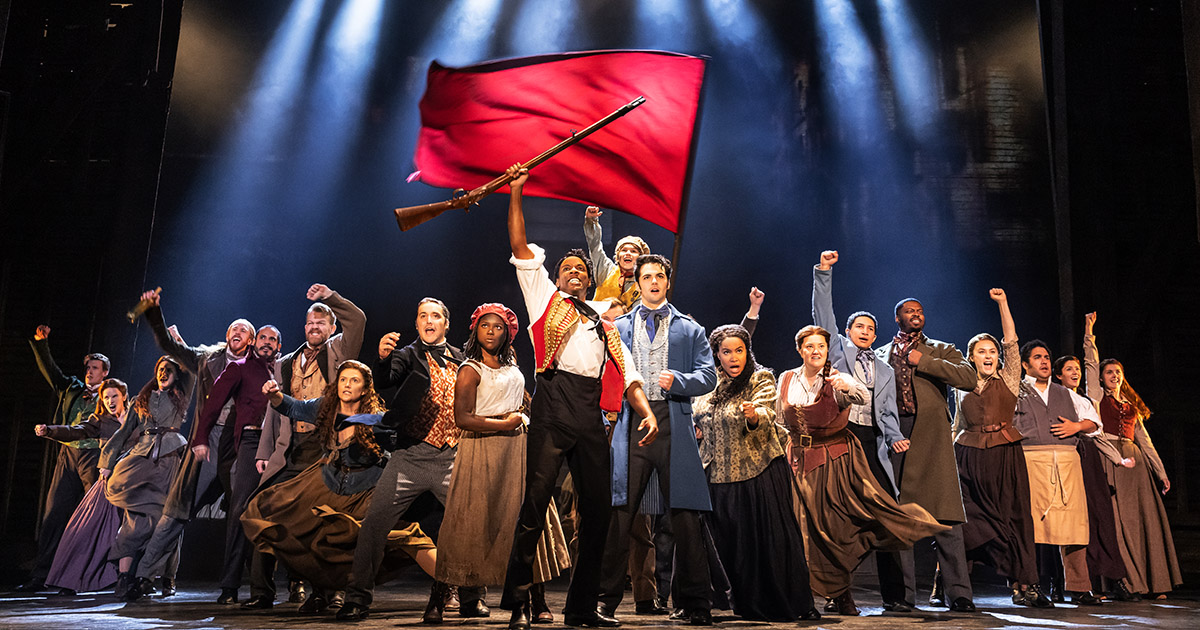
The history of the musical Les Misérables almost defies belief, the number of international, Broadway, and U.S. National Tour productions creating quite a task for those who count such things. Its U.S. life began in 1987 with a pre-Broadway run at the Kennedy Center in Washington, D.C., followed by a Broadway stint that continued until May, 2003, at the time becoming the second-longest running Broadway musical after Cats. As a testament to its “beloved” status that stems from its themes of sacrifice and redemption against a backdrop of the very best and worst of humanity, the musical is still thrilling audiences and making them think. A current National Tour of Les Misérables is making an 8-performance stop in Knoxville through August 3 at the Tennessee Theatre.
Based on the 1862 Victor Hugo novel of the same name, Les Misérables features a score by Claude-Michel Schönberg, lyrics by Alain Boublil and Jean-Marc Natel, and a book by Schönberg and Boublil. The story centers on the life of one Jean Valjean, a convict that has been paroled after serving 19 years for stealing a loaf of bread. Breaking parole, Valjean is pursued with single-minded vengeance by policeman Javert, but assumes a new identity and becomes a successful businessman. Coming to the aid of an abused and dying woman, Fantine, Valjean promises to care for her daughter, Cosette, raising her as his own daughter. Years pass and an adult Cosette falls in love with Marius, a revolutionary involved in the Paris student rebellion of 1832. The authors have used the conflict as a metaphor for addressing injustice in society.
Directors Laurence Connor and James Powell have assembled a seriously impactful production that draws the theatre-goer in with a relentless storyline and dramatic intensity. It goes without saying, then, that one of the many superlatives surrounding this production is its uniformly fabulous cast of leads and secondary roles, expressly demonstrated by Nick Cartell as Jean Valjean. Cartell has been in the role since this tour’s beginning in 2022, his bio indicating the miraculous feat of over 1500 performances to his name. Cartell’s voice has a natural heroic quality, if such a thing can be defined, and his delivery and stage movement has been honed and polished into a stage presence that is at home in both confrontation and gentleness. Cartell’s voice range was particularly impressive, marvelous both in strength and a poignantly enticing falsetto in “Bring Him Home.”

As Valjean’s antagonist, Javert, Nick Rehberger was appropriately villainous and obsessed but with an extended dimension to the character that suggested the psychological flaws that presage his downfall. Lindsay Heather Pearce as Fantine delivered a gorgeous “I Dreamed a Dream” that achingly brought a tear to more than a few eyes.
Mya Rena Hunter was superb as Eponine, as was Delaney Guyer as Cosette and Jake David Smith as Marius, who combine for a beautiful take on “In My Life” and “A Heart Full of Love.” Hunter’s “On My Own” was a showstopper. Leading the uprising was Christian Mark Gibbs’ Enjolras.

If comic relief exists in Les Misérables, it certainly shows up in spades via the characters of Monsieur and Madame Thenardier taken by Matt Crowle and Victoria Huston-Elem. Their energy is infectious and their scheming presence is a delicious counterpoint to the otherwise serious dramatic confrontations.
Given the through-composed nature of the score that approaches opera in its structure, density, and intent, it made sense that this tour travel with its own orchestra of 14 or so players, rather than supplement locally. This orchestration that has been reworked since the original Broadway days is a satisfactory mix of both keyboards and strings, winds, brass, and percussion players doubling on instruments. In this performance, the conductor was Tim Lenihan.
A feast of grays, browns, and muted colors, the set of rolling wagons backed with abstract suggestive video projections by Matt Kinley worked marvelously in defining place and time, from taverns to street barricades to the Parisian sewer. The lighting by Paule Constable was a painter’s Stygian delight aided by haze and scrims.
If there is an almost predictive weakness to this production, it is one that plagues many Broadway tours that visit a range of venues and have limited time to tweak: intelligibility of voice reinforcement. Not an issue of volume, balance, or of the singers’ otherwise crisp diction, one struggled, nonetheless, to catch the subtlety of lyrics in particular moments, putting the listener at the disadvantage of missing key moments in the story.
At this moment in the four-decade life of Les Misérables, we, as 21st Century theatre-goers, unfortunately find ourselves revisiting in our daily lives the issues of inequality, loss of freedom, and injustice. Those that raise their voices, like the student resistors of Les Misérables. should be listened to, the message an important one that obviously needs consideration. Although we shouldn’t have to depend on musical theatre for such a reminder, it is one we genuinely welcome.
Tennessee Theatre, 604 S. Gay Street
July 29 – August 3, 2025
Tickets and Information
*****Recommended