

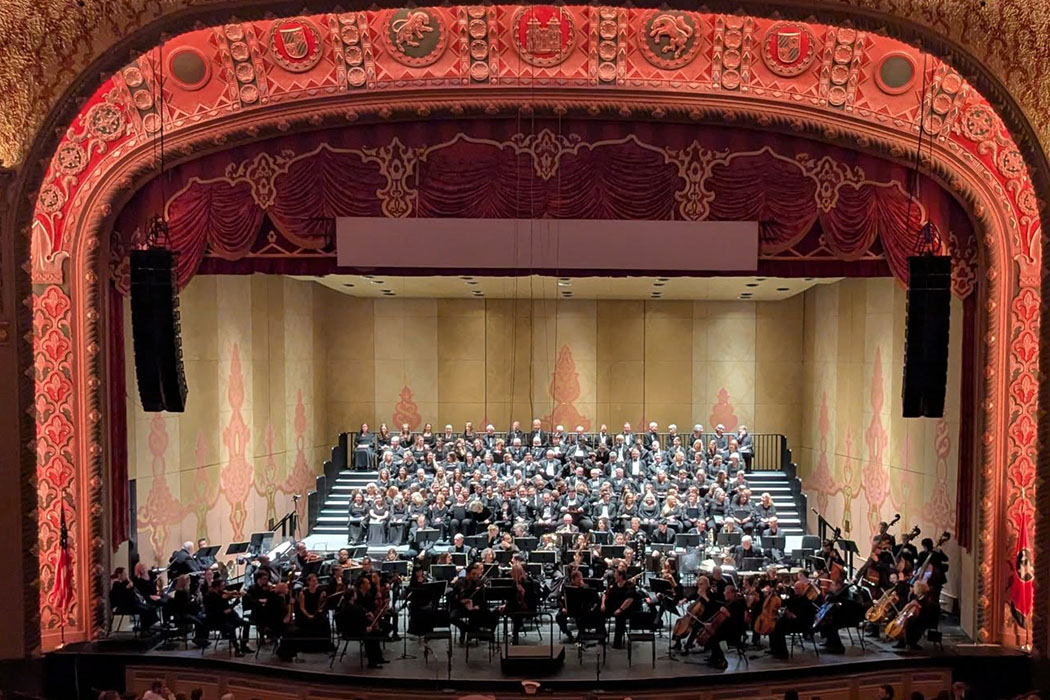
It came as no real surprise that Maestro Aram Demirjian chose to open the Knoxville Symphony Orchestra’s 2025-26 season with Beethoven’s Ninth Symphony. After all, the work is perfect for celebratory occasions, in this case, the beginning of the KSO’s 90th anniversary season. Programming Beethoven’s complex and challenging masterpiece also speaks volumes about the orchestra’s level of artistic achievement, and it is the perfect symbol of the organization’s creative hopes and dreams for the season. What was a surprise, though, was that the entire evening took on an almost magical ebullience, weaving a spell that grew throughout, sending the audience back into the night, visibly moved by the sublime performance they had just witnessed.
Underlining the impressive significance of a 90th season, the KSO has undertaken “9 for 90”: a commissioning program from nine composers, creating works featured in this concert season in a variety of the local venues and ensemble formats. The first of these, XC Blast, by Pulitzer Prize and three-time Grammy-winner Jennifer Higdon, opened the concert. Going well beyond what one might expect from an orchestral fanfare in terms of rhythm and richness, the work was an ideal musical appetizer.
Although bass Kevin Burdette—Knoxville native and no stranger to opera houses around the world—was on hand as the bass soloist in the Beethoven, Maestro Demirjian called on him to close out the first half of the concert. This time, though, it was his musical storytelling ability that was needed for Selections from Aaron Copland’s Old American Songs I and II, including the familiar “Simple Gifts”, “The Dodger”, “I Bought Me a Cat”, “and “At the River.” Burdette’s warmth and tone had just the right degree of folksiness for the material and was nicely backed up by Copland’s poignant arrangement for the orchestra.
At intermission, as the choral forces for the evening—the Knoxville Choral Society and the Pellissippi State Variations Choir—took their place on risers behind the orchestra, and soloist chairs appeared downstage, the sense of anticipation for Beethoven’s Ninth Symphony was palpable. At any time, the Beethoven symphony’s presence exudes an emotional force that defies description. But almost at once, one felt the special direction that Demirjian was taking: crisp, but not excessively rapid tempos, and an attention to details of dynamics that seemed to breathe. Together, this marked ensemble playing that was impeccable, certainly making the point that, despite first-concert enthusiasm, everyone was focused on the same ideal.
The first movement opened almost ethereally. By the third Adagio movement, I was certain that the performance I was hearing was perhaps the most accomplished in memory. The movement’s fluidity and balance was gorgeous in its serenity of woodwinds and strings conversing peacefully.
That tonal serenity sets the stage for the intensity of the finale movement and its “Ode to Joy” theme, the text of which was projected in supertitles. The soloists—soprano Laura Strickling, mezzo-soprano Renée Tatum, tenor Kameron Lopreore, and bass Kevin Burdette—made quite the quartet, their vocal elegance matched by the right degree of dramatic fire.
Although one can imagine the temptation to over-exploit Beethoven’s final tug of gravity, Demirjian, orchestra, chorus, and soloists embraced the ebullience of the moment and rendered a coda that was as magical as any in memory. The audience felt it and after leaping to their feet, rewarded all concerned with a significant ovation. One can only imagine what this may mean for the remainder of what should be a stellar season.





I heard they opened with the Star-Spangled Banner.
You are correct.