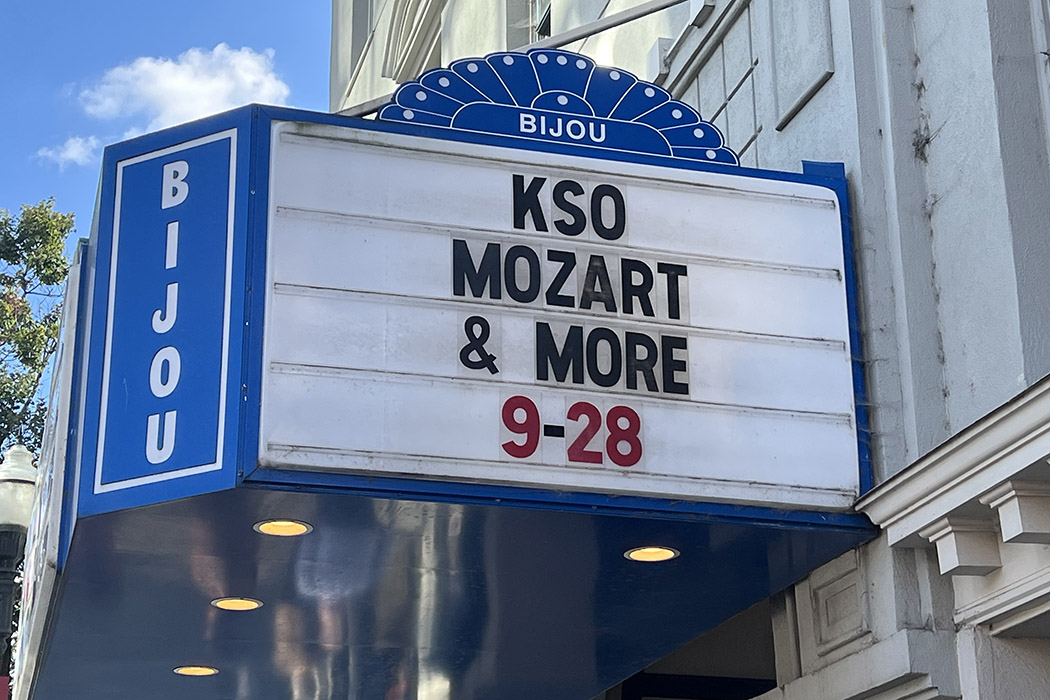
With a big helping of momentum from its recent Masterworks season opener, the Knoxville Symphony Orchestra turned its attention to the popular Chamber Series for its season opener Sunday at the Bijou Theatre. Once again, the KSO embraced those assets that have been responsible for that popularity. Of course, the intimate charm of the Bijou itself and its amazing acoustics are a given. The series itself is devoted to programs of less massive musical gems that luxuriate in that intimacy. And finally, soloists in the series are drawn from the orchestra’s own ranks, showcasing the incredible range of local talent.
Maestro Aram Demirjian chose three works for the opener that represented a substantial range of varied styles and instrumentation. First came Octet for Brasses and Piano by Florence Price, the 20th Century American composer whose reputation has grown by leaps and bounds thanks to the recent rediscovery of a cache of her unpublished works. The work—scored for two trumpets, two horns, two trombones, tuba, and piano—is a marvelous addition to the repertory available to brass ensembles. In this performance, though, the volume of the rich brass harmony was a tad too much for the piano volume, something that would have worked itself out with additional performances.

Audiences know full well the talent of the KSO’s horn section, led by Principal Horn Jeffery Whaley. In this performance, Whaley stepped into the soloist’s spotlight for Richard Strauss’ Horn Concerto No. 1 in E-flat Major—an early, but accomplished work from 1883 by a teenage Strauss. Although Strauss had not yet come under the sway of deep Romanticism in the work, Whaley and Demirjian recognized the connections. Ultimately, though, one was simply riveted by Whaley’s command of his instrument, a command that never failed to impress. That ability transcends technique and places him in the rarified air of hornists who have mastered both the intricate craft and sublime art of horn performance.
As an encore, Whaley jumped ahead to the more mature Richard Strauss and a selection of horn themes and passages from the tone poem Till Eulenspiegels lustige Streiche (Till Eulenspiegel’s Merry Pranks).
Those who are not shy about praising the Bijou’s acoustics found a lot of material in the final work of the afternoon, Mozart’s Symphony No. 40 in G minor, K. 550. The symphony’s minor-major landscape is strewn with little magical moments of physicality and detail that standout in the venue’s crystalline acoustic air. Given this magnificent performance, the very idea of listening to it with anything but a chamber-size orchestra now seems impossible. Moreover, Demirjian and the orchestra recognized the freedom and made the most of it.