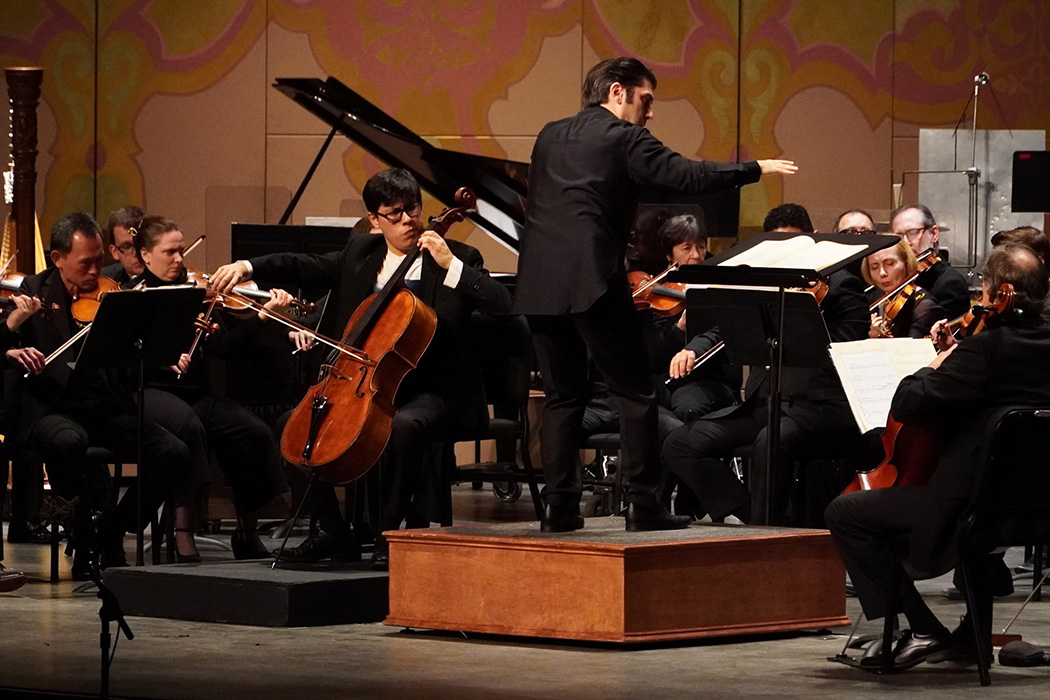
As much coincidence as it was a deliberate plan, October has become something of a showcase month for the Knoxville Symphony Orchestra’s Masterworks Series. The concerts this past weekend, as programmed by Maestro Aram Demirjian and delivered by the orchestra, featured a brilliant take on Edward Elgar’s Cello Concerto by the young dynamic cellist Zlatomir Fung. The orchestra players were in the spotlight for the 1947 concert hall version of Igor Stravinsky’s ballet Petrushka and its dramatic orchestral storytelling. And, the opener, Meilina Tsui’s Floridian Symphony, was a delightfully vibrant and atmospheric new work that calls on orchestral instruments and their players to explore and artistically replicate the natural sounds of a rural Florida environment and its world of insects, birds, and other animals.
Hearing soloist Fung in the Elgar concerto was something of a revelation as well as a joy. The 25-year old cellist displayed a musical maturity far exceeding his years, one that somehow allowed him to plumb the depths of Elgar’s 1919 melancholic work with an uncanny understanding. Elgar was deeply affected by the destruction and loss of life in World War I, something that he talked openly about. This sorrow became the emotional underpinning of the concerto that was revealed through a dusky, poignant lyricism—a quality that would challenge cellists of any age and ability.
Although the concerto has its satisfying virtuosic moments, Fung mastered them without ostentation, leaving the listener in awe of his ease and technical ability. From the opening solo, Fung established his emotional context in no uncertain terms, effortlessly handling the lyricism alongside virtuosic moments. As the opening movement proceeded, Fung was supported by Demirjian and the orchestra with careful dynamics that duly ebbed and flowed, adding the necessary background without encroaching on the cello’s point of view. In four movements, the concerto seemed to center on the second (a somewhat mournful Lento) taken as a journey of hope as Fung pulled earthen beauty out of the low pitches and found a miraculous refulgence in the high ones. The finale, though, comes as something of a surprise, its substance flowing out of a welcome excitement and then concluding with only a brief deliberation of three chords.
Although one could be forgiven for thinking that the Elgar concerto was the ultimate statement for the evening, a second magical journey was still ahead. For the second half of the evening, Demirjian chose Igor Stravinsky’s 1947 slimmed-down re-orchestration of his 1911 ballet score Petrushka. Interestingly, projected supertitles were used here as a running description of the ballet’s unfolding story, something that was clearly useful for first-time KSO listeners, even though the score practically narrates itself.
It would be difficult to say, though, who had the most fun with this performance. Demirjian was in full storyteller mode, lavishing the piece with swath after swath of bold dynamics and delightful rhythmic punctuation. The orchestra players, too, were obviously enjoying themselves, if truth be told, for there was a bounty of delicious moments for a number of them. And, clearly, the audience was relishing all of the above efforts.
In four story parts, the piece opens with a bold telling of the festive confusion of a Russian Shrovetide Fair, one full of street-hawkers, carnival sounds, organ grinders, dancers, and browsing crowds, all made possible by a variety of woodwind and horn effects. The compelling sound of loud drumbeats (percussionist Bob Adamcik) indicate the change of scene. The Magician (bassoon Duncan Henry) enters and with his magic flute (Devan Jaquez) brings the puppets to life and the beginning of their jealousies.
Of course, Stravinsky’s orchestration is the storyteller here, brought to life in delicious moments by clarinet (Victor Chavez), oboe (Claire Chenette), English horn (Ayca Yayman), piccolo (Cynthia D’Andrea), trumpets (principal Kole Pantuso and second trumpet Brian Winegardner), horns (principal Jeffery Whaley, Kelsey Bentley, Brooke Ten Napel, and Sean Donovan), tuba (Mike Anderson), piano (Emi Kagawa), and violin (concertmaster William Shaub).
Admittedly, the story of Petrushka requires the listener to accept the creative license that Stravinsky assumes, but that is the magic of storytelling through music. Demirjian’s sculpting of this story through the orchestra—escapism in all its glory—is one that places it squarely in the category of most memorable performances. And the season is still young.