Note for note, minute for minute, Georges Bizet’s Carmen can seem today like one hit tune after another. Interestingly, it didn’t start its operatic life that way, the premiere in 1875 being quite the disaster. Thankfully, time and great productions have solidified its reputation as a masterpiece, the familiarity of its musical and dramatic story serving as the basis for many a production since that ill-fated premiere. Curiously, opera companies today that choose to do Carmen often fear that the familiarity will lead to staleness, and so take stylistic departures or alterations of plot in an effort to make frequent productions unique and fresh. The Metropolitan Opera’s current “cowboy” Carmen is a perfect example of this. However, as Knoxville Opera magnificently proved in its production at the Tennessee Theatre this weekend, Carmen needs but one thing: fabulous voices able to paint their characters with the particular dramatic qualities of the role, from sensuous dramatic heat to the angst of an obsessive love that was not to be.
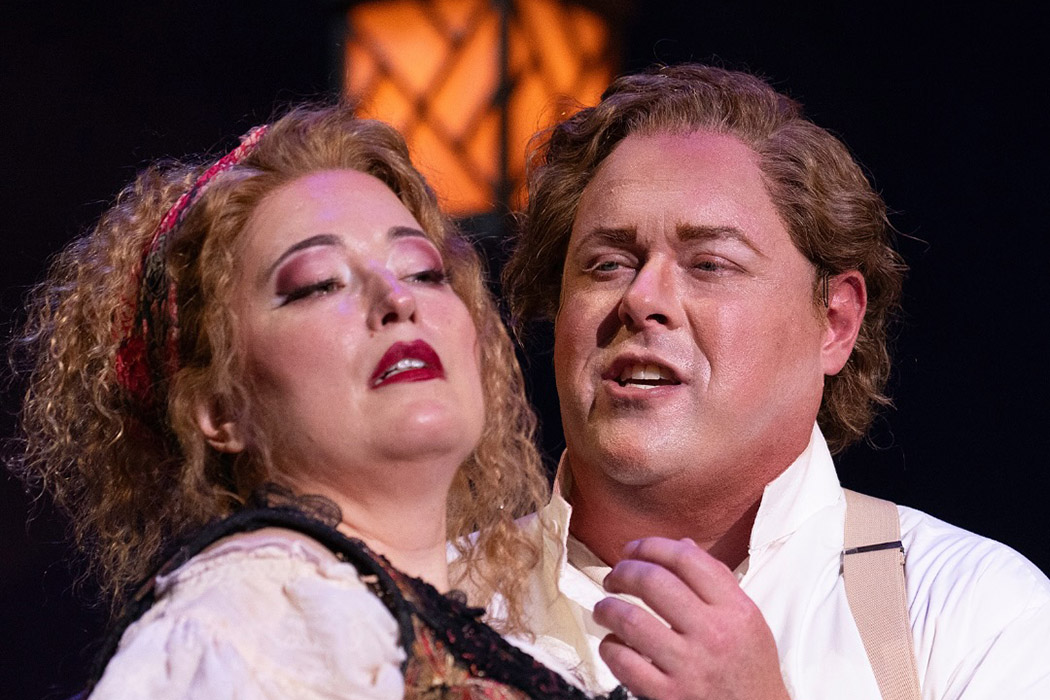
In his prefatory remarks, KO executive director Jason Hardy indicated that mezzo Renée Tatum would be performing her role of Carmen despite being under the weather. However, to be honest, her strong voice betrayed no hint of indisposition, at least to my ears, with all the clarity intact through her range that the role requires. If her energy was lacking, kudos for her ability to compensate and treat the audience to a marvelous performance. In fact, Tatum luxuriated in Carmen’s sultry depth, and seemed comfortable in the higher nooks and corners of Carmen’s vocal line.
As it turned out, Tatum’s superb performance was matched by an excellent cast across the board. Ben Gulley was this production’s Don José, a character hopelessly smitten by Carmen in word and deed. Gulley’s voice seemed perfect for Don José, including an incredibly impressive high range that was presented with a marvelously thrilling clarity. Gulley was also impressive in dealing with his character’s dramatic arc—a man torn by his mother’s love and guidance on one hand and the obsessive allure of the fringe world of the magnetic Carmen on the other.

Light and luscious is often the description of soprano voices who take on the role of Micaëla, Don José’s would-be fiancée. Karen Chia-ling Ho had those qualities in depth, but also quite a bit more in terms of a lovely strength and vocal clarity. As the third side of the Carmen/Don José dynamic, she seemed to understand Don José’s dilemma despite her uncompromising love for him. Vocally, her Micaëla had a powerful edge that lurked within a pure and charming tone, one that offered a beautifully different angle to the character—one that earned her a substantial ovation at the curtain call.

Making a Knoxville Opera debut as the toreador/Carmen-plaything Escamillo was the baritone Jonathan Patton. His take on the “Toreador Song” was rich, boldly swaggering, and energetic, although the number’s staging seemed a bit underdone.
As much as in any other opera, Carmen cries out for a strong show by acting-singers in the secondary roles, something that contributes substantially to the sparkling success of this Knoxville Opera production. Lauren Boozer as Frasquita and Hannah Shea as Mercédès gave their characters a nice painterly oomph that added yet another facet to the story. The pair join with smugglers Le Dancaïre (baritone Joel Brown), Le Remendado (tenor John Overholt), and Carmen, in the marvelous Act II quintet that was as simply charming as it was satisfying vocally. Two familiar faces and voices turning in wonderful performances: JJ Robinson was a marvelous Zuniga; Maurice Hendricks was the swaggering soldier Moralès.
Stage director Keturah Stickann has kept KO’s Carmen mostly true to its warm, sun-drenched Seville locale, populated by cigarette factory girls, children, bullfighters, soldiers, and smugglers in various levels of theatrical energy. As a choral force, the excellent KO Chorus was an enjoyable support for the crowd scenes. The single set (set designer Bobby Bradley; lighting designer John Horner ) of platforms, steps, and wall works well and serves all four acts in different dressings of furniture and props. Costumes from Sarasota Opera via designer Howard Tsvi Kaplan thankfully avoided the usual theatrical trap of bright, “folk-style” colors and opted instead for a muted realistic look which allowed the singers to stand out against each other.
Interestingly, there were two additions/alterations that remain a puzzle. Stickann added a non-speaking figure—I assume a symbol?—to the stage picture—a mysterious sleeping beggar woman in Act I who is quite awake for the finale. And—spoiler alert—in a twist, Carmen miraculously seems to survive Don José’s knife thrust. Don José doesn’t fare as well.
Conductor Noam Aviel guided the Knoxville Symphony Orchestra in the pit with an energy that was palpable, especially in the overture and in moments where orchestral details are an unconscious part of the story.
At curtain call, the ovation was raucous from an audience that had absorbed the theatrical energy of Carmen and was ready to return the favor. Knoxville Opera returns to the Tennessee Theatre in February 2026 with Rossini’s Il barbiere di Siviglia.