Editor’s Note: While Arts Knoxville has a long-standing policy of not critiquing non-professional performers under the age of 18, Knoxville Children’s Theatre and its current production of The Crucible has so impressed theatre-goers, that we will be making an exception to that policy. This review of KCT’s The Crucible is by guest writer JP Schuffman, the co-founder of the Knoxville Theatre Club. He is a multidisciplinary theatre artist, poet, and occasional critic.
The walls are closing in. That’s the distinct impression I had as I entered the auditorium for Knoxville Children’s Theater’s latest production of Arthur Miller’s Tony Award winning classic, The Crucible. On stage, highlighted in stark relief, wooden beams vault upward and loom inward to frame the playing space while upstage the forest presses in at lopsided angles. Upon this unsettling scaffold Artistic Director Dennis Perkins and company present a fierce, unflinching, and timely exploration of colonial Salem’s harrowing descent into zealotry and totalitarianism. In the process they prove that, in some cases, “children’s theatre” can be more accurately described as just Theatre. No caveats. Just theatre. And The Crucible is very good theatre, indeed.

It is Salem, Massachusetts, 1692, when young Abigail Williams (Leeland Robins) starts accusing other women in the village of witchcraft in order to distract from her own wrongdoings. These accusations, legitimized and prosecuted by an all-powerful state run inquisition; fueled by fear, coercion, rampant superstition, and personal vendettas, all culminate in the infamous Salem Witch Trials. The central thrust of the play follows John Proctor (Sage Jamison) who has committed adultery with Abigail, and who must decide what to do when Abigail names his wife Elizabeth Proctor (Emma Regan) as a witch.
Jamison’s Proctor is an absolute hurricane of a man. Violent, angry, loud, and often shockingly cruel. He is unlikeable in the extreme and an unlikely candidate for a protagonist. Jamison doesn’t flinch from the brutishness of the man and clearly illuminates his deep flaws. But, more importantly for me, he does a good job of delivering moments of real desperation, tenderness, and vulnerability, especially as the play reaches its fatal climax. The total effect is the portrait of a man of extremes who, in an extreme situation, makes an extreme decision. We may agree or disagree, but by the end of Jamison’s portrayal, we understand why John Proctor makes the choice he does. Emma Regan’s Elizabeth Proctor was pitch perfect. Regan skillfully weaves an Elizabeth of unpretentious virtue and quiet nobility. Her performance was, for me one of the evening’s highlights, not just because of her delivery and physical control (although there was certainly nothing lacking in those regards either) but rather, because I always understood exactly where her attention was, and could guess, through delicate expressions what was going on behind whatever she was saying – or was being forced to say.
Reverend John Hale is played with clarity and conviction by Alex Bowden. Bowden’s Hale is deeply assured of both his faith and his reason as the play begins, and Bowden presents Hale as every inch the expert. Then he takes the character on a very well-constructed descent into doubt and ultimately regret, which was very enjoyable to watch. The transformation is almost imperceptible at first, and because of this, as things begin to reach their climax we are not entirely certain what Hale will do – whether he will have the courage to do what is right – and I thought that was spot on. Vivienne Bullard’s depiction of the Proctor’s housemaid Mary Warren was entirely convincing. Bullard was in every way a disempowered and downtrodden woman doing her best to keep her head above water as forces outside of her control threaten to destroy her at every turn. Bullard makes us worry for her Warren, we see ourselves in her and we want to protect her. And that is why, in the climactic scene, what she does is so shocking. Deputy Governor Danforth (Azariah Arnold) does not appear until the second act – with the exception of a brief but haunting stage image in the first act. Nonetheless, he manages to absolutely command the second half of the play. With a volatile mix of religious fervor and social superiority Arnold’s Danforth wields his near-total power with unrelenting force. I was particularly impressed with his handling of several unwieldy and litigious passages which, in less skilled hands could easily have become tiresome, but which instead served as a cold reminder that Danforth has at his disposal all the awesome powers of the state – including the power of life and death.
Hogan Honeycutt delivers one of the most subtle performances of the evening with his depiction of Reverend Samuel Parris. The intense and deeply engaging first scene between himself and Abigail Williams not only set the stakes for the audience, but for me, signalled just exactly the level of sophistication we could expect from this production overall. And speaking of Abigail Williams, Leeland Robbins absolutely stole every scene she was in with her wild-eyed and brilliantly realized embodiment of this role. In the grand tradition of villains we love to hate, Robbins renders Abigale as self-centered, opportunistic, unabashedly manipulative, and it is an absolute delight to watch as she bullies, lies, schemes, and perjures her way into getting whatever she wants, no matter the cost. On the opposite end of the character spectrum from Abigail is the ornery salt-of-the-earth Giles Corey (Kai Cass). Cass does a wonderful job of not only delivering some desperately needed humor – no easy task in this otherwise infernal machine of a play – but Cass seems careful not to oversimplify the role, and instead renders Corey fully, with simple charm, never playing for laughs, but getting them anyway, and sure enough we find ourselves falling for the old codger.
Allison Loveday’s Rebecca Nurse, and Graham Sexton’s Judge Hathorne both deserve praise for the completeness of their renderings, especially in regard to the physical work each is doing. Loveday isn’t given an enormous amount to say (although her delivery is powerful and evocative when she does) and Sexton’s Hathorne says even less, but the visual storytelling they engage in makes for some of the most striking and memorable stage pictures of the show. Teagan Allen, Charlie Fritts, Jenna Blumberg Camila Herrera, Lena Kennedy, Harper Knight, and Ava Regan comprise the rest of the ensemble, and do an excellent job of keeping the action moving while still making the town feel truly lived in by a community of real people.
I want to say one last thing here about the performances in this show before I move on to the design elements. I was absolutely blown away by the level of technical proficiency in the fundamentals of the craft exhibited by every member of the cast. Diction, breath control, projection, proper posture, insightful textual analysis, all of these are on full display to anyone familiar with the particular requirements of the artform. And as a director and acting coach myself, it was incredibly invigorating to see the essentials of the craft being executed with such consistency and to such an elevating overall effect.
Sophia Bishop and Joelle Arellano are to be congratulated on their exceptional scenic design. I opened this review talking about the impression that their arresting tableaux had on me, and I just want to say again that at several points I found myself admiring how well the simplicity of the concept served the storytelling of the show. Well done, indeed. As lighting designer, Tabi Maanum is unafraid of painting the set’s spare beams and sparse furnishings with colors that seemed to grow in saturation and intensity as the play progressed. I especially liked how hot the courtroom scene felt, where the ember orange on the cyclorama filtering through the beams upstage conjured the feeling of looking through the grates of a boiler furnace. Scarlett Cooper’s costume design is evocative of the period and of each characters’ status. I admired the color coding of each character into either blacks, browns, or earth tones, with blue being reserved exclusively for Danforth (a detail I found to be an especially thoughtful touch). Prop Master Addy Kate Thomas does solid work providing everything from quills to muskets, and I was very impressed by the intricate details on the cover of the book that Reverend Hale reads from in the first scene. The combination and execution of all these design elements lends unity to the piece and makes it not just an expertly told story, but a beautifully presented one as well.
So, I’ll end with this: You should go see this play. I don’t mean only if you’re interested in seeing young theatre artists really coming into their own within the craft. And I don’t mean only if you’re ready to lower your expectations about the quality of entertainment on offer. I’m saying you should go see this show for the same reasons and with the same expectations that you might go to half a dozen other shows being presented in town this weekend. Knoxville Children’s Theatre has staged a version of The Crucible that is haunting, relevant, and in dialogue with this cultural moment. It’s a well crafted, well executed piece of art. I’m not sure what more you could ask from a show than that.
Knoxville Children’s Theatre’s production of The Crucible runs for one more weekend Nov 6 – Nov 9
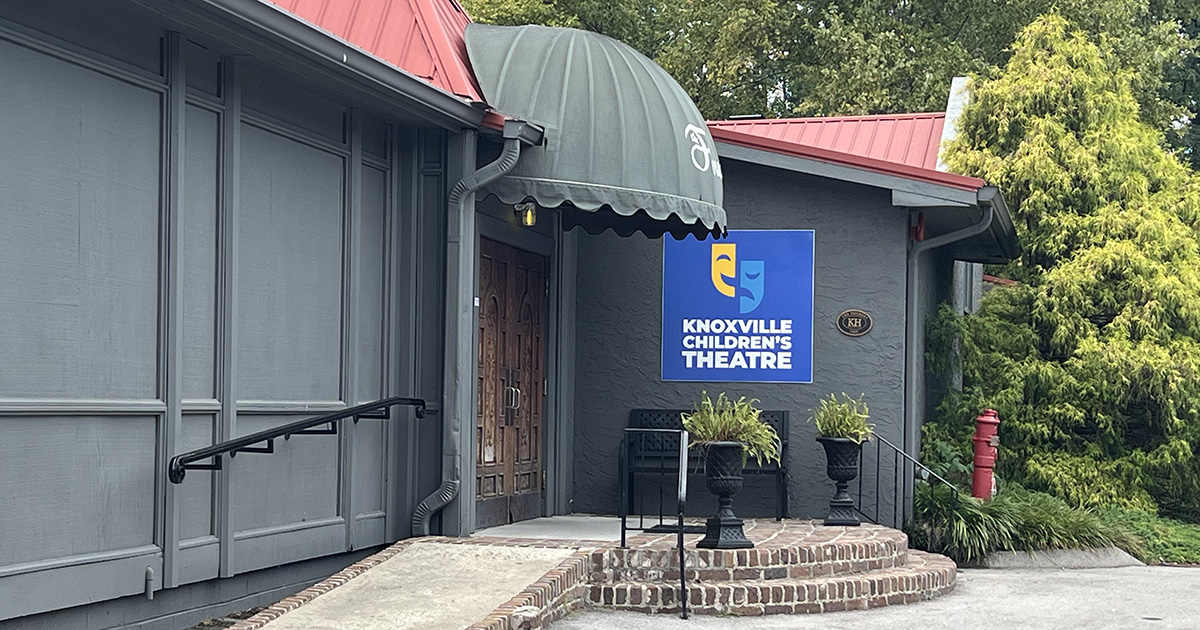
Performances are at KCT’s new home: 747 World’s Fair Park Drive, Knoxville, TN 37902
Tickets: knoxvillechildrenstheatre.com/tc-events/the-crucible-2/