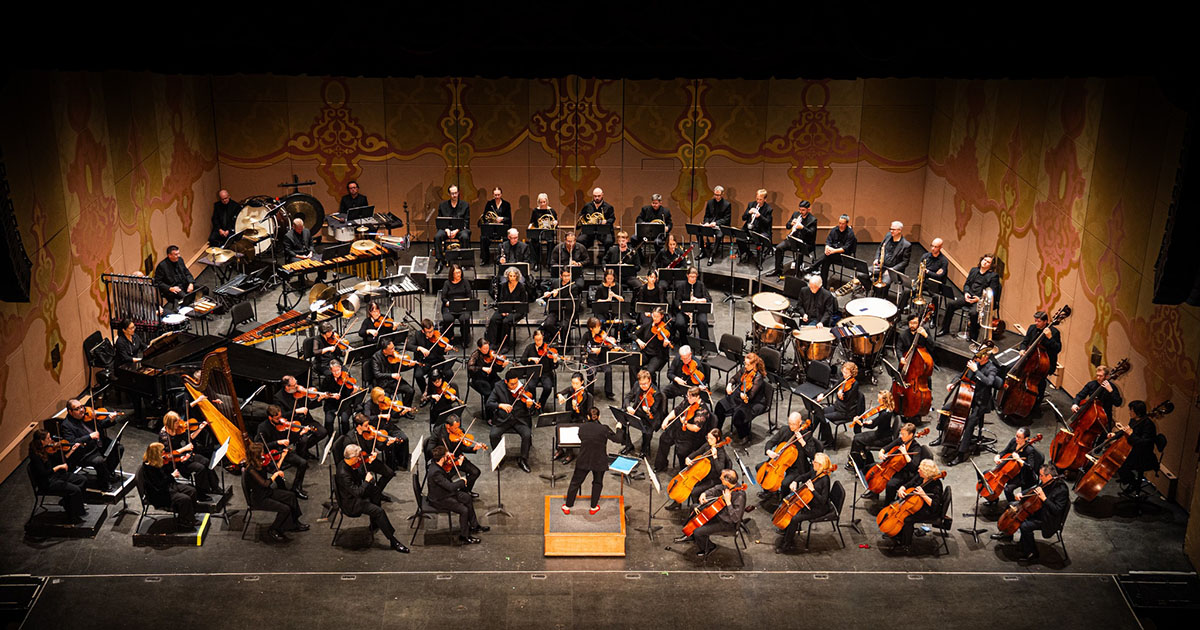
With the beginnings of the holiday season now upon us, Knoxville Symphony Orchestra Maestro Aram Demirjian took the week off and handed the baton for its November Masterworks pair of concerts this past weekend to guest conductor Michelle Di Russo. Not a stranger to the orchestra and audience, Ms. Di Russo had previously conducted the KSO in the March 2024 Chamber Classics concert and had made a significant impression with her charisma and energy. With her reputation on the rise, Di Russo recently began her tenure as music director of the Delaware Symphony Orchestra, previously serving as Associate Conductor of the North Carolina and Fort Worth Symphonies.
In her preface to the evening’s music, Di Russo admitted that the evening would be something of a Concerto for Orchestra with all of the selections featuring a multitude of instrumental solos and exposed moments. This was certainly the case with the opening work by Nikolai Rimsky-Korsakov, Capriccio Espagnol. The five-movement work, taken without pause, is broadly considered a masterpiece from a composer who literally wrote the book on orchestration, the posthumously published Principles of Orchestration. As a result, we find ourselves lavishing praise on the deserving orchestral players with the caveat that this actually includes every player in the orchestra, perhaps to the sad and unintended exclusion of proper and joyous respect for the work as a whole.
Nevertheless, one was immediately drawn to the first movement by a deliciously textured clarinet solo from Victor Chavez and a corresponding dialog taken with the violin, beautifully played by Concertmaster William Shaub. The second movement, a luscious display of variations featured a brilliant take for horn (Principal Jeffery Whaley), English horn (Jessica Smithorn), and flute (Principal Devan Jaquez). An important part of the composer’s orchestration scheme was the oboe (Principal Claire Chenette) which in the third movement gets an oh-so lively exposure. In the fourth movement, there were notably exposed moments for trumpet (Kole Pantuso), more from the flute, clarinet, and harp (Cindy Emory).

Despite attention-grabbing works on the program by Rimsky-Korsakov, Carlos Simon, and De Falla, the presumed center of gravity for the evening was a performance of George Gershwin’s Rhapsody in Blue with pianist Chaeyoung Park joining Di Russo and the orchestra. Although the original jazz band scoring of 1924 (orchestrated by Ferde Grofé) has received some notable reconstructions, this KSO performance was Grofé’s 1942 orchestration for symphony orchestra that remains most familiar to concert hall listeners.
Despite that familiarity, one of the delights of the work is its jazz improvisational opportunities for pianists, something set in motion by Gershwin’s own little freedoms he took as the original 1924 soloist. Park’s take was impressive, gloriously charming, and sublimely intriguing in her departures not just of melodic tweaks and twists, but also in jaunts of rhythms which were in themselves an American music history lesson. Technically, Park aced the broad outlines of the familiar phrases, but still managed to inject twists and turns—her own performance decisions—that elevated the character of the piece to something overflowing with thrills without the spills. All the while, Di Russo and the orchestra took their own journey of instrumental colors and textures that carried the listener along, not unlike waves crashing ashore, only to subside and prepare for the next. Of course, the clarinet glissando that is the work’s famous opening was dramatically crafted by Victor Chavez.
If anyone needed more evidence of Park’s interpretative ability, she eagerly offered one in an encore of an arrangement of “Embraceable You.”

A happy revelation came with Carlos Simon’s energetic Four Black American Dances that came after intermission. Recently commissioned by the Boston Symphony Orchestra, the work explores, in the context of the symphony orchestra, black dance forms and how they relate in American culture. The four movements refer to a specific style of dance: Ring Shout, Waltz, Tap!, and the Holy Dance.
For the audience—and perhaps for the orchestra as well—the four Simon movements felt a bit like an extension of the Gershwin in that melody, rhythm, and harmony exist for their own sake. Connections, if any, to jazz, blues, or gospel are as much a product of the listener as of the composer. In this way, one almost senses a cinematic experience, an expression of mood and emotion rather than an impression of style.
The concluding work for the evening was music from Suites No. 1 and 2 from Manuel de Falla’s ballet El sombrero de tres picos (The Three-Cornered Hat). Had anyone thought that there was no more to say after the swaths of orchestral color in the first three works had only to board the train and be transported by the Spanish flavor.
Principal bassoon Duncan Henry had his own beautiful programmatic virtuosic moment as the Corregidor in No. 1. Principal horn Whaley had an impressive solo in The Miller’s Dance. The Final Dance was ebullient in the extreme, its energy and brash crispness eventually overwhelming even the broad lusciousness of the evening. Can there ever be too much orchestral color? I think not.