It is fair to say that our Christmas season today would be vastly different had Charles Dickens not treated us to the novella masterpiece that is A Christmas Carol. The work influenced and popularized many of the Christmas-time traditions we now accept without thinking: festivities centered on friends, family, food, and drink; exchanging gifts; the public singing of carols; and a strong emphasis on charity, benevolence, and helping the less fortunate. And, of course, our language has been fully affected by using “Scrooge” as a term for a miserly person. Even the use of the greeting “a very Merry Christmas” was popularized by Dickens’ usage in the novella and in his public readings of the work.
We also have Dickens to thank for a work that has spawned innumerable film, television, and stage adaptations, many of which have become traditions in and of themselves. In that category, we can certainly include the Clarence Brown Theatre tradition of a stage adaptation of A Christmas Carol running in November and December, something that has been a Knoxville holiday event for over 30 years.

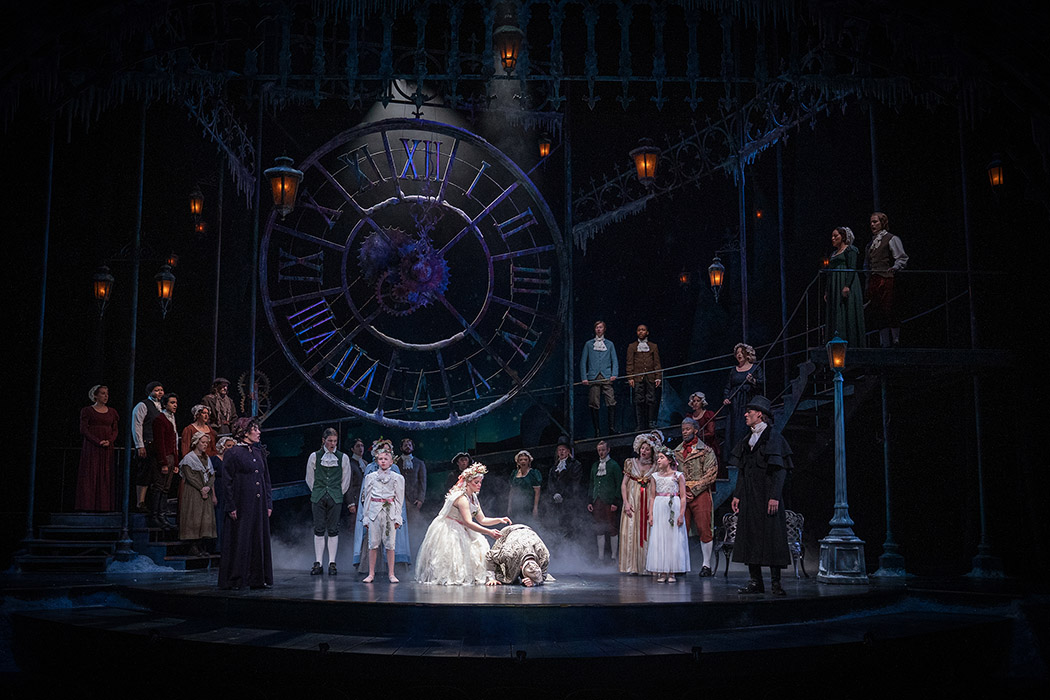
The marvelously touching and entertaining 2025 CBT version of A Christmas Carol which opened this past weekend is an adaptation by Edward Morgan and Joseph Hanreddy with music by John Tanner. That production first appeared on the CBT stage in 2016, subsequently returning for three more years before the pandemic closure of 2020. This popular version returned in 2023 and 2024, and returns again this Holiday season. Its original—and popular—visual premise by designer Kevin Depinet remains happily intact. In it, a huge Victorian clock with moving hands acts as a visual metaphor for the passage of time in Ebenezer Scrooge’s evening of redemption.
The production’s visual appeal and staging have been brilliantly, if not sublimely, refreshed, renewed, and re-imagined by third-time director Patrick Lanczki and his creative team. In addition to physical changes in furniture, props, costumes, lighting, sound, and projections, some of Lanczki’s re-imagining also appears to be in the narrative: the balancing and tightening of scenes as well as re-thought blocking to enable more relevant and appropriate movement by the actors. Ensemble crowd movement has been enhanced along with choreography (choreographer Casey Sams), and what seems like an expanded use of music and Christmas carols (music director Terry D. Alford) sung by ensemble members integrated into the crowd scenes.

As one must inevitably admit—the key to a portrayal of Scrooge is pulling off the necessary dramatic arc from miserly curmudgeon to redemption, and making it believable and heartwarming. Returning in the role of Ebenezer Scrooge to do just that was Jed Diamond, one of the several UT Theatre faculty members in the production. While Diamond’s take on Scrooge has always been impressive, this season’s characterization has benefited from his past explorations, finding a sensational balance between hard-heartedness on one hand and poor soul consumed by regrets on the other.
The instigator of Scrooge’s night of redemption is the 7-years-departed ghost of Jacob Marley, taken once again by UT Theatre Faculty member David Brian Alley. Presented in an unearthly green light and smoke, and wrapped in the symbolic chains and money boxes of a tortured soul, Alley makes his Marley quite terrifying. In a separate role of Old Joe, the “estate goods dealer,” Alley creates a marvelous character that not only provides a bit of comic relief, but also symbolically represents the grim circumstances of poverty.
Also from the faculty roster, Laura Beth Wells made her two secondary roles eminently notable in their depth: housekeeper Mrs. Dilber and the delightfully accommodating Mrs. Fezziwig.
As Marley foretells, Scrooge is visited by three ghosts: the gauzy and light Christmas Past (Elise Thayn), the boisterous and rambunctious Christmas Present (Anquanizia Hall), and the voiceless suggestion of non-redemption, Christmas Future (Calvin Flowers).

At times a narrator and representing the family-centered ideal of Christmas spirit is the all-important character of Fred, Scrooge’s nephew, taken this year with a dose of appropriate gravity by Thomas Nash Tetterton. Kat Lee portrayed Fred’s wife Catherine, who, despite being shunned by Scrooge, must present a gentle forgiveness that is a key to Scrooge’s redemption.
Along with new MFA acting candidates Tetterton, Lee, Thayn, and Hall, highlighting the rather large cast are many of the other candidates, some making their debut appearances on the CBT stage: Izaiah Ramirez as Bob Cratchit; Bryce Hagan as Young Scrooge; Gabrielle Fernandes as Belle, Scrooge’s lost love; and Keith Allen Davis, Jr, as Grimgrind. Familiar faces were Gabriela Bulka as an excellent Mrs. Cratchit and Denzel Dejournette as the magnanimous Mr. Fezziwig.
The old saying goes “…no one leaves the theatre humming the scenery,” but I will state with authority that there is plenty to talk about in this production’s visual effects. From Marley’s ghostly appearance, to Scrooge’s disappearing bed, to magnificent projections and sound effects by Joe Payne, to John Horner’s lighting, to Liz Aaron’s costumes—this is a visual production that leaves the audience agog.
CBT has, once again, created a production of A Christmas Carol that does what good theatre is supposed to do. Don’t worry, though. Should you leave the theatre with a bit of happy moisture in your eyes, your secret is safe with me.
Edward Morgan And Joseph Hanreddy—Music By John Tanner
Clarence Brown Theatre
Now through December 20
Tickets and Information