It is a regular theme—one can hardly talk about the Knoxville Symphony Orchestra’s January concerts without mentioning the possibility of weather complications. That was the case for this past Sunday’s Chamber Classics concert at the Bijou, a situation in which icy precipitation and low temperatures threatened but did not force a cancellation. While some audience members may have opted out, most seemed more than eager to brave the elements for the KSO’s intriguing combination of Edward Elgar, J.S. Bach, and Joseph Haydn.
As originally programmed for this concert, the Bach Orchestral Suite No. 2 was to precede the Elgar Introduction and Allegro, possibly reflecting the issue of contrasting the Baroque with 20th Century sensitivities. KSO Resident Maestro James Fellenbaum chose, however, to reverse the two, allowing Elgar’s work—essentially a Baroque concerto grosso itself in structure scored for string quartet and strings—to open the afternoon, setting up a bit of drama with the Bach to follow. The marvelously solid and revealing performance of the Elgar was the perfect introduction.
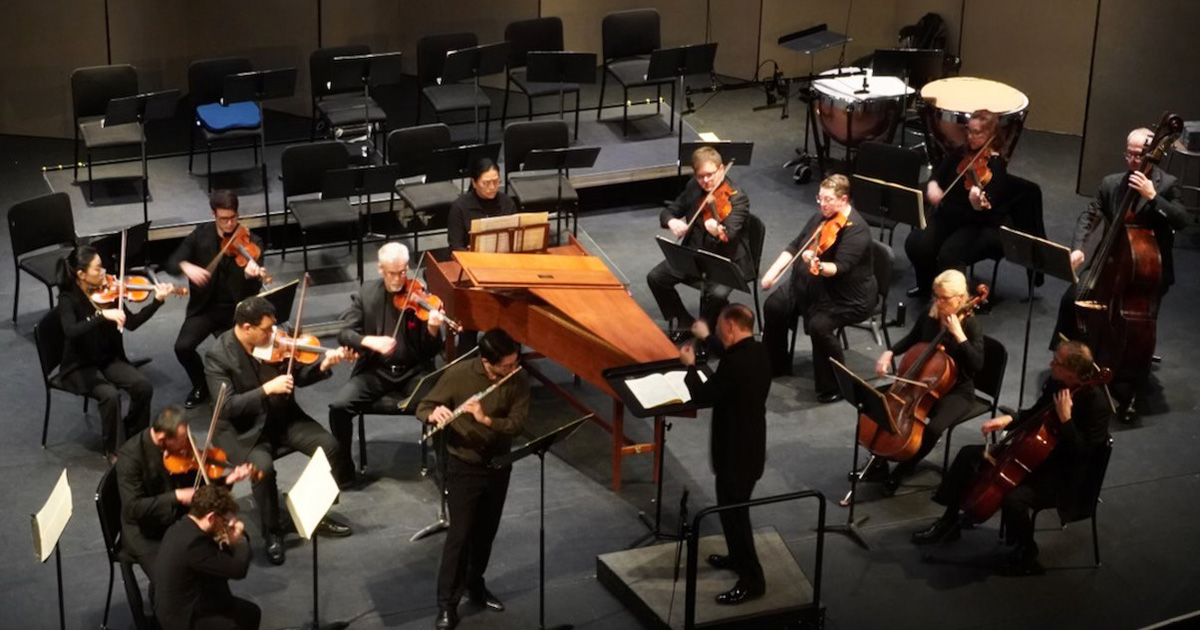
This scheme certainly seem to work well for both the audience and the orchestra. Of course, the KSO Chamber Classic series has as a basic tenet the use of orchestra members as soloists, so many were awaiting the Bach Orchestral Suite No. 2 and its virtuosic flute lead solo performed by KSO Principal Flute Devan Jaquez. And, they weren’t disappointed.
In the delicious acoustics of the Bijou, Jaquez, Fellenbaum, and the strings were perfectly balanced in volume and texture. Tempos were brisk enough, so that by the final movement (Badinerie), Jaquez had made a thrilling showcase out of the high speed dialogue with the strings.

After intermission, Fellenbaum and the orchestra tackled the Haydn Symphony No. 92 in G major, nicknamed the “Oxford.” Haydn’s inventiveness and sense of humor was in full view, particularly entertaining, first in the Adagio movement where the solo flute (Jill Bartine) and oboe (Claire Chenette) surprise with a touch of dissonance, then later in the Minuet with the two horns (Jeffery Whaley and Kelsey Bentley).
The finale is a Presto, a movement that was given charm, humor, and inventiveness by Haydn and performed with such glee and brightness, that it served as a very proper antidote for whatever Mother Nature might have been planning.