For the winter installment of the Knoxville Symphony Orchestra’s Concertmaster Series, Concertmaster and host William Shaub offered up an intensely intriguing program with an evocative title: “Tides of Solitude.” That title, of course, referred to a work on the program, Tides of Solitude for Violin, Bassoon, Cello, and Piano by contemporary composer Katerina Souponetsky. The program as a whole suggested an exploration of a more reflective side of Valentine’s Day, something that Shaub and his colleagues managed with a sensitive balance of ensemble artistry and musical introspection.
Shaub departed a bit from his usual concert-opening fireworks of virtuosic solo violin works with Johan Halvorsen’s Passacaglia, a re-imagined arrangement of music from George Frideric Handel’s Harpsichord Suite in G Minor. This demanding arrangement in 12 variations, performed brilliantly here by Shaub and KSO cellist Adam Ayers, had all the fireworks one needed in terms of speed, energy, and awe-inspiring double stops, scales, and pizzicato effects. Although Handel’s original ended in a moody minor chord, Halvorsen closed the piece with a Picardy Third, thus leaving Shaub, Ayers, and the audience with an upbeat segue to the remainder of the program.
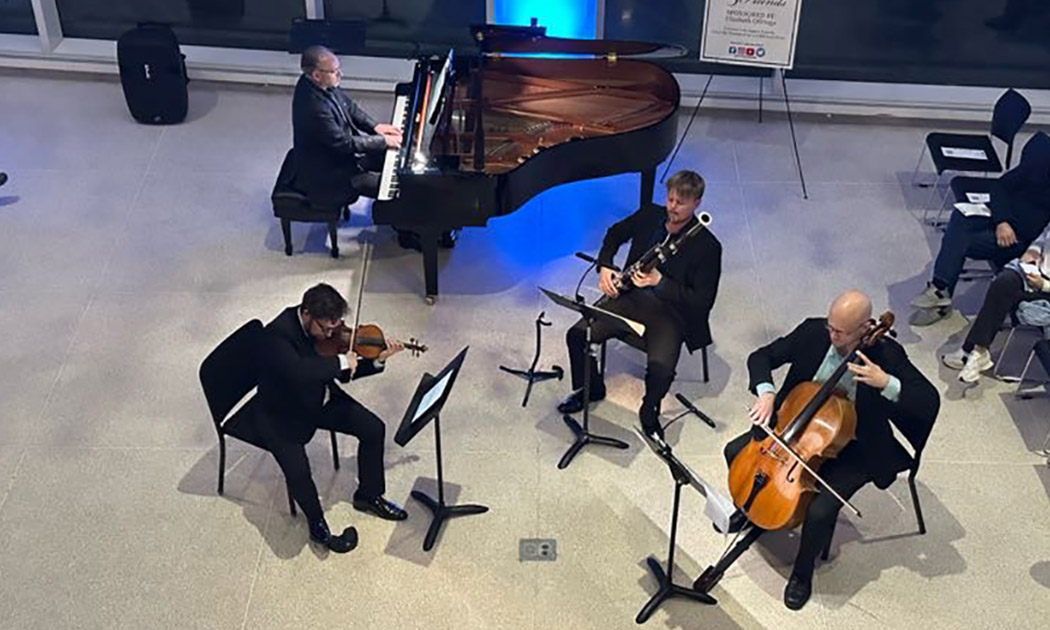
Pianist Kevin Class joined Shaub for Karl Goldmark’s emotionally deep and poignant Air, an arrangement of the second movement from the composer’s Violin Concerto No. 1. To close out the first section of the concert, Shaub was joined by KSO Principal Bassoon Duncan Henry, cellist Ayers, and pianist Class for the titular work, Souponetsky’s Tides of Solitude for Violin, Bassoon, Cello, and Piano. In this case, the work suggested a darker, more visceral and poetic side to romance, a layered construction that was haunting in a fair amount of complexity. The role of the bassoon, given here a rich, burnished atmospheric tone by Henry, was perfect in its evocation of a twisting narrative. The quartet’s performance was a hauntingly introspective one, appropriately leaving the listener with deliciously unanswered questions.
Although Shaub often closes out the Concertmaster concerts with a number of KSO colleagues in a major ensemble work, he chose a more focused closing, Robert Schumann’s Sonata for Violin and Piano No. 2 in D minor, Op. 121. Shaub and pianist Class have developed into an impressive duo over the period of their Concertmaster Series collaborations, their respective assets of stamina and focus intermingling in their performances. In their playing, complex and relentless sections are smoothed out; one continually admires their ability to maintain a dramatic (and a quasi-romantic) point of view as duration and intensity carry the listeners to their destination.
Shaub returns in a short two months, on April 8 and 9 at the Knoxville Museum of Art, to close out this season’s Concertmaster Series with works by Pyotr Ilyich Tchaikovsky, KSO “9 For 90” Commission & World Premiere by Saad Haddad, Manaka Kataoka, and Johannes Brahms, his Piano Quartet No. 3 In C Minor, Op. 60.