Opening night in most any theatre is a special occasion, one that bristles with the nervous excitement of performers—and audiences—high on anticipation. However, when that opening night is also the opening of a new theatrical venue, the excitement is off the chart. That was the case last Friday as the Clarence Brown Theatre at the University of Tennessee added its new theatre, the Jenny Boyd Theatre, to its list of performing arts venues. Replacing the Carousel Theatre that served the community and the university for almost 75 years, the new theatre space features a flexible black-box arrangement and flaunts the latest in theatre technology.
Interestingly, the work chosen by CBT to open the new theatre was Cabaret, the musical based on the Christopher Isherwood novel and the stage play adaptation I Am a Camera by John Van Druten. Cabaret opened on Broadway in 1966 with music by John Kander, lyrics by Fred Ebb, and with a script by Joe Masteroff. Its success led to a variety of re-imaginings, including the notable Bob Fosse film, a Sam Mendes production in London in 1993, and a Broadway revival in 1998 with choreographer Rob Marshall. Subsequent revivals, both in London and New York, have only boosted the musical’s edgy timelessness—the work’s most prominent feature. By default, every production of Cabaret invariably holds a metaphorical mirror up to its audience who must confront the reflection and decide whether we have learned anything from history or are doomed to repeat it.

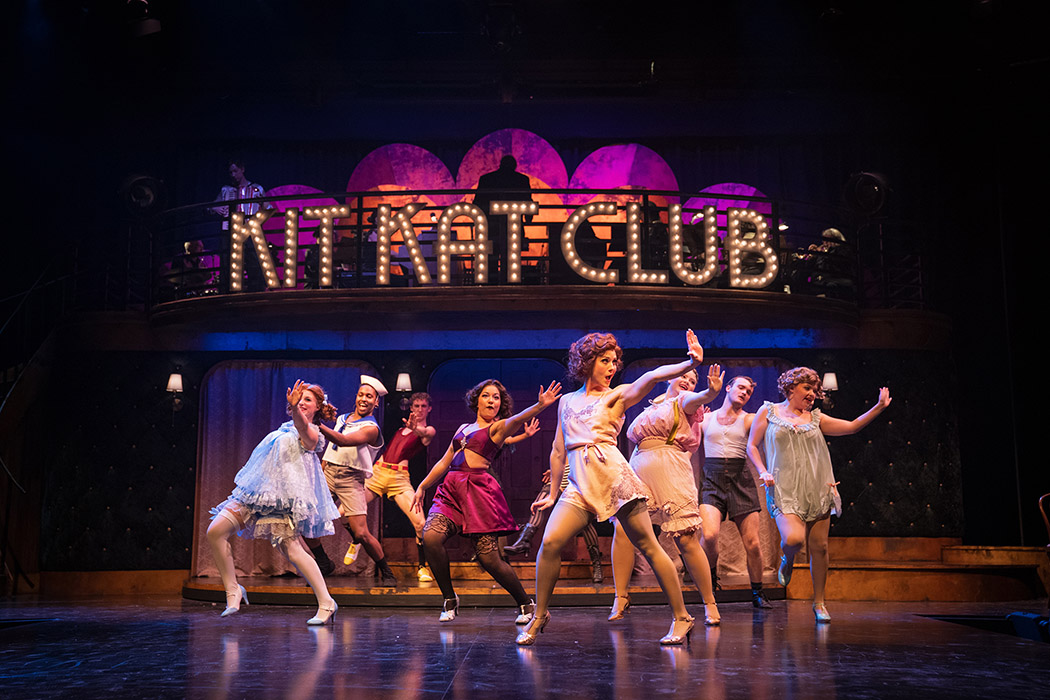
The story takes us to Berlin in the early 1930s, during the Nazi rise and grasp for power. The scene is a seedy nightclub, the Kit Kat Club, that wallows in the slick decadence of the period, its performers and patrons willfully oblivious to the storm of hate and violence that is brewing in Germany. The club’s creepy Emcee (Sammy Pontello) is a master of distraction and detachment, and, along with the club dancers epitomize the unrelenting decadence of the period. Similarly, the club’s gold-digging-roughly-glamorous headliner, Sally Bowles (Kim Morgan Dean), lives an existence based on ignoring the failing world around her. After all, “…life is a Cabaret, old chum.” We also meet a struggling, bisexual American writer, Clifford Bradshaw (Bryce Hagen), who has come to Berlin to absorb the atmosphere and write a novel, settling into a boarding house run by Fräulein Schneider (Tricia Matthews). Sally and Cliff’s paths intersect and they become lovers, as do Schneider and her tenant, a grocery shop owner, Herr Schultz (John Cherry), who just happens to be Jewish.
Director Halena Kays and scenic designer Kristen Martino have configured the performance space of the Jenny Boyd Theatre as a thrust stage arrangement that places the nightclub and its performance space on the jutting apron, and the boarding house and other locations on an upstage turntable, the overhead portion holding “Kit Kat Club” in lights, and serving as a platform for the 12-member instrumental ensemble conducted by music director Terry D. Alford. Despite the staging opportunities of this thrust, Kays generally kept the performers’ orientation to the front, leaving those in the audience to the sides with the feeling they were missing important details.
Kays and her choreographer, Tor Campbell, have given the Kit Kat Club’s nicely-staged production numbers (“Willkommen,” “Mein Herr,” and “Money”, for example) a vibrant energy that is addictive, although one gets the feeling that it all should have been a little rougher, a little edgier, even a little naughtier, to make the point.

Along the same lines, the powerful voiced Dean gave her Sally Bowles a judicious balance of good girl versus bad girl, perhaps weighted a little toward the former. The character of Cliff seemed like the perfect role for Bryce Hagen, an actor able to fill a character with unexpected nuances. And, speaking of nuances, Gabriela Bulka was brilliant as the tragi-comic Fräulein Kost, the “working girl” boarder at Fräulein Schneider’s that represents the duplicitous conflict of the German people. Also in a secondary, but oddly pivotal role was a scary Thomas Nash Tetterton as Nazi funds smuggler Ernst Ludwig.


Although the primary story revolves around Bradshaw and Bowles, the secondary plot line of the older Fräulein Schneider and Herr Schultz got the importance it needed in its representation of the conflict felt by the German population. Tricia Matthews was marvelous as Fräulein Schneider as was John Cherry as Herr Schultz. Their numbers “So What?,” “It Couldn’t Please Me More,” and “What Would You Do?” foreshadow the tragedy and the loss of life and love that was to be their inevitable conclusion.
That inevitable conclusion is made real at the end of Act I with a reprise of the Nazi anthem “Tomorrow Belongs To Me” sung by Bulka as Fräulein Kost. Left with this cringing horror at intermission, the audience enters Act II changed and apprehensive. What follows is a glimpse at the true reality of hate, hate that is demonstrated by “If You Could See Her,” a direct representation of what the dog-whistles of anti-semitism really mean.
As the company presents the finale of Cabaret, a twisted “Willkommen”, one could feel an unease wash across the audience. These are the moments that theatre does best—there is an important message here that hopefully we can understand before it is too late. Our world depends on it.
Performances continue through Sunday, March 1. Check the CBT website for available performances and tickets.