Once again on Sunday afternoon, the Knoxville Symphony Orchestra demonstrated why its Chamber Series at the Bijou Theatre is so effective and entertaining. First—as we never tire of saying—is the Bijou Theatre itself. The combination of its size and intimacy is perfect for a chamber orchestra-sized ensemble and results in remarkable acoustics that hide nothing from the eager ears of the audience. Second, the orchestra makes use of its own players in solo roles, a truly satisfying way to offer a well-deserved spotlight to some magnificent musicians.
March was guest conductor month for the KSO Chamber Orchestra, this time welcoming conductor Chelsea Gallo to the podium. Maestro Gallo, currently Resident Conductor of The Florida Orchestra and Principal Guest Conductor of the Orlando Philharmonic, opened with Beethoven’s Overture to The Creatures of Prometheus, one of the works last offered up by the full KSO during the 250th Beethoven Anniversary celebration period in 2019. The first glimpse of Gallo’s conducting style was impressive in its energy, sparkle, and clarity. Illuminating, too, was hearing the Beethoven played by a lighter, chamber-sized orchestra versus a more voluminous one in a larger venue.
It is interesting that despite Arnold Schoenberg’s reputation for his pronouncements and creation of atonal music, the tonal Verklärte Nacht (Transfigured Night) by a 25-year old Schoenberg is easily one of his most-performed and admired works. The 1899 work, originally written as a string sextet, was performed here in a 1917 string orchestra version, arranged by the composer himself.
The performance of the Schoenberg was nothing less than a remarkably impressive one with Gallo and the orchestra capturing both the delicate string textures in a range of dynamics, but also the woodwind-like chirps and blurps that were essential in painting the details of the poem and its emotional dialogue. And, importantly, concertmaster William Shaub gave the exposed violin solos and moments both solidity and chills with some really superb touches.
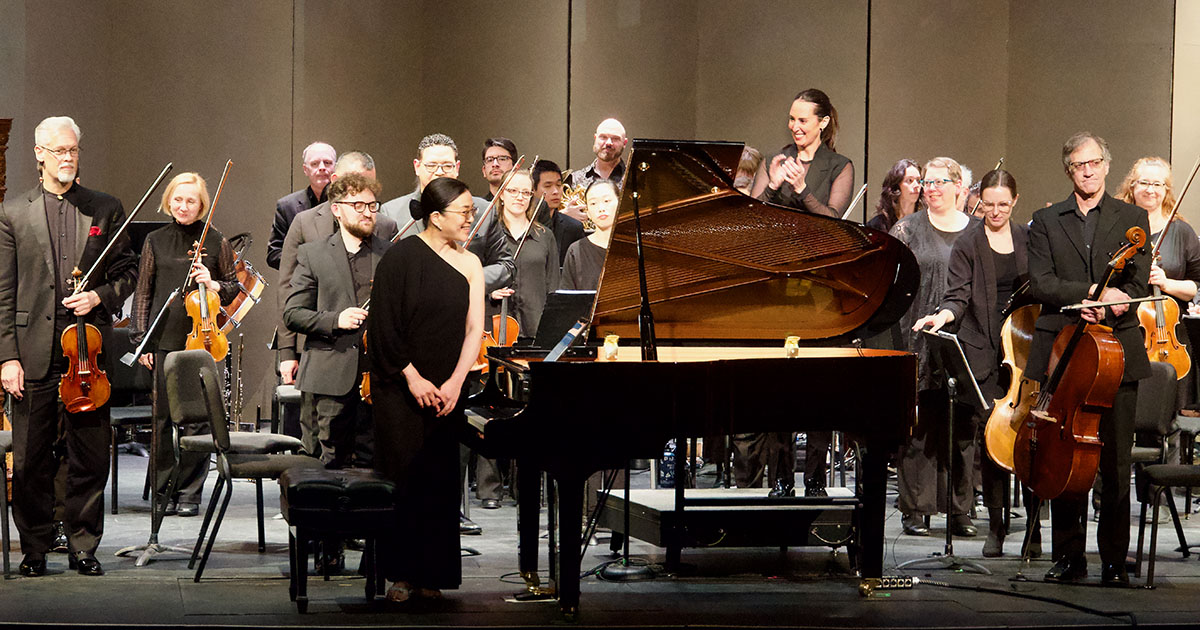
After intermission, Gallo and the orchestra turned to contemporary composer Ellen Taaffe Zwilich and her Peanuts Gallery for Piano and Orchestra. Although inspired by Charles Schulz’s comic strip and containing six movements related to his Peanuts characters, one almost wishes this charming work had a different title. Despite the work’s bounteous humor and wit, its sophistication and diversity of musical textures are its chief features that take it beyond a simple entertainment level. After the opening movement, an expected “Schroeder’s Beethoven Fantasy,” one naturally searches their own experience with the comic strip. The piano, performed here marvelously with a sublime and subtle wit by Emi Kagawa, took on the role of the cartoon-speak and the conveyor of dialog.
Similarly witty was the closing work, Ravel’s Mother Goose Suite from 1908. Originally created for piano four-hands but orchestrated later by the composer, the five-movement suite and its lush textures take the humor and impressionistic description to a higher and texturally expansive level. Of course, the work is—and was here— a feast for the woodwind principles and percussion who are called upon for a range of characters and moods, many of them exotic in a European sort of way. In addition, especially notable here was Concertmaster Shaub in solos in the fourth (“Conversations of Beauty and the Beast”) transformation description and fifth movements (“The Fairy Garden”). As a whole, Gallo and the orchestra gave the work a luminous, fairy tale whimsy, a rich illustrative quality, even with the reduced forces of a chamber orchestra.
• • •
The Chamber Series has one more event this season on May 3, a concert of American music that concludes with Aaron Copland’s Appalachian Spring Suite and includes a world premiere performance of Nicky Sohn’s A Tale of the Bunny and the Tiger as part of the seasons 9 for 90 Commissioning program.