Asked to describe American orchestral music over the last 130 years in a few words, we may find ourselves struggling for a quick answer. Admittedly, that’s probably because our own music history doesn’t necessarily feel like “history.” Case in point was this past week’s compelling and entertaining Masterworks concert by the Knoxville Symphony Orchestra that offered three American works—each separated by 65 years or so—that suggested distinctly different musical vocabularies, rather than different histories. On the other hand, the three works most certainly enjoy different places in the space-time continuum of diverse music tradition.
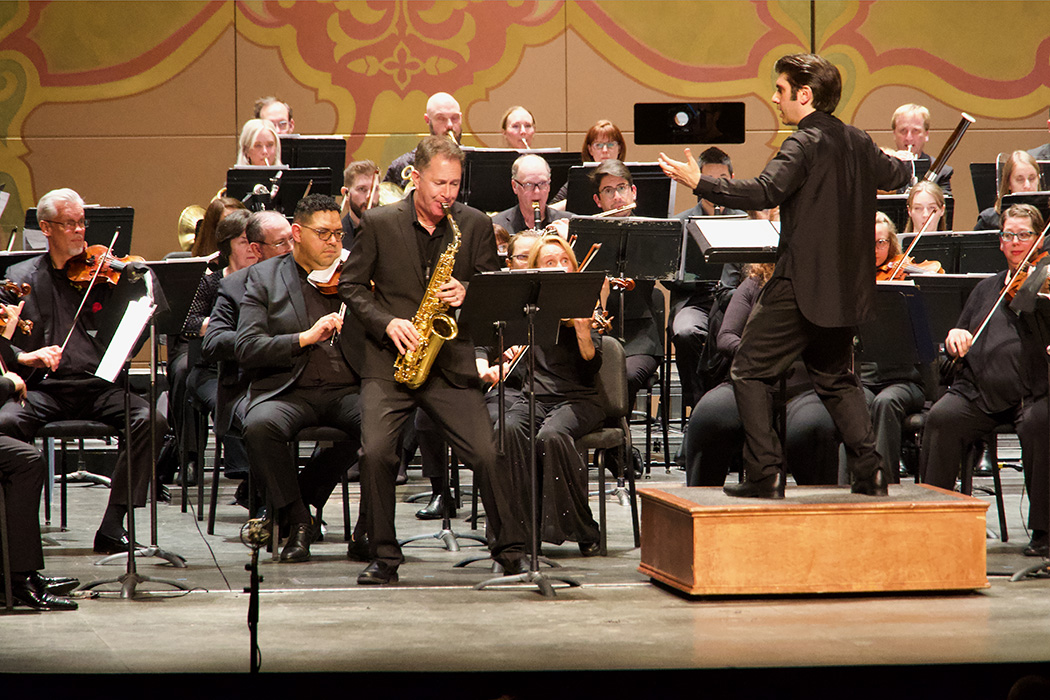
As part of the KSO’s “9 For 90” series of premieres this season, Maestro Aram Demirjian offered the World Premiere of Robert Paterson’s Alto Saxophone Concerto (“Cocktail Concerto”), performed by its commissioner, saxophonist Christopher Creviston. Completing the concert were other gems of American music, Leonard Bernstein’s Symphonic Dances from West Side Story and the Symphony No. 2 in E minor (‘Gaelic’) by Amy Beach. As it turns out, this was the first KSO performance of the 1896 Beach symphony, an occasion deserving kudos on its own as long overdue attention is finally being given to the neglected works of women composers.
Demirjian opened the concert with the Bernstein Symphonic Dances from West Side Story, a compression of nine numbers from the stage musical that ran on Broadway 1955-57. This is an arrangement that not only stands on its own, but actually benefits in intensity from some re-orchestration by Sid Ramin and Irwin Kostal. The Prologue sets the right tone of suspense, tension, and drama that subsequently supports the stylistic diversity of the eight other movements. “Somewhere” and its dreamlike poignancy were beautifully rendered, first by the KSO solo strings (Concertmaster William Shaub, violist Kathryn Gawne, and cellist Andy Bryenton), then by a passage in the solo horn (Jeffery Whaley). Overall, the work was a showcase (“Mambo,” “Cha-Cha,” and “Rumble”) of wildly diverse instrumental moments for the KSO players, including the masterful, hot-and-heavy punctuation of textural effects, dance rhythms, and bold syncopations by percussion section Co-Principal Clark Harrell and his colleagues. As if in a dream, though, the Finale beautifully underlined the storyline tragedy that dissolves into thin air.
After the Bernstein, room was made on the Tennessee Theatre stage for one more, saxophonist Christopher Creviston performing the World Premiere of Robert Paterson’s Alto Saxophone Concerto, nicknamed “Cocktail Concerto.” With Creviston making his entrance carrying his sax and two martini glasses—one for Maestro Demirjian, one for himself—one naturally wondered what level of seriousness one should attach to the occasion. Thankfully, the performance yielded—as hoped for—an admirably virtuosic and kinetic work for saxophone acting as an instrumental vocalist with an orchestration that shouldered the responsibility of setting the atmosphere and environment for the thematic four movements.
Each movement was based on a specific cocktail, or at least, one’s familiarity with the intended cinematic reference. Movement 1 was “Shaken, Not Stirred,” a reference to James Bond and his requirement for martinis. Movement 2 transported the listener to a gritty world of urban noir and a “Cosmopolitan.” Movement 3 referenced the film Some Like It Hot via the song “I Wanna Be Loved by You.” Movement 4 referenced the Sandra Bullock and Nicole Kidman film Practical Magic. There was significant fun to be had with this piece, whether or not one had taken advantage of the special Cosmo from the Tennessee Theatre bar. And, to be honest, those unfamiliar with the movie references and the intended musical environment probably had to settle for something musically non-alcoholic.
At intermission, it was a bit distressing to see a more-than-normal exodus of audience members choosing to miss the Beach Symphony in E minor. As mentioned above, this was the KSO’s first performance of it, so it wasn’t as if this had any connection to musical likes and dislikes. As it turned out, those missing this performance—and performances have been rare even in the big city orchestras—did themselves a real disservice.
Not deserving its “rarity” status, the Beach “Gaelic” Symphony is a marvelous work of end-of-the-century Romanticism, cleverly constructed out of some quoted Irish songs of different temperaments and the composer’s own absorbed influences of Appalachian folk music. Demirjian and the orchestra displayed both a sharp ear for important details and a deliciously solid grasp of the atmospheric big picture.
There were numerous magic moments of solo and ensemble work from the KSO, notably the passing and restating of themes between woodwinds and horns that appeared as subtle sylvan airiness. Particularly notable was Concertmaster Shaub’s solo in the third movement that took on an evocative dancelike quality. The final movement, an Allegro, was emphatic in the approaching dark of twilight, the final chords aggressive with a distinct minor feel that leaves its implications to the listener.
The next KSO Masterworks concert pair comes on April 16/17 with a program featuring violinist Midori performing the Beethoven Violin Concerto.