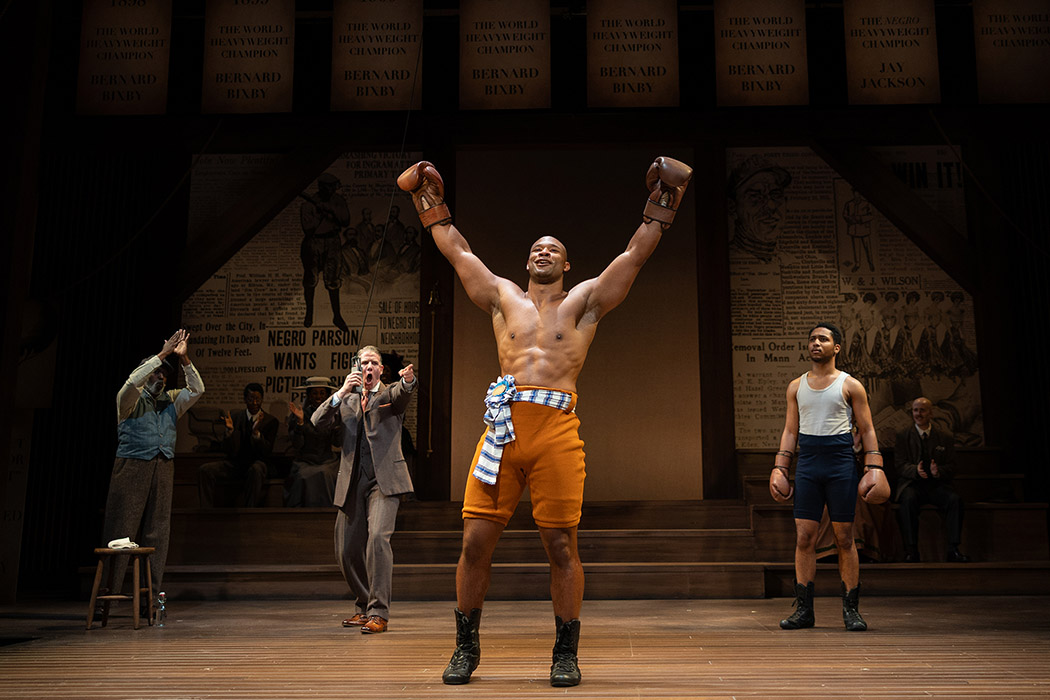
Is there poetry in pugilism? Admittedly, boxing isn’t necessarily the first vehicle that comes to mind when one thinks of a poetic and lyrical battle against systemic racism. Yet, that battle that moves far beyond fists, muscles, and punching bags is the subject of The Royale, a play by Marco Ramirez that is the second production mounted in Clarence Brown Theatre’s new Jenny Boyd Theatre this season. Loosely inspired by the real life character of Jack Johnson, the first black heavyweight champion in the early days of the 20th Century, this is a play that embraces the lyricism of a dream in which the deepest struggles of an individual come not in the ring, but deep inside one’s ambition and character.
In much the same way that a Cezanne still-life conveys the weighted impression of a table and fruit, Ramirez and director Tosin Morohunfola have structured the stylized play around the impressionistic details of what boxing is all about without actually resorting to physical blows. This represents the power of pantomime in making its point through realistic visual suggestion and the sound and rhythm of hand claps, foot stomps, and drum percussion.
With a slight nod to inspiration, Ramirez’s character is “Jay Jackson” (Denzel Dejournette), a successful and charismatic boxer, but one whose ambitions have been thwarted by the reality of Jim Crow laws that mandated racial segregation in public events, disallowing blacks and whites to compete against each other. Jay sees his path as challenging/winning the Heavyweight Championship against the current white champion. While Dejournette’s statuesque and towering physique make him ideal for the role, his ability to layer confidence and swagger on top of emotional vulnerability ultimately defines his success. As the story proceeds, Jay’s desire to reject control by others becomes a major dramatic arc, one that also reveals his ability to manipulate those around him, including a room full of white reporters, and even his trainer Wynton (Kerwin Thompson) and manager Max (Jeb Burris).

Fortunately—or perhaps unfortunately—the one person Jay is unable to manipulate is his sister Nina (the brilliant Anquanizia Hall), a woman who knows Jay well, and knows his vulnerabilities. In what is arguably the most compelling scene in the play, Nina visits Jay and describing her own path of acceptance in a segregated society, offers that should Jay prevail in a match with the white champion, her own life, those of her children, and those of other blacks will be in jeopardy due to rioting and directed violence. In a striking and symbolic depiction, Nina becomes Jay’s competitor in the pantomimed match.
Symbolic of commonplace blacks struggling to find success in a white-ruled society is the young boxer, Fish, portrayed with energy and insight by Keith Allen Davis, Jr. As a competitor, Jay toys with the mismatch, but takes Fish on as a sparring partner. Davis, a foot shorter than Dejournette, no doubt makes an unintended point with the contrast—while his enthusiasm and dedication is infectious, his life parallels Nina’s in that Jay’s triumph means hardships for other blacks.

Worn down by the years in the fight business, Kerwin Thompson’s Wynton has seen it all—and done most—in a life that he realizes has come to little. It is Wynton that reminds us of the meaning of “Royale” — the old uncivilized days when fights were animalistic knock-down, drag-out affairs staged for the amusement of a white male crowd.
Jeb Burris is marvelous as Max, Jay’s manager and fixer. Burris not only paints that side of the fight partnership with a touch of reality, but also does a masterful job as the voices of multiple boxing reporters demanding the usual info—or looking to inflame.
Scenic designer Alondra Castro has used the Jenny Boyd Theatre’s thrust capability with an appealing and metaphoric suggestion of a boxing ring that doubles for Jay’s living room and a press room, all this coming in tones of warm off-whites that feel like aging newsprint. Maranda DeBusk’s lighting was important in setting the place and mood and mirrored that color scheme. Tori Niemiec’s costumes were both individualistic in defining the character, but also set the imagination going for the period. Sound designer Willow James also weighed in on period and place, as well as supporting the production’s heartbeat of percussion.
The Royale truly is a production with a heartbeat, a pulse—not the beat of a metronome, but a living, organic one that represents the human struggle of an underdog against the status quo. The Royale does leave one question unanswered, though—knowing that question is more than half the battle.
CBT’s Jenny Boyd Theatre on the University of Tennessee campus
Directed by Tosin Morohunfola
March 25 – April 12
Tickets and Information