I’ve often said that Big Ears is like my Christmas. No other annual event makes me feel similar to the way I felt as a kid at Christmastime. Nothing else has me experiencing such anticipatory excitement months in advance. Scrolling through the website the day the lineup is announced is not unlike flipping through the Sears catalog when it arrived in the mail. Starting to plot my festival course when the daily schedule is released is like finally settling on which toys I would ask for. Soaking in the days-long celebrations, reuniting with old friends or relatives you haven’t seen since last year, and the rest of the world melts away for a bit and we’re not going to school or work or even checking the news.
Talking to a co-worker about this recently, the thing that hadn’t consciously occurred to me until I blurted it out was that over the last few years, Big Ears is one of the few things I look forward to with much excitement at all. Harsh but true, but I doubt I’m alone in this. It seems a lot of people who attend the festival regularly view it as a sort of emotional or spiritual reset, a reminder that when things seem dour, there is still so much to enjoy.
Last year, the open dialogue from artists and attendees about the state of the world and where we’re headed included a lot of talk about community building and supporting one another, and finding inspiration and succor through art and music. We were on a scary precipice at the time, eager to hear words of encouragement. A lot of things, and people, have gone off that precipice in the last year, and truth be told, I heard much less of that kind of talk this year. A lot of us seemed even more tired, discombobulated and a little spooked. Despite this, maybe because of it, the performers and audiences were 100% committed and a lot of people said it was the best Big Ears yet. (That’s said every year, of course, and every year it’s correct.)

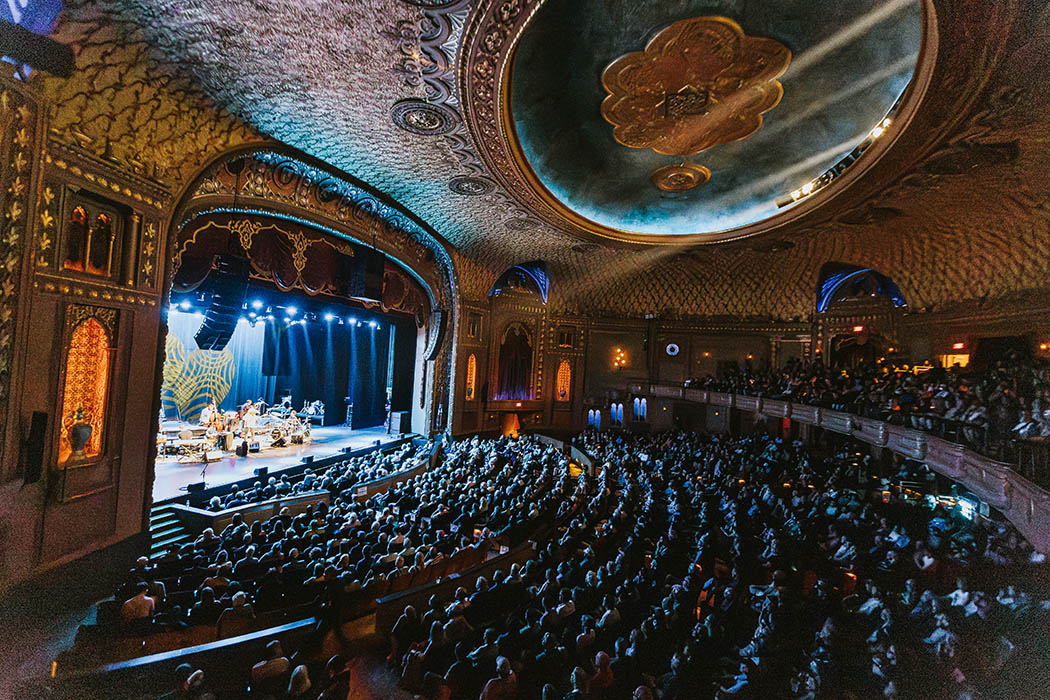
This mix of concern, curiosity and celebration was notably manifested throughout Laurie Anderson’s performance of her new work, What War Is This? What Time Is It? It’s so new, in fact, Anderson alluded several times to the fact that she had only recently written it, even working on it on the plane to Knoxville. It did seem at times like a rough draft, ideas she was teasing out in real time. Having seen multimedia performances by her a few times before, I appreciated this aspect of the piece. There are so many ideas floating around in her multimedia performances, it was interesting to see them developing. A friend posted a photo from her later performance with Sexmob at the Civic Auditorium and asked, “Has Laurie Anderson always been corny?’” I figure the answer to that is, “Yeah, kinda,” but she also somehow always makes her work affecting.
Recently I was bemoaning America’s lack of public intellectuals as interesting as ones in the 1960s and 1970s. I think Anderson qualifies as one of our more enduring ones, even if she is identified as an artist. It’s too limiting to refer to her as a political artist, and fortunately her new piece was absent of agitprop. I don’t know if she’d even want to be considered a public intellectual, and throughout What War is This? she was definitely asking more questions than she answered, which is what you want artists doing. Overall, though, she seemed as bewildered and concerned as the rest of us about the senseless acts of brutality and cruelty we’re witnessing on a daily basis.
At one point during the performance Anderson mentioned she was on a Zoom call a while back with international artists talking about the role and usefulness of artists at this time in history. The moderator asked each of them to write down one thing they could do right now that might make an actionable difference. To her surprise, all of them revealed they wrote “Go to Minneapolis.” A murmur went through the crowd. They knew exactly what she meant. Anderson didn’t mention if any of the participants actually went to Minneapolis. And it seemed to me that was as relatable to the audience as anything I witnessed this weekend, as right now many people are feeling like helpless witnesses to an ugly history unfolding and when a thought of action does occur, we usually don’t go through with it.
Toward the end of the presentation, Anderson told stories involving her grandfather, who immigrated from Sweden in the late 1880s, and the obvious lies he told about his life that became family lore, following this with anecdotes and reflections on Sigmund Freud.. She used AI to create bizarre photos and animations of her grandfather and Freud, and the audience at the Tennessee Theatre all had a good laugh at how fake and stupid these images looked, because we all hate AI-generated art— don’t we?

We do now, but during Flying Lotus’s wonderfully immersive set later that night, the bass-heavy, sample-driven music accentuated with clever, kinetic visuals, I had an intrusive thought that took me right out of my reverie: Some of this could be AI-generated and most of us wouldn’t realize it. (Not that I think Flying Lotus would do that, he’s had a 20 year career as a musician proving his talent over and over again.) As AI improves and we are endlessly bombarded with it, how and will it matter if it’s incorporated into electronic music and visuals? How different are the AI critics and naysayers from those who decried the invention of recorded music at the turn of the century, or those who loathed synthesizers and computer generated music when they first appeared? How far are we from a curated stream of AI-generated art at Big Ears? Because, after all, the argument goes, you can’t put the genie back in the bottle and some artists are using it in creative ways. (2015 Big Ears alumni Holly Herndon and Matt Dryhurst were well ahead of the curve on all this, though their methods and opinions remain controversial to many.) The field of AI is one of the most rapidly moving targets our culture has ever experienced, so these are probably conversations that should be had sooner rather than later.
Anderson’s playful debunking of family lore was especially welcome after having seen Terry Allen evoking tall tales of his own grandfather, including a doozy of a story involving the incorrigible hitchhiker disappearing for a few years, only to return to say he had been living in Alaska. I don’t know if this was meant to be true or not, but it didn’t matter much, as the point the Allens seemed to be making with the entirety of their show was how important family bonds are and how important it is to stay connected to your past. During the Truckload of Art performance at the Black Box, Allen and his wife Jo Harvey swapped autobiographical stories between Terry’s songs on keyboard, backed by his son Bukka on accordion. The entire show was delightful, a great history lesson concerning not just the Allen family’s life and art, but a reflection on a changing America.

Another performer who evoked her grandfather was Cleo Reed. She relayed that he was a blues musician, and his advice to her was always, “Slow down.” Anderson and Allen’s grandfathers would have been born in the late 1800s, Reed’s probably in the mid 20th century, and all three performers were looking to stories, lore, wisdom and inspiration from elders who navigated different but no less difficult times. Though obviously a little flummoxed by flight delays and a noon time Friday set, Reed gamely delivered a passionate set and was not in the least bit shy in fore-fronting the anti-capitalist ideology that underpins her songwriting. It was encouraging to hear such a wonderful voice with a dynamic range sing lyrics that make clear the absurdity of the American economic and political systems.

By far the most contentious show I attended was Dirty Three at Tennessee Theatre Friday Night. I saw people walk out throughout the set, but that occurs regularly at festivals, so I didn’t think much of it. (“I like playing festivals because people leave all the time and I always want to leave,” joked Hand Habits’ Meg Duffy during their Sunday set at The Point. “It’s OK to leave. But please don’t leave! That’s my attachment style.”) A highlight of the weekend for me, I didn’t realize until talking with friends and strangers alike over the next few days how many people absolutely hated it.
Ellis did post an Instagram selfie from an airplane a few weeks ago with the caption: “Coming to North America. @therealdirtythree tour. Most tickets sold out. Showing the kids how to do it. Three hour set. Not for the faint hearted Or the curious.” Their set at the Tennessee Theatre was only 90 minutes (15 minutes over their allotted time, so Union overtime pay went into effect), but Ellis still managed to infuriate some people with his synthesizer noodling and frequent audience engagement, rather than a structured set of songs with his violin as the focal point. There’s some debate over whether the band played two or three or four songs, because Ellis would interrupt the music seemingly at random to try to lead the audience in a cheer or deliver a monologue.
Granted, I’m a Dirty Three fan and was aware of Warren Ellis’s long monologues and gestures toward showmanship, and I find it entertaining, just part of the show. But I totally get why many people found Ellis talking about his former heroin habit or hemorrhoids or chatting with the crowd annoying, even if he did balance all of this with one of the strangest and sweetest moments I’ve witnessed at the Tennessee Theatre. Ellis invited audience members to hold up their phones with pictures of their pets, only to have a few dozen people march to the front of the stage and show them to him as he bent over for a closer look, showering these cats and dogs with praise. This bit ended with him leading the audience in a long moan meant to raise the spirit of Sinead, a concert goer’s pet chicken that was taken by a hawk a few days prior. That’s entertainment!
Those familiar with the group might have been expecting more of the achingly beautiful music they created in their early years, and less of the noisy almost jamming that made up most of the set. Those unfamiliar might have been bored or confused. “Indian Love Song,” from their first album, was about as traditional as it got, and they absolutely lit that one up, Ellis really sawing away at his violin. It still all felt like just a taste of what was possible, and I can’t wait to hear the bootlegs or official release from some of the concerts, which at times have stretched to three hours and 45 minutes.

People also had strong opinions about YHWH Nailgun’s set at Mill and Mine, ranging within my earshot from “I actually like this live but wouldn’t listen to this at home” to “I like their record but it didn’t really work for me live” to “These guys have one song.” As an admirer of the band and their record, I’ll split the difference and say I liked the show, even though I would have preferred to have heard it at The Standard, and I was satiated after about thirty minutes. Amazing drummer, creative use of synthesizer, lots of repetition and a frontman doing quasi-Cookie Monster death metal vocals in a completely alien context. But he’s the kind of vocalist that is meant to sound like another instrument in the band rather than one delivering narrative or emotional content.
But it was good to hear rock music in a festival teaming with jazz, new music and lots of unclassifiable sounds on the more mellow side. By Saturday evening I wanted to hear loud rock music so badly I had a classic Big Ears moment when I decided to attend a concert I had absolutely no intention of seeing, MJ Lenderman at the Civic Auditorium. He and his band The Wind sounded great in that large space, especially the countryified Crazy Horse-ish guitar solos. It was also a kick thinking how less than two years ago Lenderman was on the tiny stage at Pilot Light and was now commanding that cavernous room even more adeptly. He’s bound to change or want to switch up his sound eventually, but for now he keeps plowing away with a basic rock band supporting his highly praised lyrics and it’s working out well. I would have been equally engaged with Winged Wheel or Ryan Davis, who travel similar roads, but I also wanted the seating the Auditorium provided, rather than standing in a crowded room.

I returned to the Auditorium the next day for Hania Rani’s 45-minute piece “Non Fiction,” performed by Rani and the Knoxville Symphony Orchestra. A piano concerto in four movements, it was the most perfectly executed and moving performance that I saw over the weekend. Programmed on Sunday afternoon, it was a calming and palate cleansing experience before winding down the festival. I always see one or two classical/new music pieces at Big Ears, always enjoy them and vow to see more next year, but that rarely manifests. You go where the mood takes you, and in my case, that can change like the March winds.
My mood carried me to see SML’s residency at the Greyhound bus station for three of their six sets. Each was captivating and trance-inducing, the same but different. The four-piece jazz group (with special guests during two sets) reminded me of Australian trio The Necks in the way they start each performance with slow, exploratory motion, as if feeling each other out, then locking into grooves that build incrementally until you find yourself in the middle of a whirlwind you can’t explain how you arrived within. Even watching them perform live, you’re not sure how they do it. If Shahzad Ismaily remains the Big Ears MVP, SML’s residency this year dominated the festival, and is going into the BE Hall of Fame.
As for the Greyhound as a venue—good idea—who doesn’t love hearing music in abandoned buildings, especially in the round? But the staging took up so much of the space that it got crowded pretty fast, and with no air conditioning or circulation, the first few nights were at capacity and sweltering inside. Lou Reed’s all day Drones installation allowed for a better look at the space itself, unencumbered with crowds and musicians. I heard a few romantic comments about the space resembling architecturally interesting abandoned Eastern Bloc buildings repurposed for music performances, but to me it seemed like an abandoned Greyhound bus station in Knoxville. It might end up being refurbished as a more proper venue, but if that doesn’t happen by next year hopefully it will be used during Big Ears again, hopefully with less staging and more ventilation. And I hope the security guard that was standing inside during Drones got hazard pay.
Richard Dawson and Eliana Glass were two insular, idiosyncratic acts this year. Dawson has been at it a while, and it was great to finally have him at the festival, see him in such an apt venue as The Point, and hear the audience rapturously receive his songs. His set was primarily comprised of songs from his latest album, End of the Middle, along with a few older songs like the Covid-era classic “Jogging.” Two a cappella story songs bookended the set, and he allowed himself several unpredictable guitar solos that at times were every bit as erratic as Bill Orcutt’s.

Eliana Glass is a relative newcomer, and her 2025 debut album E captivated a lot of listeners. As I wrote elsewhere, if it clicks with you, it’s one of those albums you know you’ll be listening to for the rest of your life. I hesitate to call what she does jazz, as it’s more slow and abstract than most jazz, and it’s not really comparable to much else. You’ll just have to listen. Her two concerts, solo at First Presbyterian sanctuary and with a full band at Regas Square, lived up to high expectations. She and her band held everyone mesmerized at a late night Saturday set.
I closed out the festival with the one-two punch of Orcutt/Shelley/Miller and Alan Sparhawk with Trampled by Turtles, two very different vibes. Orcutt played the day before at Regas Square and delivered probably my favorite set I’ve seen him play. He’s such a fascinating guitar player to watch, because you never know what he’s going to do or how long he’ll explore a riff or pattern before moving on to another idea. He’s a dynamic player and a dynamic thinker. His trio with bassist Ethan Miller and drummer Steve Shelley was a delightful rock improv blast that flirted with classic rock tropes but kept things loose. Not since Rangda has there been a power trio that delivers on all the best promises of rock and improv. You could see how much fun they were having, and you could hear it from the audience.
Alan Sparhawk and Trampled by Turtles initially seemed a bit of an odd choice to close the festival. Although they had a lovely set built around their collaborative album with a few Low, Sparhawk and Turtles songs thrown in, the songs are largely melancholic meditations on grief and loss. But given our emotional and psychological state these days, it’s not the worst thing in the world to have everyone exiting the weekend reflecting on our mortality and how best to be present for others and ask for help when you need it. Multiple friends shared with me how moved they were by the performance, how many tears they shed.
Sharing my thoughts with Pilot Light artistic director George Rutsyamuka, he replied, “I would say the performance was like a grieving oriented music therapy group led by a therapist who is aptly qualified.”
Well put, and a reminder that Big Ears is always about much more than a bunch of musical acts playing across four days.