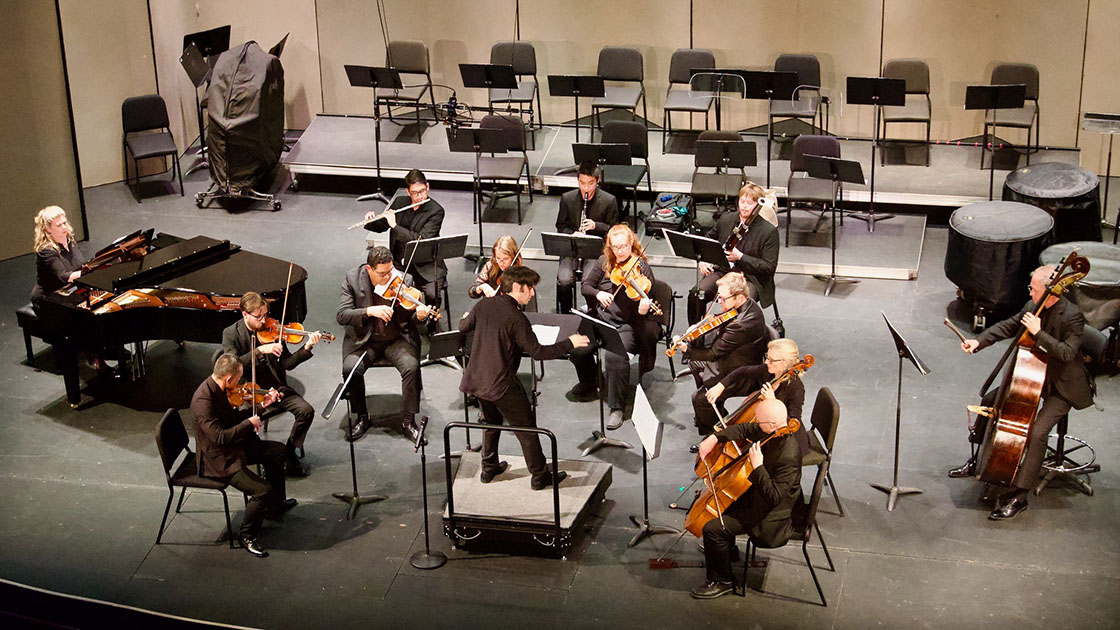
As it turns out, one doesn’t necessarily need one of Edward Elgar’s Pomp and Circumstance marches to feel the nostalgia at end-of-the-season concerts. Last Sunday, Maestro Aram Demirjian and the Knoxville Symphony Orchestra beautifully accomplished the task of closing its 2025-26 Chamber Series with a carefully and skillfully assembled program of American music that conjured up ineffable feelings of familiar times and places. Along with Charles Ives’ Three Places in New England and Aaron Copland’s Appalachian Spring Suite, came an arrangement of W.C. Handy’s song “St. Louis Blues” and the World Premiere of Nicky Sohn’s A Tale of the Bunny and the Tiger. No pomp here, but a marvelously eclectic program of circumstance.
Although wildly different in intent and texture, the music of Charles Ives and Aaron Copland seems to achieve the same goals, that of evoking very specific emotions. In the case of Charles Ives’ Three Places in New England, Demirjian provided a lengthy “Ives 101” explanation, not just of the three movement piece, but also an audience-friendly general approach to Ives and his methods of construction, interweaving, and distortions of melody. It is in Ives’ particular methods of musical collage and cacophony that allowed listeners—and obviously, the fully engrossed KSO instrumentalists as well—to slip into a very magical emotional consciousness that transcended the geography of the three locations.
Aaron Copland was a fan of Charles Ives and often mused about the secret to the Ives’ ability to evoke time and place within his musical language. Of course, Copland was a master himself of evoking the nostalgia of time and place, most assuredly in his ballet music for Martha Graham, Appalachian Spring. Interestingly, Demirjian opted not for the full chamber orchestra version of Copland’s Suite, but rather for the version for 13 instruments (4 violins; 2 violas; 2 cellos; 1 double bass; 1 each of flute, clarinet, and bassoon; and piano). As a result, this was a sublimely beautiful performance that sparkled with the agility of a small ensemble. Details were crisp, and the balance of strings to woodwinds perfectly set the textural foundation for the poignant melodies for the flute (Principal Devan Jaquez).
Demirjian opened the afternoon concert with Jeff Tyzik’s arrangement of W.C. Handy’s blues classic “St. Louis Blues,” an arrangement that featured marvelous solos for clarinet, trumpet, and trombone.

Blessed by a season of newly commissioned works in the KSO’s “9 for 90” commissioning project, listeners were naturally anxious for A Tale of the Bunny and the Tiger by composer Nicky Sohn. The work was a through-composed 11 movement, extensively programatic piece inspired in its narrative base by folktales from the composer’s Korean childhood.
Simultaneously surprising and challenging in its stylistic approach, Sohn’s work is remarkably Western in a carefree sort of way, but with moments of Asian influence that drift in and out of the narrative. This sets Sohn apart from other contemporary composers, particularly in her general sense of tonality.
With the wrapping up of the KSO’s Chamber Series, a few interesting points come into focus. Obviously, one can opine that the Chamber Series is unquestionably popular as evidenced by its almost full house this past Sunday for an admittedly diverse program. That premise will certainly be tested in next season’s Chamber Series opener in September. That concert will feature the contrast of J.S. Bach’s Brandenburg Concerto No. 2 with Higdon’s Mandolin Concerto. And, importantly, the series feature of spotlighting KSO instrumentalists as soloists returns—Prokofiev’s Peter & the Wolf with tubist Mike Anderson and KSO Principal Bassoon Duncan Henry in Mozart’s Bassoon Concerto.