Composer Giacomo Puccini was reportedly adamant that the three one-act operas—Il tabarro, Suor Angelica, and Gianni Schicchi—comprising his triptych Il Trittico be performed together. Clearly, music history had other ideas. While the works premiered as a triptych in Rome in 1919, it is a common occurrence today for each to stand on its own or be paired with one-acts from other composers. Il tabarro is a gritty tale of tragic passion on a riverside wharf; Suor Angelica concerns a tragic realization in a convent. Of the three, though, the comedy Gianni Schicchi has shown the greatest popularity and attraction, easily absorbing the creative needs and impulses of opera companies, including updating its time and locale from 1299 Florence into modern times. And, importantly, it is a work that easily embraces whimsy, if not snark, in its visual metaphors.
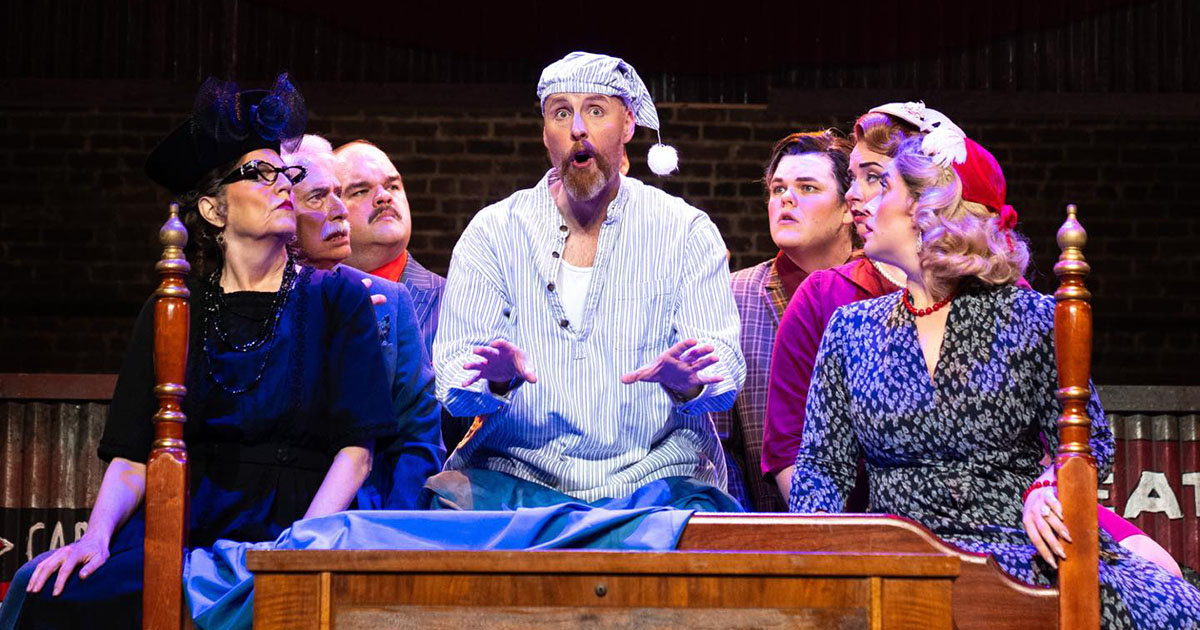
This certainly describes Knoxville Opera’s deliciously delightful standalone production of Gianni Schicchi that had two performances this past weekend at the Bijou Theatre. Stage director Dean Anthony exercised his usual creative license by updating the time of the action to something more like the latter half of the Twentieth Century. The familiar Vespa logo was prominently displayed on an open upstage wall, behind which was conductor Benjamin Makino and the Knoxville Symphony Orchestra. Of course, the set is the cluttered Florence bedroom of the elderly and soon-to-be-departed Buoso Donati, his last moments witnessed by a gathering of his relatives hoping for an inheritance despite the rumor that the old guy had left his entire fortune to the church.
As Buoso audibly breathes his last, the collection of relatives frantically search the cluttered room for the man’s last will, only to be inconsolable when they finally discover it and confirm that the fortune will go to the monks at a nearby monastery. The group reluctantly takes the suggestion of young Rinuccio that they ask the assistance of the clever and resourceful Gianni Schicchi, who just happens to be the father of his girlfriend, Lauretta. At first, unwilling to assist the greedy relatives, Schicchi eventually gives in to the lyrical entreaties of Lauretta, devising a plot that will enrich himself, allow his daughter to marry Rinuccio, and thwart the grasping and undeserving relatives.

Timothy Mix was a beautifully scheming Gianni Schicchi, willing and able to resort to rumple-tumble physical comedy as became necessary. Tenor Charles Calotta was a marvelous Rinuccio, his vocal clarity clearly establishing his role as the romantic lead with Lauretta (Helen Zhibing Huang). As Gianni Schicchi’s daughter, her touching plea to her father, the gorgeous and poignant “O mio babbino caro,” was a showstopper.

The beauty of Gianni Schicchi is that it is a masterpiece of ensemble construction with the eclectic characters of the relatives offering singers with comic ability a real vehicle rarely found in opera. With familiar faces and voices for Knoxville Opera audiences, the ensemble of the relatives and their whining machinations was dramatic comedy at its best. Karen Nickell was a marvelous cousin Zita; Andrew Wentzel, known for commanding a stage, was a vocal and comic joy as Simone; tenor Cody Boling and soprano Tori Franklin were the petty and whining Gherardo and wife Nella, respectively. In a treble role, Isla Burdette was their son Gherardino. JJ Robinson was Marco, Simone’s son, and his wife La Ciesca was Hannah Shea. Daniel C. Webb was poor in-law Betto (who miraculously plays a phonograph record of Il tabarro in the preface). Joel Brown was the Notary and making a necessary cameo appearance was director Anthony as the doctor Spinellocio.
The upstage position of Makino and the orchestra seemed to work well from an acoustic point of view although word has it that the best balance of voices to orchestra in this production was in the Bijou’s balcony, something that seems counter-intuitive. Having said that, I will reiterate: the Bijou Theatre is an acoustic marvel that is irreplaceable. And, as it turns out, it is a perfect space for KO to try out alternative approaches to opera, both traditional and new.