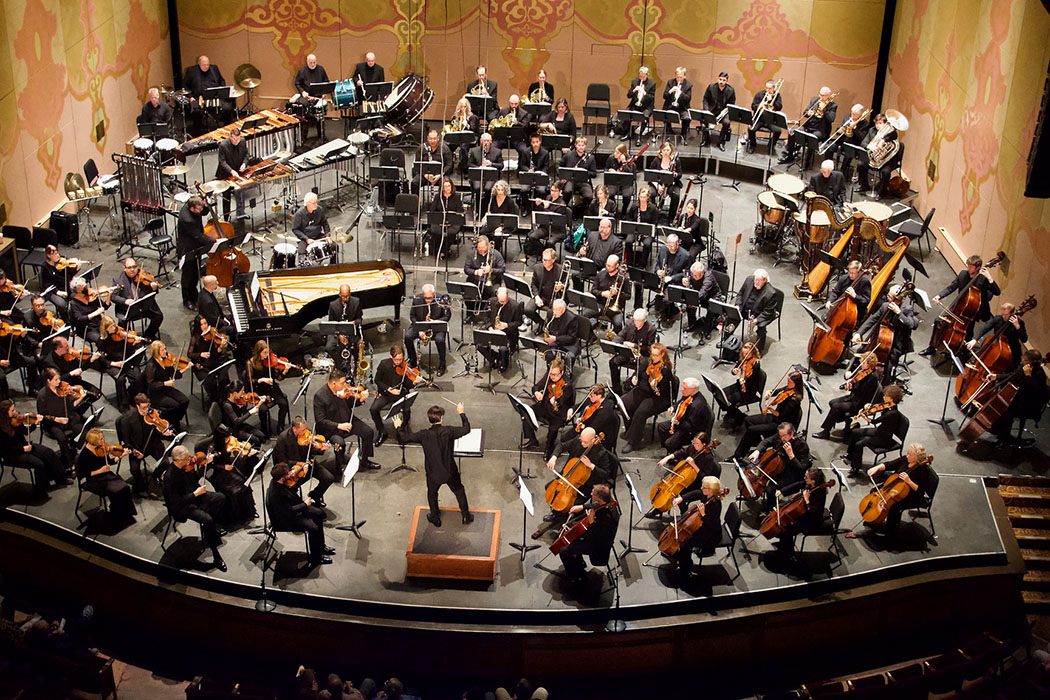
Sometimes, if we’re lucky, there is more to a concert than just a collection of music, more than just sounds in the air and notes on a page. That was the case for the Knoxville Symphony Orchestra last week as they concluded the 2025-26 season in their Masterworks Series. Freely explaining the theme and goal for the evening, KSO music director Aram Demirjian had assembled a group of American works that began the tie-in to the America250 celebration that will continue in September.
Defining America with music seems simple on its face, but is, in fact, systemically difficult. Continuing the American music road-trip that began with the final Chamber Series concert at the Bijou earlier this month, Demirjian chose to begin this concert with a major collaboration of the KSO with the Knoxville Jazz Orchestra—a performance of three movements from Wynton Marsalis’ surprising Swing Symphony. This ambitious work was premiered in 2010 by the New York Philharmonic along with members of the Jazz at Lincoln Center Orchestra. Originally in six movements and running almost an hour, a seventh movement was added by Marsalis in 2013. Demirjian has opted for performing the first three movements on this concert.
Scenes dot this comprehensive musical landscape with broad evolving hints of ragtime, blues, and New Orleans jazz. The dozen or so impressive KJO soloists were musically spotlighted but remained a part of the orchestral whole, throwing off any bit of suggestion that this might be just a concerto for jazz band. Admittedly, Swing Symphony begins to feel long and a bit over-composed, even in a partial performance of three movements. But, as a roadmap of American swing, it certainly accomplished its goal thanks to some excellent performances.
After intermission, the evening’s music hit the trail with the familiar third movement, “On the Trail,” of Ferde Grofé’s Grand Canyon Suite. The piece, of course, was a feast of textures for the KSO percussion section, although there seemed to be some smiles emanating from the brass and woodwinds as well.
In what was inarguably a substantial contrast in tone and substance to the Grofé came a 10-minute work, Field Guide by Gabriella Smith, a mentee of composer John Adams. This work features the usual double winds and brass plus strings and percussion, but has players using and manipulating the instruments in different ways that create new sounds. These extended techniques are naturally a challenge for the players who must embrace something different. The sonic environment created, however, is important in supporting the composer’s parallel goal of bringing important environmental issues to confront audiences, albeit gently. In this case, the cacophony of bird-inspired sounds draws one into a natural world that is sadly beset on all sides by the effects of climate change.
Yet another musical pathway came with Margaret Bonds’ arrangement of spirituals performed here by the incomparable Knoxville baritone, Michael Rodgers. Known for his awe-inspiring rich voice and attention-getting vocal narrative ability, Rodgers visited “Ezek’el Saw the Wheel,” “He’s Got the Whole World,” “Hold On,” “I Got a Home in that Rock,” and “Joshua Fit the Battle.”
Demirjian closed out the evening’s American music survey with the fourth movement of Aaron Copland’s Symphony No. 3, a movement that is an extension of the composer’s inspiring Fanfare for the Common Man. By this point in the evening’s music, it seemed apparent that the program was much more than a tasting menu of American music, but a symbolic reminder that the American experience should reflect our best values of citizenship, not our worst.
Traditionally at the final concert of the year, the KSO recognizes five-year (and multiples of five) milestones of the orchestra’s personnel, always an opportunity to applaud the musicians’ commitment to their career of making music. In addition, the KSO recognized three retiring members, violist Bill Pierce, trombonist Brad McDougall, and timpanist Michael Combs. Combs is stepping down after 57 years with the orchestra having begun with the KSO in 1968.