Although the official response to America’s Semiquincentennial celebration has admittedly felt a bit underwhelming, certainly no blame for this can be levied against the country’s larger classical music organizations and venues. These arts groups planned ahead for significant 250th anniversary events, focusing their efforts on the history and entertainment value of American music. Locally, the Knoxville Symphony Orchestra, under music director Aram Demirjian, has offered up programs over the last six months that were aimed squarely at celebrating American music and American composers, both historical and contemporary. Also included here is a sub-focus on music that comes from those viewing the American musical experience from a different perspective in celebration of the idea that America is —and always has been — a country of immigrants.
Begun last season, the KSO’s journey through American music spilled over into the 2026-27 season with its eagerly anticipated opening concert festivities last week titled “Gershwin’s An American in Paris.” Along with Gershwin’s immensely popular symphonic poem, Maestro Demirjian and the orchestra ventured off in three other programming directions—first Antonín Dvořák’s Cello Concerto in B minor, Op. 104, a work written in New York City while the Czech composer was in his third term as the Director of the National Conservatory. Also on the concert was Korean-American Nicky Sohn’s Is This the Happiest Place of Earth? and William Grant Still’s Symphony No. 1 (Afro-American).
Demirjian opened the concert with a 250th celebratory prelude of two works: first the traditional playing of The Star Spangled Banner followed by an arrangement of Julia Ward Howe’s The Battle Hymn of the Republic that borrows a popular tune penned by William Steffe. In this performance, KSO’s new Poet-in-Residence, Rhea Carmon, supplied her own emotional and appropriate poetry to accompany the orchestra and the occasion.

Equally satisfying but in a less heavy circumstance, Carmon was also on hand for a marvelous performance of William Grant Still’s Symphony No. 1, given the subtitle “Afro-American.” The work dates from the middle years of the Harlem Renaissance and is in four movements labeled “Longing,” “Sorrow,” “Humor,” and “Sincerity.” The four movements refer to passages by the poet Paul Laurence Dunbar which were recited by Carmon as prelude to each movement.
The beauties of Still’s symphony flow from the stylistic shifts of traditional European orchestral textures and structures into blues-influenced rhythms and colors, and then back, often in surprising and unexpected ways. These moments—at times moody, sad, or pensive—were captured by Demirjian and the orchestra with a clean matter-of-fact-ness. Among these intriguing moods were themes that used a muted trumpet (Principal trumpet Brian Winegardner) and oboe (Principal oboe Claire Chenette).
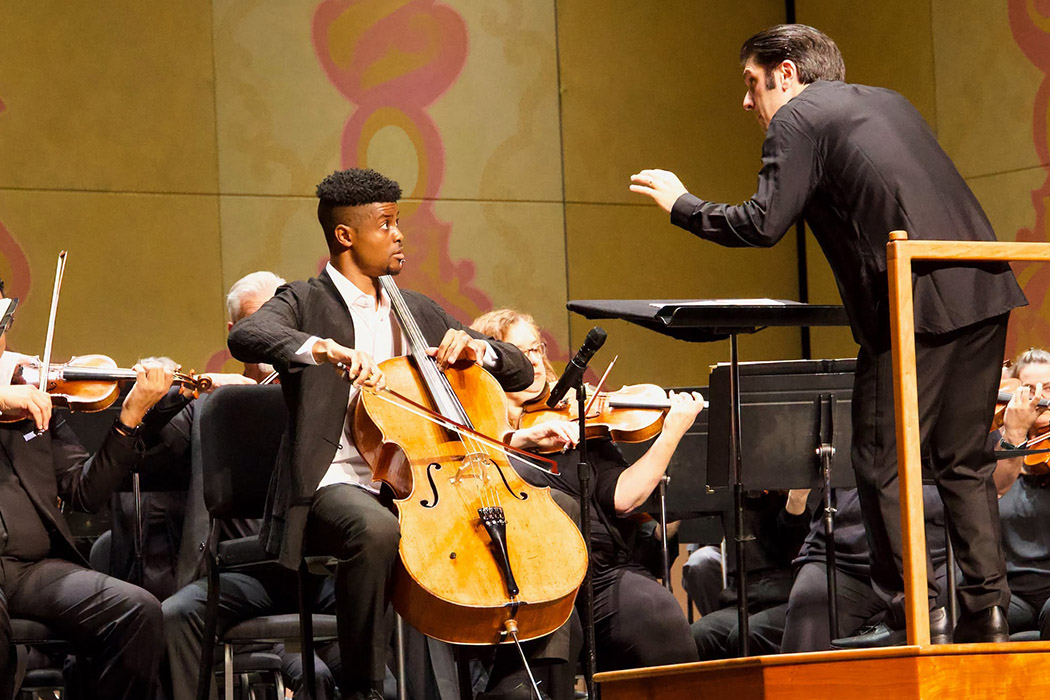
To close out the first half of the concert, Demirjian and the orchestra were joined by the twenty-something young cellist, Sterling Elliott, in a performance of Dvořák’s Cello Concerto in B minor. One immediately sensed Elliott’s demonstrable command of his instrument, an ease, musical maturity, and technical accuracy that usually comes to performers only with age and long years of performance. Also remarkable was his presentation of dramatic passages that cry out for a touch of Slavic lyricism. The end of the second movement was a perfect example of this gentle lyricism as the cello and the flute (Principal Devan Jaquez) share an intimate conversation that ends with hope.
As we occasionally mention, one issue always confronting guest soloists in the Tennessee Theatre is adapting to the hall’s remarkable acoustics and deliciously warm resonance with an audience and the orchestra shell in place—acoustics that can lead one to misjudge balance between orchestra and a solo instrument. As a result, the Thursday evening performance was somewhat too subtle in cello volume and dynamics. On Friday evening, though, perfect adjustments had been made and Elliott’s performance was enticingly bold with Demirjian encouraging the voice of Elliott’s cello—certainly a gorgeous voice delivered beautifully—to find its place soaring above the orchestra.
The calling card of the evening was George Gershwin’s An American in Paris, a work that seems to define nostalgia for the American urban environment more accurately and defiantly than any text, despite its reference to Paris of the 1920s. One felt at home with this terrific performance by Demirjian and the orchestra, a performance that echoed the sadness with a solo trumpet, confidence with trombones and horns, amorous encounters by the strings, and Parisian jazz that truly reminds one of home, even if the memory is a bit hazy. And, of couurse, the hopefulness of the crescendoed finale is one that hasn’t gotten old, a feeling that resonates with quiet joy as we embrace the season and our tasks ahead.