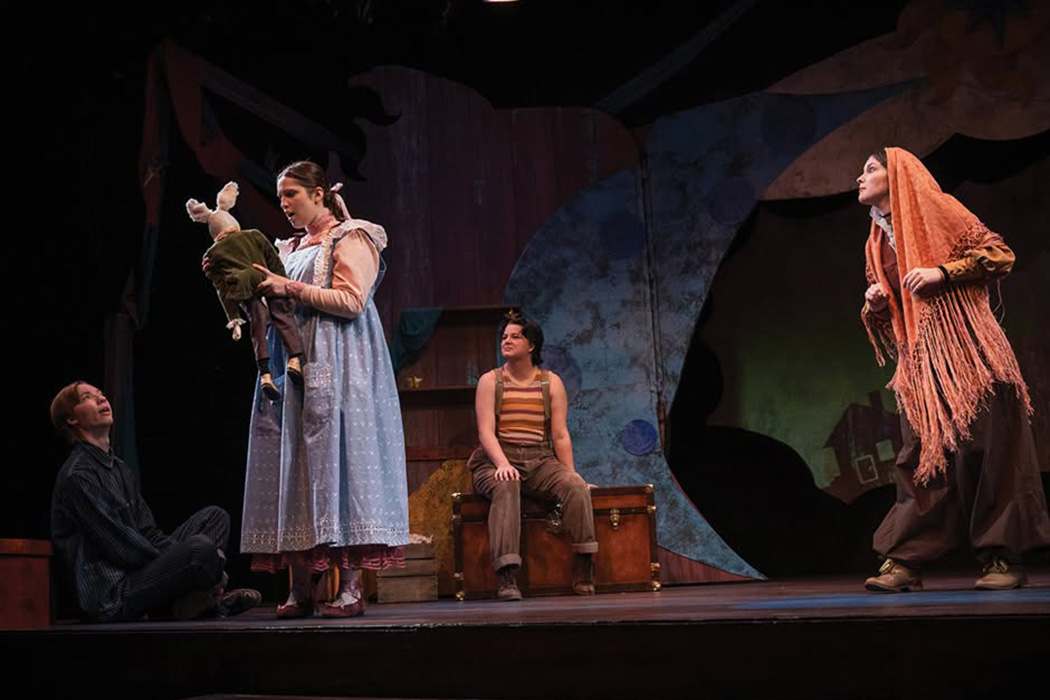
Life is a journey, it seems — even if you are a porcelain rabbit named Edward Tulane.
Adapted for the stage by Dwayne Hartford from the popular 2006 children’s novel by Kate DiCamillo, The Miraculous Journey of Edward Tulane, which opened in the Clarence Brown Theatre’s Lab Theatre last Friday, explores by way of some clever and theatrical storytelling the journeys we all take — some real, some metaphorical. This journey is one that is charming, moving, and poignant.

Directed with beautiful detail and necessary energy by UT Theatre faculty director Casey Sams, the story is handled by an excellent ensemble of only five distinctively different actors who otherwise take on a staggering number of different roles in Edward’s life. Officially, the roles are given ambiguous titles: The Traveler (Maddison Goerg), The Musician and voice of Edward (Hayden Springer), Woman (Mia Eller), Man 1 (Jackson Neilson), and Man 2 (Ava “Raine” Jensen).
Set in a timeframe of the 1930s and 40s, the story begins as a Grandmother gives a handsome china rabbit doll to her granddaughter Abilene as a gift. Abilene promptly names the rabbit doll “Edward Tulane” and sees to it the doll has clothes for every occasion—and lots of love. Of course, Edward cannot move, but that doesn’t prevent him from registering attitudes and opinions by way of Springer’s character. We find, like many humans, that Edward takes his luxurious life for granted—a bit smug, vain and overindulged, and self-centered.

Abilene and her family take a sea voyage to England, and naturally, Edward comes along. Unfortunately, Abilene and Edward are teased by other children on the ship with Edward being tossed around from child to child until a missed catch causes Edward to fall overboard only to sink slowly to the sea bottom. Deprived of his life of luxury, thus begins Edward’s adventure of identity that takes him to a fisherman’s wife, the city dump, a rescue by a dog and a hobo only to be tossed from a train, and more—all the while slowly learning about sadness, love and loss, abandonment, and belonging. “Does Edward find a forever home?” is a question that mirrors our own human existence.
In addition to the ensemble’s notable and charming—dare I say remarkable—performances, there was substantial atmospheric charm in the production’s stagecraft. The set by Arianna Reid is a beautifully textured creation that adapts to the multiple locations while gently guiding the audience’s imagination with visual suggestions. As one might expect, Dallas J. Cook’s lighting takes on a big responsibility in defining scenes and emotions—and delivers creatively. Adding greatly to the defining of locations and mood was Sound and Projections Designer Chance Beck. MFA candidate and Costume Designer Amelia Strahan succeeded in differentiating and describing the multiple characters through a myriad of costume changes—a grandmother, a young girl, a fisherman, a dog, a waitress, a doll restorer, and others, almost too many to count. And, as one might expect, there are multiple Edwards, no doubt thanks to Props designer Rachel Winenger.
Although one might consider The Miraculous Journey of Edward Tulane as a play with music (Music Director is UT Theatre faculty Terry D. Alford), this production has limited it to a few key song instances and background, among them guitar (played by Springer) and squeeze box (played by Neilson).
The concepts and charms of The Miraculous Journey of Edward Tulane are suitable for children of all ages. The production runs through October 18 in CBT’s Lab Theatre.
Tickets