It puts a knowing smile on one’s face to consider that Pyotr Ilyich Tchaikovsky’s Fifth Symphony was once criticized as “new music” that displayed “wild savagery” and harsh harmonies. Time marches on, and so has the public’s musical sensitivity, so much so, that the work is more inclined to elicit a shrug given its extreme popularity, rather than any doubt of its masterpiece status. Today, we are all too happy to embrace Tchaikovsky not for savagery, but for melodic lushness solidly supported by orchestration that is so instantly recognized and talked about. Obviously, that was the opinion of Maestro Aram Demirjian and the Knoxville Symphony Orchestra as they lavished heaping amounts of detail and beautiful playing on the Tchaikovsky Fifth Symphony on last week’s Masterworks concerts at the Tennessee Theatre.
The acoustics of the Tennessee Theatre simply adore works like the Tchaikovsky—surprising warm resonance for the low strings and low brass and a remarkable brightness for violins, woodwinds, and percussion. Starting with this, Demirjian established a presence that moved with an energetic heartbeat. Inevitably, discussions turn to the second movement where the famous horn solo cries out for poignancy and a luminous, heroic tone—and it received it from KSO Principal Horn Jeffery Whaley. I was also struck by the perfectly balanced clarinet echoes (Alex Chang) and more sparkle from the oboe (Claire Chenette).
The relatively short third movement (Valse: Allegro moderato) offered a pleasant change of mood, both in tempo and in character. Demirjian and the orchestra came through with just the right touch of waltz rhythm without losing the complex symphonic personality. The finale, of course announces itself in Tchaikovsky style from its very first notes that recall the noteworthy Fate Theme from earlier, so that there is no question as to the movement’s destination. While there is no savagery here, there are shows of ever-increasing strength, agitation alternating with grandeur and majesty. The big finish is just that, a finish that stirs the heart and banishes cares, at least for a golden moment or two.
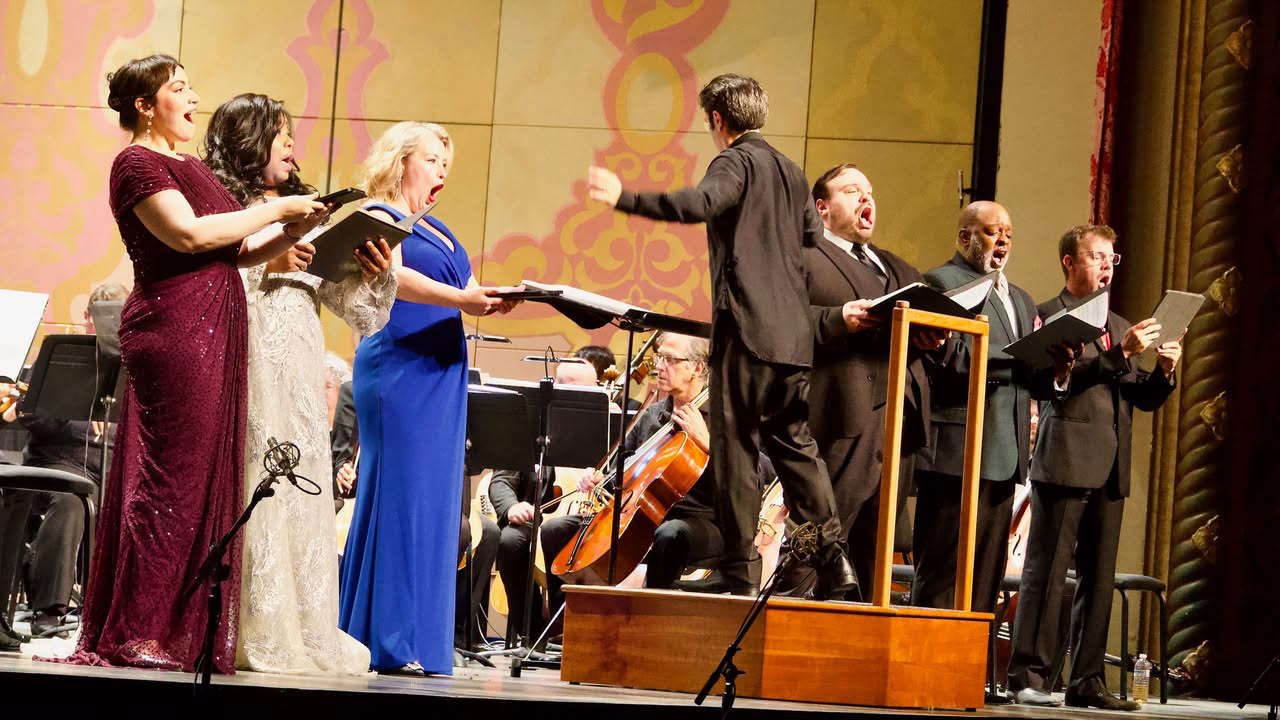
Occupying most of the first half of the concert was Leonard Bernstein’s Songfest: A Cycle of American Poems for Six Singers and Orchestra. Originally intended to be a part of the 1976 Bicentennial celebration, the work wasn’t finished and settled for a 1977 performance with Bernstein conducting the National Symphony Orchestra.
The 13 American poems that are the guiding structure of Songfest represent not only voices that were speaking for, and about, humanity and American life, but also Bernstein’s own personal beliefs. The poems run the gamut of style and intent—from poets as varied as Walt Whitman, Langston Hughes, Anne Bradstreet, e.e. cummings, Gertrude Stein, and Edgar Allan Poe—They reach deeply into the American experience—some are universal, others intriguingly specific.
The musical structure is equally symmetrical; there are six songs for ensembles and a solo song for each of the six singers. Bernstein’s score is nothing if not eclectic with the specific style of each song having the composer’s take on Broadway, blues, jazz, traditional Americana, and even 12-tone music. Ultimately, though, most listeners will judge the success of the work on how well Bernstein has communicated the personality of each poem’s voice with its respective orchestration.
If the audience was left wanting, that was certainly no fault of the six soloists. Notable here was an absolutely stellar group of singers assembled by Maestro Demirjian, some of whom were quite familiar to Knoxville audiences. They were: soprano Raquel González; mezzo-soprano Cierra Byrd; alto Renée Tatum; tenor John Overholt; baritone Stephen Salters; and bass David Crawford.
Demirjian opened the evening’s program with Ye, Who Seek the Truth, a 1952 work by the American composer, Julia Perry. Surprising in its simplicity and strength, the performance featured an arrangement for strings and harp by Jannina Norpoth, based on Perry’s original that was scored for tenor, choir, and organ.