In the wide—and often wacky—world of operetta, Johann Strauss’ Die Fledermaus (“The Bat”) occupies a singular position, happily standing apart from its fellow denizens of the 19th century. Although premiered in 1874 in Vienna, Die Fledermaus has evolved into a beloved vehicle used for supporting celebratory occasions by opera and theatre companies. The work has been subjected to a plethora of English translations over the years that embrace these occasions by taking substantial license with the original text, unabashedly twisting the libretto with comical anachronisms and local in-jokes, even inserting celebrity walk-on guests into the Act II party scene.
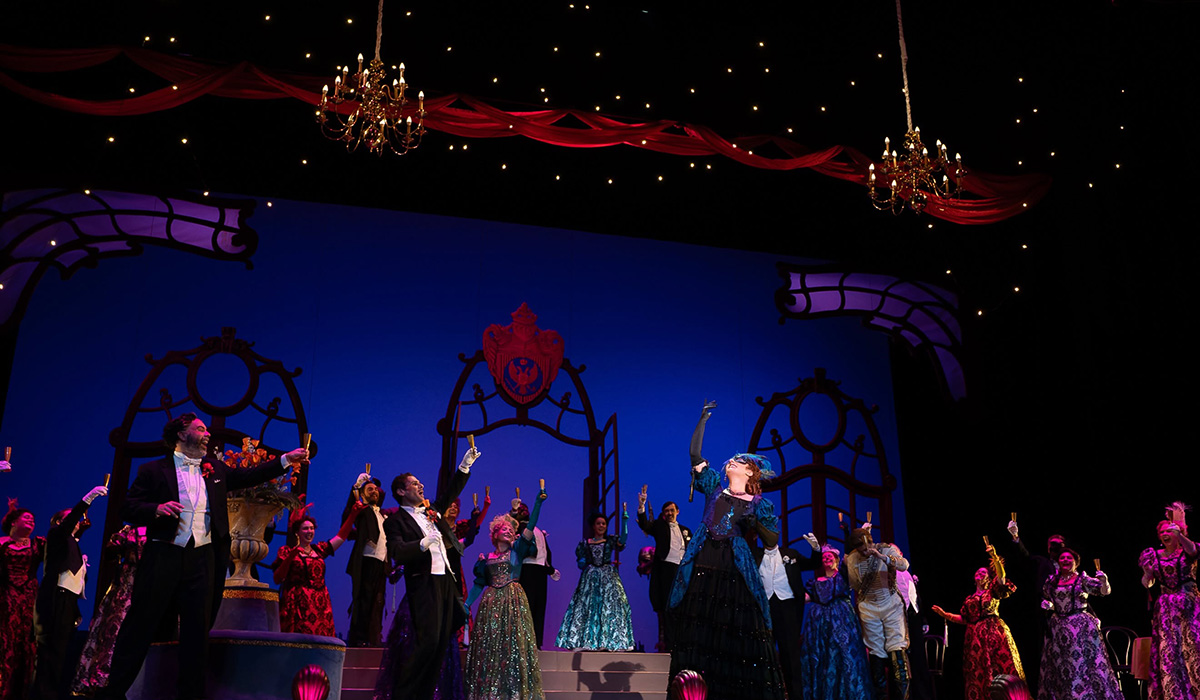
Interestingly, Knoxville Opera’s current production of Die Fledermaus at the Tennessee Theatre this weekend avoided the most extreme twists of staging and played it mostly straight, although “straight” still means a wild and mostly-rhyming English libretto chocked full of charming modern references. Stage director Dean Anthony has kept the comic pace tight and clean, using a set that facilitated the all-important snappy comic entrances and exits, and minimally suggested an opulent art nouveau period.
Particularly notable in this production was the Knoxville Symphony Orchestra in the pit, under the direction of conductor Noam Aviel. Beautifully balanced against the vocalists and paced with addictive sparkle and drama, the orchestral presence was certainly an essential key to this production’s success.
After the tuneful and waltz-y overture, the Act I curtain rises on the Vienna living room of Gabriel Eisenstein and his wife, Rosalinda, a couple whose relationship is torn by comical duplicitousness. Rosalinda is being serenaded by an operatic admirer, Alfred, who is hoping for romance. Meanwhile, their chambermaid, Adele, has her eye on a night off so she can attend a lavish party at Prince Orlofsky’s home. Complicating Eisenstein’s situation is the fact that he must surrender himself for an eight day jail sentence for insulting an official. Eisenstein’s friend, Dr. Falke, stops by to encourage him to delay jail and attend Orlofsky’s party with the promise of enjoying the company of ballet dancers. Of course, Falke’s real intention is revenge on Eisenstein, a payback for a practical joke played on him in which he was discovered drunk and pants-less in a bat costume in a public square. Much to his pain, Alfred becomes a victim of mistaken identity when jail warden Frank arrives and finds him wearing Eisenstein’s dressing gown. Alfred is carted off to the jail, instead of Eisenstein, leaving Eisenstein free to attend the party.
Most of the lead singers in this strong cast were making their debuts with Knoxville Opera, the exception being baritone Brian James Myer, who turned in a nice take on the marriage-challenged Eisenstein. Myer was heard previously as Mercutio in KO’s 2020 production of Roméo et Juliette.
Singing the role of Rosalinda was soprano Emily Margevich, her power and vocal sparkle giving the role an attention-getting focus. Her unfortunate admirer, Alfred, was sung by tenor Julius Ahn, a singer with a powerful edge that he beautifully adapted to making the comic role memorable.
A comic standout was soprano Rachel Blaustein as the chambermaid Adele, who once again floated her claim of a “dying aunt” in order to attend Prince Orlofsky’s party. And then there is Prince Orlofsky “himself” — a pants role sung by mezzo Kira Dills-Desurra — a parody of the European ruling class that is bored with life and that seeks excitement whatever the cost or expense.
Baritone Marcus DeLoach feasted on the role of Dr. Falke, artfully telling the tale of the “Bat” with a strong and arresting vocal narration. Similarly, Robert Mellon as the jail warden Frank, made a marvelous comic turn.
Sean Whitson (the wigged Dr. Blind), Meghan Cluskey (Adele’s sister Sally), and Lennon Schriever (Ivan) constructed their secondary roles with marvelous vocal and comedic stage presence. Of course, no Knoxville Opera production seems to be complete without stage director Dean Anthony in a comic role, this time the non-singing—and very drunk—jailer, Frosch.
A big plus for this production was the Knoxville Opera Chorus, under the direction of chorus director Christy Lee, that contributed serious backbone to the crowd scenes, notably the “Champagne Chorus” of the Act II party scene. And, deliciously, everyone seems to show up at the jail for the big finale. Operetta wouldn’t have it any other way.
Knoxville Opera’s Die Fledermaus has a final performance on Sunday afternoon at 2:30 PM at the Tennessee Theatre.