Good theatre, whether tragedy or comedy, is a journey for both the performers and the audience in which the destination is a matter of characters making choices for themselves that aren’t necessarily easy. That is certainly one of the sparkling attributes of Lynn Nottage’s Clyde’s, the current production in Clarence Brown Theatre’s Jenny Boyd Theatre. The journey here is the kitchen of a truck stop diner called “Clyde’s”, languishing in the rust-belt territory of Reading, PA. The four cooks, all of which were previously incarcerated for one crime or another, now make sandwiches for truckers and struggle against a system that seems to encourage recidivism. Despite the obvious makings for tragedy, Nottage has somehow turned her work into a comedy of hope that dangles the specter of poverty and homelessness as obstacles for the formerly incarcerated and offers up the quest for the ideal sandwich as a metaphor for freedom.
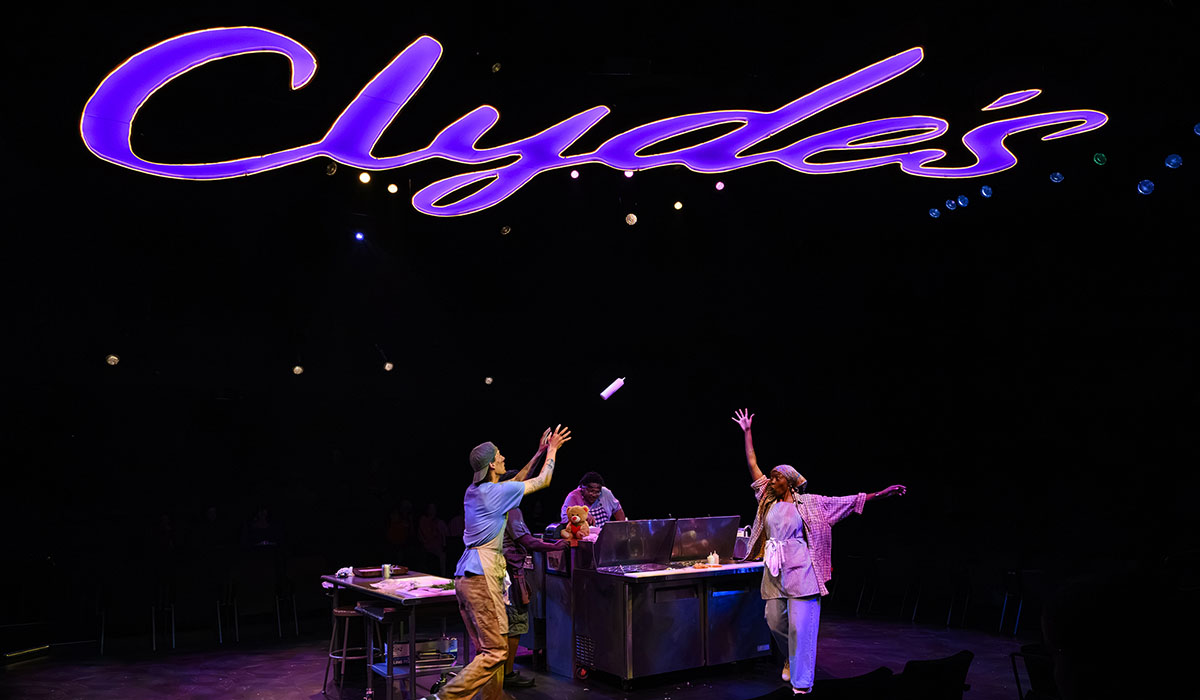
Miraculously, the one-act, 100+ minute runtime of Clyde’s flies by, its narrative pacing crisp and percussive. Director Katie Lupica has creatively configured the flexible black-box space of the Jenny Boyd Theatre into a complete surround arrangement that places the mostly-working professional kitchen prep equipment center, allowing the actors movement around it, all the while giving each character a bit of home space. This is a move that maximizes dramatic intimacy, but one that also brilliantly necessitates an almost choreographed movement of the actors that satisfies the needs of the audience and makes dramatic sense in delivering dialog. All the while, a giant “Clyde’s” sign looms over the actors, suggesting that they have traded one type of confinement for another.

Little by little, Nottage fills in the bios of the cooks, their crimes, and their journey, giving Lupica a lot of guidance in assembling this wildly successful and impressive cast. Letitia (the beautifully expressive Anquanizia Hall) broke into a pharmacy to get medication for her daughter and helped herself to some “oxy” on the way out. A gentle and hopeless romantic, Rafael (Izaiah Ramirez) held up a bank to buy his girlfriend an expensive puppy. Ramirez actually convinces us that this could happen. Montrellous (Kerwin Thompson) is quiet and subdued, even philosophical, owning the respect of the others for his ability to move past bitterness.
The newcomer to the group is Jason (Bryce Hagen), a character recently out of prison and sporting white supremacist tattoos. Although we are led to expect clashes with the other cooks, notably Letitia, he actually blends in quite successfully. The character of Jason was first introduced in Nottage’s previous play, Sweat. Although the audience need not know his background from Sweat, one wonders whether Nottage had a different plot in mind for him, as his presence seems less and less important as he becomes assimilated into the group and their premise-level fantasy quest for the perfect sandwich.

Something of a mystery herself is the diner’s proprietor Clyde (Shinnerrie Jackson) in a magnificently demonic performance. Either through a voice-over or an appearance, Clyde’s presence produces a cowering, cringing effect on her employees as they dread any interaction with her, even the mere thought of one. Adding to this effect is a costume change for each of Clyde’s actual appearances, progressively projecting more audaciousness and visual violence in an ever-increasing hatefulness. (costumes by Tori Niemiec) She roars insults and threats, making it clear that those who choose to stay and take her abuse, prove they really have no other options. It comes as no surprise to learn that she was also incarcerated, although it is only suggested what heinous atrocity she may have committed.
The set of actual restaurant kitchen equipment (scenic designer Kristen Martino) and the horizontal overhead “Clyde’s” sign was a marvelous tie-in to reality, something that is obviously necessary for this play. On the more abstract side, Miguel J. Santiago’s lighting made marvelously subtle mood adjustments and scene changes. Joe Payne’s music and ambient sound effects were the perfect atmosphere.
Of course, there is fantasy in the comedy of Clyde’s. In that world, resistance is not futile. It merely exists in a world where there is no punishment for being a dreamer and hope is what keeps it spinning. In this world, hell really is a ham and cheese sandwich on Wonder Bread.