When first announced by the University of Tennessee Opera Theatre, a production of Francis Poulenc’s Dialogues of the Carmelites at the Bijou Theatre seemed like a bold and challenging choice. As it turned out, that choice took big advantage of the company’s current wealth of women’s voices. And, it was a marvelous vehicle for minimal, but inventive staging.
Loosely based on an actual historical event—the execution of 16 nuns from the Carmelite convent of Compiègne during the French Revolution for refusing to abandon their vows and live secular lives—the 1957 opera has a modern dramatic arc, but looks to its more recent impressionist ancestors for its charming tonality. Interestingly, Poulenc’s orchestration varies over the three acts in its density and range, reflecting the movement from the secular world to the hushed tones of the convent. As a result, Act I and its brass-heavier orchestrations combined with the lower vocal ranges to present problems for singers being heard over the orchestra (conductor Kevin Class). With the less dense orchestration of Acts II and III, those vocal projection issues vanished.
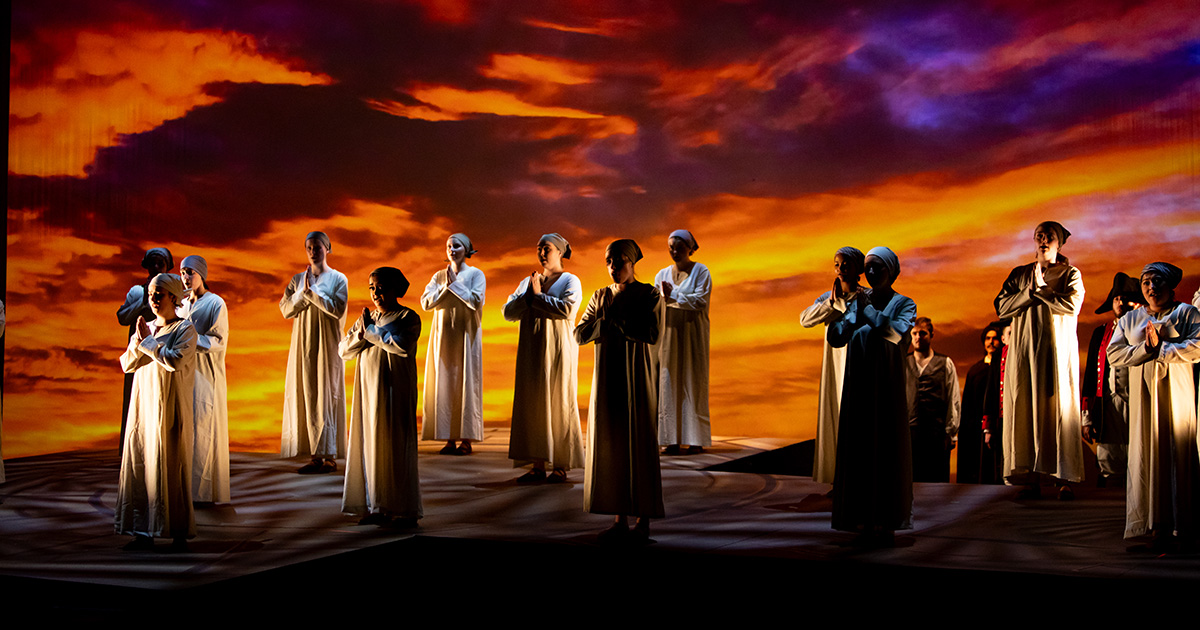
In order to emphasize the “dialogue” conversations between nuns on their internal struggles, stage director Scott Skiba has utilized a minimal physical world of a few items of furniture on a large cross-shaped platform skewed at a diagonal angle, backed by a full-width projection surface. Projection designer Brittany Powell Blaschke has chosen saturated photographic images of French historic interiors and exteriors to suggest the scene locations

As is their usual practice aiming for maximum performance opportunities, UTOT had chosen two casts of six singers each for the leading roles split over the four performances, with the remaining ensemble singers taking all four performances. The opera’s plot centers on the one fictionalized character, Blanche de la Force, a sensitive woman struggling with the fears, conflicts, and pressures of life despite her wealthy aristocratic background and family. In the evening cast, Blanche was sung by Nicole Dayton; in the matinee cast, Blanche was sung by Molly Garrett. In Act I, Blanche confides in her father, the Marquis de la Force (baritones Oliver Hassall/Deshawn Stevens), and her brother, the Chevalier de la Force (tenors Jackson Guthrie/Kurt Lannetti), her desires to enter a convent to escape her fear and anxiety.
As director Skiba indicated in his preview comments, the role of the Prioress, Madame de Croissy, is often cast with a mature veteran artist. But because of UTOT’s wealth of singing actors, they were able to cast the role with student artists (Jenna Moynihan and Meghan Krish). Of course, youth and vitality is difficult to hide with makeup and body language. As a result, a decision was made to present the Prioress as a younger person, cut down by a painful disease that requires—and receives—quite the dramatic performance.

In the one triple-cast role, sopranos Meghan Cluskey, Ashley Jones, and Emma Wilson took on Madame Lidoine, who arrives as the new prioress, selected from outside the convent. Mother Marie, the heir-apparent to the late Prioress, holds a bit of resentment at being passed over for the position, something mezzo-sopranos Staley Clark and Falynn Davis managed with nice subtlety. The talkative Sister Constance was given a chipper demeanor by sopranos Allie Thompson and Lindsay Dove. Tenors Tanner Smith and Jacob Rinke gave strong and likable faces to the role of the convent Chaplain.
It goes without saying that the most affecting moments in Dialogues of the Carmelites come in Act III when the nuns, forced out of their habits and into street clothes, face a martyr’s death and show their resolve to their principals of faith. In a finale that was as chilling and painfully eerie as theatre ever gets, the nuns, reduced to simple tunics for their deaths and singing “Salve Regina”, are symbolically cut down one by one by guillotine indicated by a tight downlight and a deafening metallic sound effect. As a result, it almost seemed wrong to applaud. But one is quickly reminded that this is theatre that deserves recognition.