Paul Thomas Anderson is the essential 90s student of cinema. His films have been overtly inspired by the grand ensemble piece works of Robert Altman and the dramatic highs and lows of Martin Scorsese’s storytelling. Anderson’s early works are exercises in flexing his bravura muscles with jarring camera movements and high-energy moments fueled by long, wide-eyed nights we can ingest from his erratic scripts.
Now, some nearly 30 years removed from Anderson’s epic portrait of a Singin’ In The Rain-inspired dive into the world of pornography, his latest film One Battle After Another has been one of the most anticipated films of the year by lonely 20-something’s who love to hit a couple repertory screenings at their local arthouse and those who follow this medium closely.
One Battle After Another feels like Anderson’s most personal film to date. Loosely adapted from “Vineland” written by Thomas Pynchon–whom Anderson has adapted from before–the newest film is a chaotic, crowdpleasing effort that can’t help but entice critics to use the word “timely”. The film follows Bob Ferguson (Leonardo DiCaprio) and his self-reliant daughter Willa (Chase Infiniti), the former being a past revolutionary with a group called the French 75, which mainly acted out attacks of detention camps along the USA-Mexico border and freeing many women and children from cages. The two live a nearly off-the-grid lifestyle until one of Bob’s evil nemesis, Col. Steven J. Lockjaw (Sean Penn) returns to try and clean up the consequences of his past.
Unlike much of the director’s former work, One Battle After Another features a nearly 40 minute prologue that feels like 5. The prologue is mostly backed by the electric performance of Teyana Taylor, who plays a character named Perfidia Beverly Hills that gets entangled with both DiCaprio and Penn’s characters. When Perfidia gives birth to a child presumed to be Bob’s, she begins to feel ostracized by the world around her. She doesn’t know if being a mother is her true calling in life and when a bank heist goes wrong, she is arrested by Lockjaw in a seemingly sexual exchange, forcing her to rat on the rest of the French 75. From here, she is put into witness protection but then quickly disappears, rejecting the mainstream American lifestyle. DiCaprio’s character and his on-screen daughter now have to go into hiding themselves, becoming Bob and Willa Ferguson and moving to a sanctuary city called Baktan Cross.
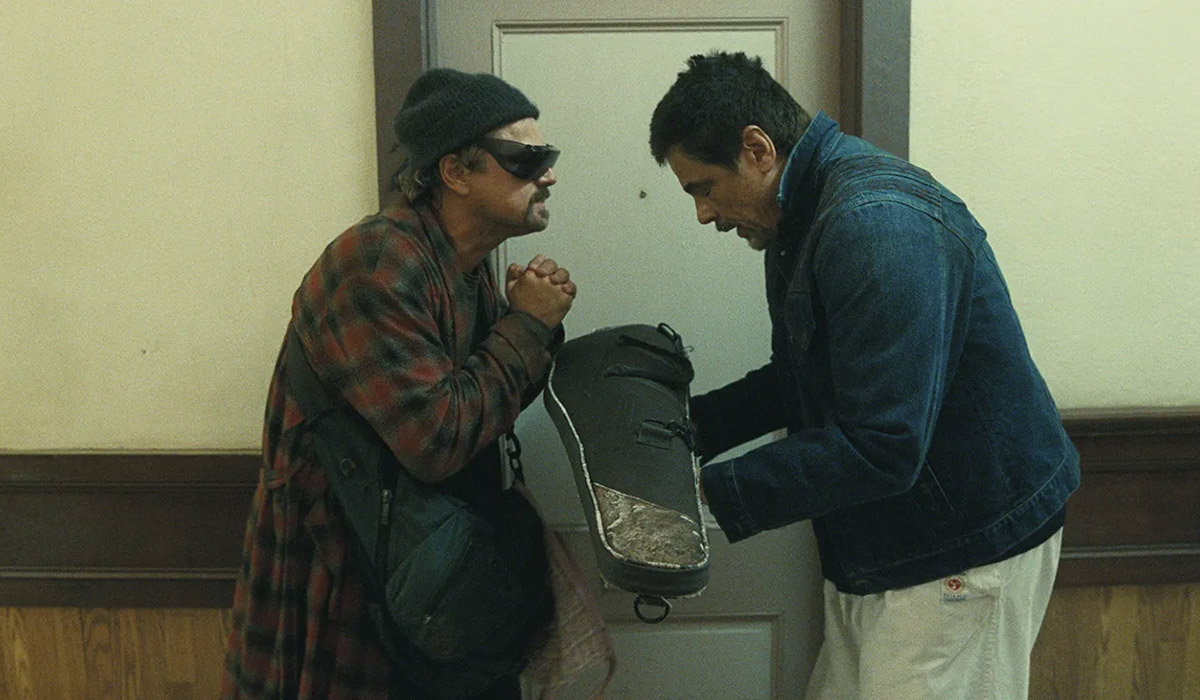
Then, we are transported 16 years into the future where Bob and Willa live an off-the-grid lifestyle where the former lives in a constant state of paranoia and has essentially fried his brain to forget about his past life. The first shot we see of Chase Infiniti as Willa is a close up of her face ready to prepare a karate move as Steely Dan’s “Dirty Work” begins to play. A bit of a tongue and cheek moment.
We finally get to learn a little more about Col. Steven J. Lockjaw in what is Sean Penn’s most haunting and comical performance to date as a xenophobic, high-ranking military official that is in charge of an ICE-like military sector that is allowed to bend the rules to make certain events happen. Geared up with his goons and a paternity test in a briefcase, his mission is to dispose of his potential mistake in Willa Ferguson. Lockjaw’s motives seemingly become aware as the Anderson film goes vintage Anderson as we learn about the “Christmas Adventurers,”-a secret society consisting of creepy white supremacists that are looking to rid the world of “lunatics and punk rock trash.” This is Lockjaw’s only purpose in the story, to be accepted into a club that quite literally greet each other with “Hail Saint Nick”. This is when the film goes full Pynchon.
What follows in the film is pure cinematic grandeur from Paul Thomas Anderson that is backed by frequent collaborator Jonny Greenwood’s erratic and tense score. The jarring keys of the piano as the title card appears 20 minutes into the film haven’t left my mind. Anderson and Greenwood’s aesthetically toned capabilities allow One Battle After Another to reach the paranoid heights on the same level as Alan J. Pakula’s iconic 1970s paranoia thrillers.
For Leonardo DiCaprio, this is only his fourth performance since 2019’s “Once Upon a Time in Hollywood,” where he plays washed up television actor Rick Dalton which has been deemed as one of his greatest roles. With ‘One Battle’, he plays a stoned father trying to erase his past who spends his days smoking joints and watching The Battle of Algiers—a notable influence for Paul Thomas Anderson. The casting of DiCaprio–who we’re used to seeing hanging out with Spider-Man and running around squirting water-guns at supermodels–is particularly interesting as the second half of his career has been dedicated to working with the finest of prestige directors and choosing the best scripts while picking up a hefty fee. This era has been dedicated to playing losers and deeply flawed individuals, it’s a total uglify of his persona. He’s the true last movie star.
At first, on the way out of my screening, I found myself incredibly hopeful of what I had seen. The ending is the most optimistic of Anderson’s efforts and deeply resonated with me. This is a film about your parents getting older and more conservative than they thought they would, as well as trying to find some sort of connection with their younger selves vicariously through their children. Lines of dialogue such as “I don’t get mad anymore,” feel so personal to Anderson. The auteur has 4 children of his own with comedian Maya Rudolph, and given the strong essence of mixed race relations in the film, it’s impossible to ignore the sentimentality of One Battle After Another.
The ending made me feel hopeful. It felt like saying goodbye to my parents as I went off to college or seeing friends for the last time without knowing it; the passing of the torch to a young person’s life as they begin to just figure all of this out on their own and maybe change the world. It’s a Gen-X love letter written by those who couldn’t make change and hope that the next generation can achieve what they failed. Last of all, the “American Girl” by Tom Petty needledrop brought tears to my eyes. Willa is the new American girl. She’s all of us in a lost world full of lost souls. My takeaway from Anderson is to be vengeful, keep your heart close, and hopefully change the world while you’re at it