Faith can be a safe haven for many of us, providing answers to life’s tough questions and a community to lean on. But just as often as it offers such answers, it can provoke just as many questions. This questioning is at the heart of Samuel D. Hunter’s 2016 play The Harvest, where a young man wrestles with the death of his father, his broken family, his faith, and his sexuality. Making his CBT Lab Theatre directing debut, David Ratliff constructs a cutting commentary on faith and fear that oozes with deep, emotional subtext. While watching a group of young adults search for their place in the world, The Harvest asks us to reflect on and appreciate our own.
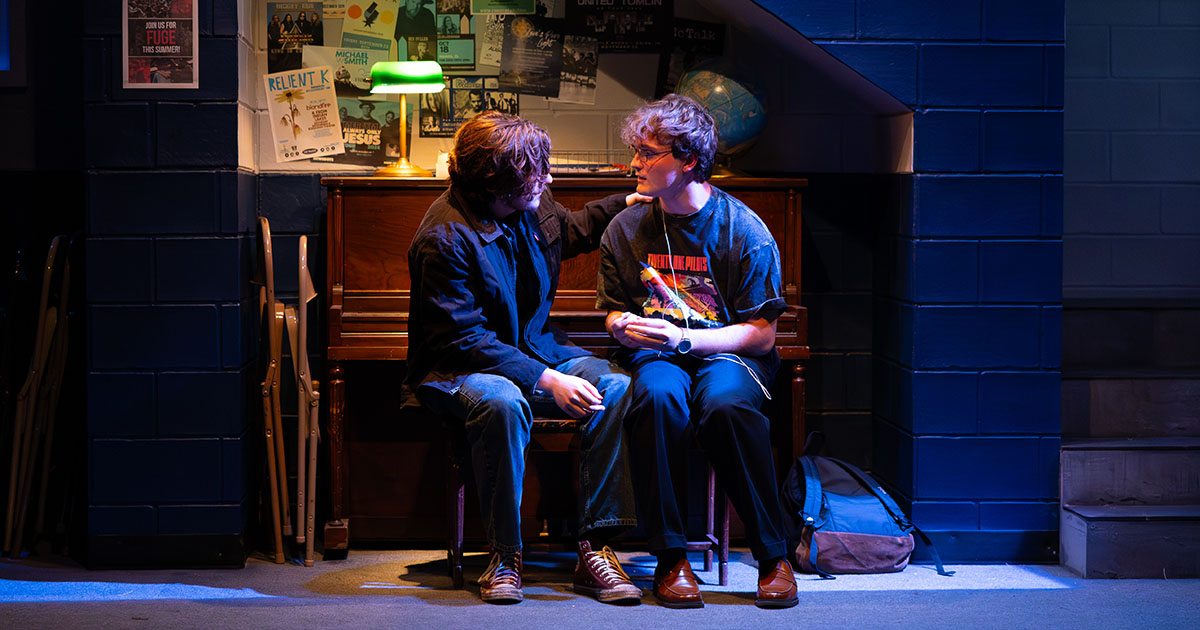
I was quite impressed by the scenic design of this production, courtesy of Leilane Bertunes. The Lab Theatre is small and dark to begin with, adding to the warm but cramped atmosphere the set design evokes. We feel as if we’re actually in the basement of the small church in which the action takes place, where a group of young missionaries prepare to travel to the Middle East. It’s every church basement you’ve ever been to: stacks of old, worn Bibles threaten to topple, a cluttered bulletin board hangs on the wall, boxes of board games line low shelves, and an antique upright piano silently awaits a player. The small details matter here: a few cutesy fridge magnets and polaroids tacked to the wall all help to visually communicate the relationships within this community of young missionaries. With cinderblock walls and coarse gray carpet lining the floor, it’s a familiar place that somehow welcomes the revelation of secrets and the telling of hard truths.
The Harvest opens with a riveting group performance where the six young missionaries—Ada, Josh, Tom, Denise, and Marcus—are engaged in prayer spoken in tongues, which is a current theme throughout the production. Josh plans to permanently stay in the Middle East, a decision which his fellow missionaries highly encourage. However, his estranged sister, Michaela, refuses to allow him to go. The mission trip seems to stir up more than evangelical excitement for the group, as each member wrestles with their own personal convictions and crises of faith as the clock ticks toward departure.
Theodore Chase Raynor as Josh has a quietly brooding quality, where powerful bursts of anger and fear rest just beneath the surface. He brings a deceptively desperate energy to his role that crescendoes at the emotional climax of the production. Tyler Monroe is stellar as Tom, Josh’s closest friend who seems to harbor a deeper emotional, if not romantic, attachment to Josh than he lets on publicly. He pretends to be someone he’s not, which manifests as an intense anxiety. Monroe is vulnerable yet cautious in this role, and you can hear his heart nearly breaking in some of his most tender lines. Together, Raynor and Monroe are simply electric, delicately dancing around the confusion and fear that their chemistry creates.
Madeline Joyner as Michaela is rough around the edges but has a heart of gold, and while she elicits a few laughs from the audience through her unfiltered reactions to the absurdity of Josh’s situation, her power lies in her moments of frustration. Orianna Stephens as Ada is the too-perky-to-bear leader of the pack, and she captures so well the slightly manipulative charisma that makes her character so delightfully repulsive. We sort of want to hate her, and it’s fun to do so. Izzy Monti-Chapple as Denise and Donte Tolson as Marcus are surprising stand-outs even in their more minor roles; playing young married couple expecting a child and anticipating all the issues that would introduced to a 4-months mission trip halfway across the globe, Monti-Chapple and Tolson walk a fine line between jocularity and criticism, their interactions laced with a bitterness that both are at times too afraid to fully confront.
Toward the end of the production, we finally encounter Pastor Chuck, the head of the church who has been mentioned in passing but never present. Jimmy Sherod as Chuck is perhaps too gentle in this role. A tense sense of authority has been built from discussions of Chuck from the young missionaries; they are too eager to please him, afraid to disappoint, especially when it comes to the upcoming mission trip. But when Sherod finally enters the scene, that anxiety wasn’t as tangible as I was expecting. I wanted to be afraid of Chuck, especially as he confronts Josh and Tom after catching them in physically close contact. Neither his sneaking suspicion of Josh and Tom’s relationship, nor any disapproval of it, was evident in the delivery of his final monologue. Sherod’s acting is technically adept but missing a bit of pious and self-righteous disapproval that would tie together the play’s bigger themes of religious anxiety.
The Harvest runs through Nov. 9 at The Lab Theatre with showings on Tuesday–Saturday (no performance on Friday, October 31) at 7:30pm and matinees on Sunday at 2pm. Tickets are available at https://clarencebrowntheatre.com/shows/the-harvest/.