For three nights only, First Take Co. and Fable Hollow Bookshoppe hosted an interactive and gamified theatrical experience, In the Castle of Eternal Sunset, a new play by playwright Charles Green. The play incorporates the chance elements of the popular tabletop role playing game (RPG) Dungeons & Dragons (D&D) into the play’s narrative building and storytelling. After all, D&D is a form of theatre in its own way, and In the Castle of Eternal Sunset expands that experience for up to 20 audience members to participate in that storytelling in low-stakes, randomized moments—effectively dictating the futures of the two boys whose D&D campaign we witness onstage. Director EG Roeder crafts an immersive, innovative experience that is sure to be a treat for anyone, but especially for fans of D&D and interactive theatre.
In the spirit of maximum theatrical immersion, I elected to partake in all the fun offerings this event provided. First, I opted to be a participant in the readings for the performance.
Once settled in with my booklet, I stopped by Fable Hollow’s coffee bar and ordered a Health Potion, a cherry vanilla soda created specially for this event. It’s a sweet and refreshing drink and kept my whistle wet in case I was rolled to read, (which I was!) so I was glad to have my Health Potion on hand throughout the night. Audiences can also choose from any of Fable Hollow’s drink menu items; as it was a biting cold night, I saw many ordering hot coffees and hot chocolates, as well.
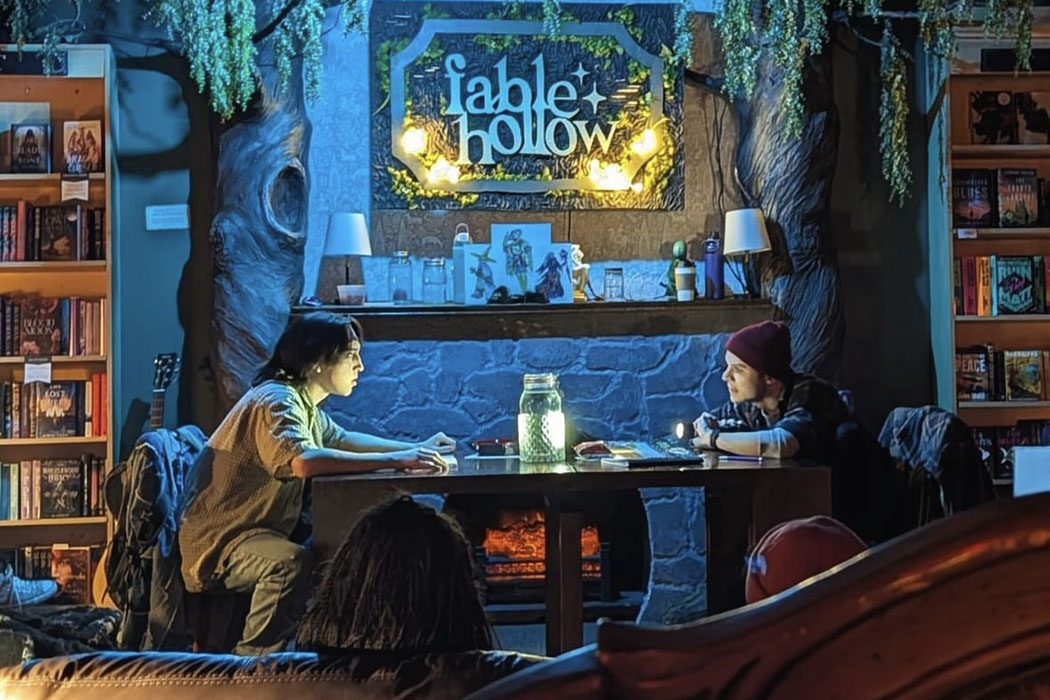
In The Castle of Eternal Sunset is a quick little play, running just under one hour, and was very well suited for production in Fable Hollow. If you’ve ever visited the location, you know there’s a cozy fireplace in the back with a decorative tree branching out and over part of the room beyond the fireplace; this area was set up with two chairs and a small table, a few notebooks, a bag of Doritos, and various tabletop RPG accoutrements like a leather dice tray and the essential d20 die that is central to how the story unfolds. And while the setting wasn’t the grungy basement vibe that we might associate with D&D players (thanks, Stranger Things), it was cozy, subtly whimsical, and intimate—with that last descriptor being the heart of what this play is about.
It is important to note that this play encourages you to play. Just like the game that is unfolding between the two boys on stage, audiences have the opportunity to engage with the storytelling and the collective construction of intimacy. Upon entering the theatre space, audiences choose whether they want to participate in the play, and participation is simply the chance to read from a provided booklet; depending on the roll of the d20, you may or may not need to read from your booklet. Each of the 20 booklets (one for each number on the d20) is unique, containing different snippets of story; no two booklets have the same snippets.
The “main” plot follows two boys who sit down for a session of a D&D campaign. Brady Craddock plays the Dungeon Master, the leader and constructor of the campaign’s events, and Hogan Wayland plays “the player,” the adventurer in the campaign. Craddock and Wayland both evoke a time gone by, an early 90s, grungy, pre-internet-age exploration of imagination, friendship, and bonding. The events of the campaign itself help to construct each character’s personality and subtly inform the audience of their relationship in the present; the two boys are at times collaborative, at others antagonistic, flitting between moments of solid trust, sly betrayal, and mutual admiration at each others’ impromptu decision-making and creative descriptions of action. Craddock and Wayland are quietly authentic and the relationship feels true-to-life—anyone who has played D&D with close friends has had this experience.
Each time the boys roll a “saving throw” for a major plot event in the tabletop campaign, an interlude takes place that dives deeper into the boys’ relationship and explores their future. These interludes are highly abstract and poetic and where the audience interaction comes into play: the audiences read imagistic snapshots of the boys’ backstory, revealing vague yet intimate details about their life, their hometown, and their small place in the world as they navigate change and growing up. While the d20 die dictates which audience member reads, a single colored light bulb hanging from the tree’s branches indicates which portion of the booklet is read, with a total of eight colors indicating eight reading moments. Audiences locate the correct reading when the color changes, and when the light brightens, they prepare for the roll and to be selected to read aloud.
While the audience reads, Craddock and Wayland perform dance-like, trance-like movements beneath the colored light, incorporating almost everything on the set into the performance—the table, chairs, and each other. It’s beautiful, powerful, and evocative, and both actors move with such grace, tenderness, and even aggression throughout these segments. These dance-like performances provide a needed physical, embodied context to the poetic readings described by the audience, and the whole theatrical space is awash in colorful, moody lighting. The most powerful moment was toward the end, when Craddock and Wayland’s performance synched for the first time with the music and rapidly-changing lighting during one of the many potential climaxes to the randomly unfolding story. As each reading dictated by the die, each experience of this play is truly unique. And while the interactive element of Castle is low-stakes, audiences should attempt to read as loud as they can, projecting so that others on the other side of the room can fully resonate with the reading. I felt like I occasionally missed plot points or imagery during the interludes because some readers were not loud enough, and there is no way to “read along” as each reading is unique. You might get lucky to have the same segment as another reader, but more than likely you won’t; I only matched up with one other reader the entire night.
Surprisingly, my number (20, a critical roll in D&D) was rolled for the very final interlude, and I enjoyed the experience of reading an element of the boy’s story and participating in the world-building of Castle. There are over 400,000 potential combinations of randomly-rolled audience readings, and at the end of the show, EG Roeder hands you a commemorative card where you can write down the date of the performance and the “saving throws” that occurred during your Castle “campaign,” documenting your unique experience of the night.
In the Castle of Eternal Sunset ran for three nights only, January 15, 16, and 17, before making its way to The University of the South in Sewanee, Tennessee, for a university tour. All showings of Castle have sold out, but after the final performance on January 17, playwright Charles Green is facilitated a post-show Q&A at 8pm which was open to the public. Fable Hollow Bookshoppe is located at 2910 Tazewell Pike Suite A. More info about Castle and the playwright talk is available at https://www.firsttakeco.com/concepts/castle or on First Take Co.’s Instagram @firsttakeco.