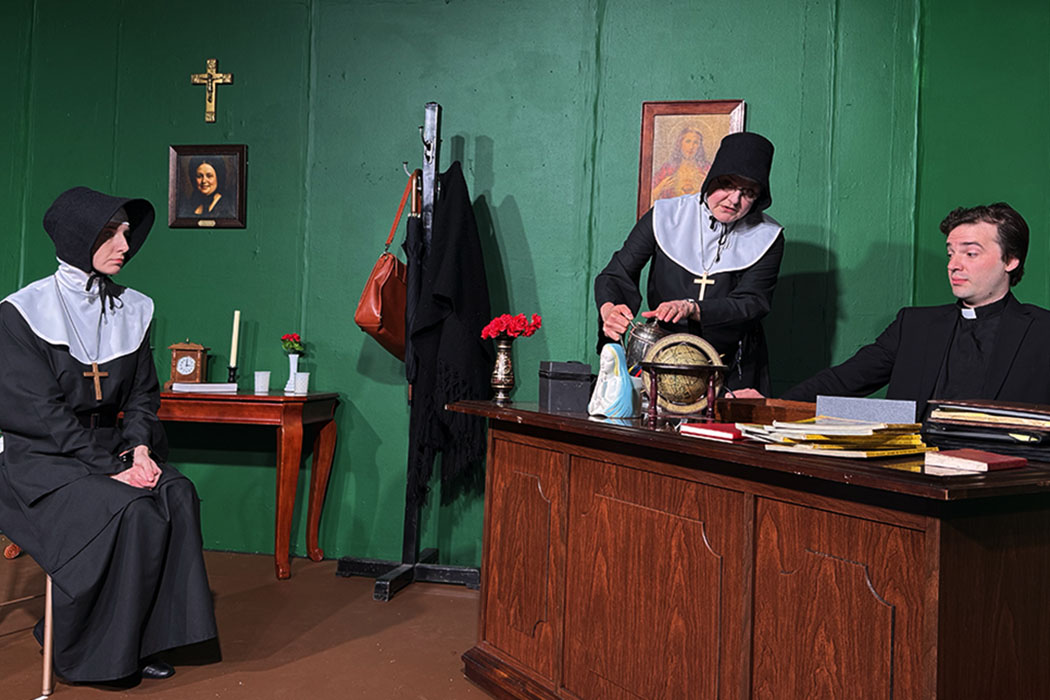
In the opening monologue of John Patrick Shanley’s 2005 Pulitzer Prize and Tony Award winning Doubt, A Parable, Father Brendan Flynn (Ben Park), priest of Bronx Catholic school St. Nicholas, delivers a sermon about the feeling that makes up the play’s title: “Doubt can be as powerful and sustaining as certainty.” When St. Nicholas Principle Sister Aloysius (Jennifer Pagnard) begins to suspect Father Flynn of inappropriate conduct with 12-year-old Donald Muller, the school’s first African American student, Father Flynn, Sister Aloysius, young teacher Sister James (Shelby Frye), and Donald’s mother Mrs. Muller (Jae Campbell) must confront their own doubts and certainties. Director Sarah Campbell crafts a memorably ambiguous production of Doubt, inviting audiences to sit with their own discomfort.
Audiences are welcomed to the TKD playhouse by a light blue curtain drawn across center stage and awash in blue, red, and purple lighting. Tranquil, atmospheric music plays and is occasionally punctuated by the sound of children laughing and playing in the distance, as if the school day at St. Nicholas is in session. It’s moody, but perhaps not moody enough, and I was expecting something a bit more gothic, a hair more sinister considering the events that follow. On the bright side, Lighting Designer Zoe Jurgensen’s choice to illuminate the audience during Father Flynn’s sermons was an interesting touch, making the audience feel as if they are the congregation.
Director Sarah Campbell also served as costume designer, and costuming was a bit, well, costumey. But vestments are a sort of costume, so the choices are forgivable, and Campbell’s use of shawls for the exterior scenes softened the costumey look a bit. Occasionally the brims of nuns’ bonnets obscured their faces, making it harder to see their facial expressions, but Mrs. Muller’s costume of a simple coat and matching pillbox hat felt period-appropriate and was the most realistic out of all the characters. In one scene, Sister Aloysius’s back was turned to the audience as she spoke with Sister James while tending to a dying plant. Blocking in most scenes was effective and notable, especially the scenes taking place in the courtyard of the parish; with only a drawn blue curtain and a simple bench to signal these scenes, the actors had to perform at their best to make up for the simplistic backdrop and lack of props to interact with. However, in one courtyard scene, Sister Aloysius’s back was turned to the audience as she was speaking to Sister James, and some of her lines were obfuscated by the blocking.
Father Brendan Flynn is one of those ambiguous characters who can be played a variety of ways, informing the mystery of the plot as it unfolds. Park’s Father Flynn is understated; there’s an innocence to his performance that complicates how we view Flynn. His monologues are nice and preachy and slowly grow to a crescendo of secretive, cutting intentionality. He slowly builds a momentum—nearly an argument—for that misplaced innocence. His performance encourages us to sympathize at times with Flynn, a hard task to ask for in this play. And there’s even an ambiguity to his final solo scene, as he sits alone in Sister Aloysius’s office with tears in his eyes and a pained look on his face: is he angry? Broken and defeated? Park’s final moments border on prayer, perhaps even confession, and leaves us guessing.
Pagnard as Sister Aloysius is commanding in her self-assured and slow delivery; she makes sure you hear every single word and take it to heart. While at first she comes off as overly controlling, Pagnard shines in later scenes with Campbell and Frye when Sister Aloysius is forced to make her case for her suspicions of Father Flynn. There’s an unwavering conviction in her delivery and bodily movements, her navigation of the stage and set, that comes crashing down so powerfully in the final scene. Pagnard maintained a subtle Bronx accent throughout the performance, which is notable. She hit that Goldilocks sweet spot with the accent, and occasionally played it up for a few well-timed comedic moments. I could tell that the early moments were supposed to be funny, but the audience didn’t warm up to the humor of the production until roughly halfway through the performance. But it can be difficult to incorporate humor into this play due to its subject matter, but we did get our laughs at Sister Aloysius and Sister James’s interactions.
Frye’s Sister James is at times painfully timid and awkward, eager in that sort of naive, rose-colored glasses way that is slowly eroded throughout the reveal of the St. Nicholas Parish and School conflict. They lend Sister James an air of intentional innocence, a self-protective measure against the suspected but never outright proven horror, a shaking of her psyche and worldview. Frye communicates this well with their body language and blocking, nearly constantly twisting their hands and their face. Sister James is uncomfortable, and Frye forces us to share that discomfort with her. And Jae Campbell’s Mrs. Muller, while in just one scene, was a moving performance laced with her own unique convictions that conflict harshly with Sister Aloysius’s. Campbell and Pagnard’s scene together is a battle of wills and cross-understandings, each woman with her own version of the story and her own choice of belief. They both share a deep care for Donald, but approach that care from drastically different experiences and perspectives. It’s painful in the best way—they both want the same thing, but neither of them realizes it. A creeping sense of helplessness takes over as the resolution to this mystery feels further and further from anyone’s control.
Doubt runs until February 1st, with showings on Thursdays, Fridays, and Saturdays at 7:30pm and matinees on Sundays at 3pm. Tickets are available at the TKD box office at 800 South Central Street or online at https://theatreknoxville.com/doubt-a-parable/.