To ChatGPT, or Not to ChatGPT. That is the existential question plaguing many of us today now that Large Language Models (LLMs) like ChatGPT, Claude, Grok, and Gemini have become more and more unavoidable. From using LLMs for simple internet searches and writing work emails to handling difficult text conversations or even finishing term papers for college courses (as an English professor at UT, don’t get me started on that last one!), humans have seemed to embrace the technology to do one of the most human things we’ve done since we’ve had the ability to do so: write. While many artists have raised blazing torches and pitchforks against the technology, Next Rung Productions poses Generative AI’s fraught relationship to the arts in the form of a challenge: to test its capabilities and our understanding, identification, value, and relationship to its output. Thus, Next Rung Productions, spearheaded by Harrison Young, took confronting AI in the arts to the next level with Page Against the Machine, an evening of exciting experimental play-doing that pits the human mind and creativity against our modern-day digital adversaries.
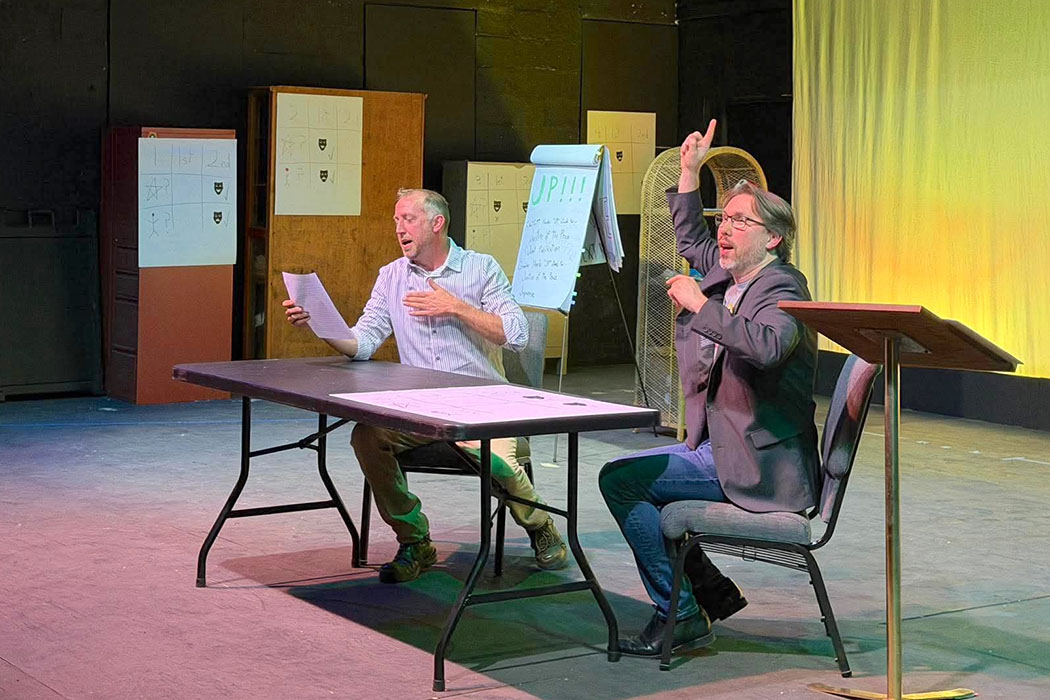
Page Against the Machine was a one night event hosted on Friday the 13th (spooky!). Defining it proves tricky: part game show, part experiment, part showcase of local playwrights and actors, it was a fun and informative community moment, where many in Knoxville’s local theater scene came together to experience and confront AI head on. The crux of Page Against the Machine was this: in nine separate rounds, audiences were presented with two monologues delivered on stage by local actors. However, the hitch was that one of the monologues was written by AI, the other a real local, human playwright. After the monologues were performed, the audience voted twice: first on which monologue they preferred, and second on which monologue they believed to be written by the human playwright. Occasionally, the vote was clearly in favor of one monologue over the other; at other times, the margin was razor thin, with only a few raised hands making the difference. Page Against the Machine as a community experiment showed us in real time just how impressive LLMs can be and how difficult it can be to distinguish between LLM output and human creativity.
According to the Pew Research Center, in 2025, around 58% of adults under 30 years old, 41% of adults from 30–49, 25% of adults age 50–64, and 10% of adults age 65 and older have reported using ChatGPT at least once. It’s popular, prevalent, pressing, and especially for artists whose work and livelihoods have come under threat of replacement from Large Language Models, a bonafide digital plagiarist. Our work, our words, feel less and less special and important when one can pull up a webpage in our internet browsers, type in a quick 15-word query, and have the LLM crank out a fully-formed monologue, scene, or even a whole play in a fraction of the time it would take us to write the same content.

Photo Victor Agreda Jr.
The event opened with a short interview with special guest Chris Craig, a digital security specialist who has worked at Oak Ridge National Laboratory and now at Amazon. Craig set the stage for the evening’s events by opening a few philosophical questions and concerns about AI usage and its future. We were then introduced, round by round, to a team of local playwrights and actors who wrote and delivered the series of monologues throughout the night. Local talent was undoubtedly on display—actors Holly Andrew, Greg Congleton, Sara Gaddis, Margy Ragsdale, Lisa Silverman, Craig Smith, Vishal Verma, Virginia Vogt, and Chris Weathers gave solid performances of the short monologues which ranged from 100 to almost 300 words each.
Our featured playwrights, including Summer Awad, Jeannette Brown, Stephanie Hall, Raine Palmer, Linda Parsons, Robert Rupp, JP Schuffman, Barry Wallace, and Harrison Young, were each given a unique prompt and were asked to write a monologue from that prompt. Prompts included instructions to “write a 150 word monologue to be performed by a woman on stage about love” and “write a 300 word monologue to be performed on stage by a man and set in a garden by a graveyard.” A LLM was also given that same prompt, and some rounds were more “challenging” than others. Sometimes, a particular round allowed a revision for both the LLM and the playwright or the LLM was queried 3 times and the best output selected to be read. And other times, the very first output was used, no refining or revising allowed. And even at others, Young himself revised or rewrote the LLM output and fed it through again. Each round was a challenging mix of LLM involvement and tweaking to test the limits of what the technology can do and our ability to detect its influence on the monologues.
As with any game show, we kept score, and human creativity was the victor for the most part; out of the 9 monologues, our dear audience preferred 7 of the human-authored monologues and only 2 of the AI generated ones. We also correctly identified 6 of the human monologues, and only twice did we incorrectly attribute human origin to an AI monologue. And even poor Young was victim to our discretion, much to his chagrin: we preferred an AI monologue over his original, as well as misidentified an AI monologue as human in his final, 3 monologue closing round.
But even if that hurt a little, it was an impressive learning and growing moment for everyone involved—host, playwrights, actors, and audience. A quick little talkback after the show proved that people were interested, invested, and involved. Described as fascinating, thought provoking, and fun—some of the more interesting responses included “a tooth-and-nail battle between meatsacks and robots” and even “Terminator 2 meets Shakespeare”—Page Againt the Machine allowed us all to see more clearly not only the limits of the LLM technology but also the limitlessness of human creativity. We humans can ignore a prompt, can think outside of the box, and can revel in the experience of creation and the journey toward the completion of art, rather than focusing on product and output. And as we were leaving, people were nearly begging Young to host another event like this: to continue the testing, continue pushing limits, and to continue to engage and explore what AI can and cannot do. Ultimately, even with AI involvement, Page Against the Machine was a celebration and testament to human creativity that is alive and thriving here in Knoxville, and I do hope there is much more to come.