It was a strange day in Nashville this Monday — the Country Music Awards Festival-goers were heading out of town (thank God!), there was a flood warning and sunshine all within an hour, and elsewhere, the New York Knicks were playing their first NBA Finals home game since 1999, which is nearly the same amount of time that Steven Spielberg last got his hands on a juicy piece of science-fiction — of course, I’m talking about A.I. Artificial Intelligence (2001) – not whatever Ready Player One (2018) was.
Alas, in between the speakers of Nissan Stadium blaring Ella Langley to the complete shutdown of Manhattan so the President can sleep through a Knicks game, my experience seeing Spielberg’s latest adventure, Disclosure Day, felt like I was rediscovering my obsessive love for not only film … but … life … community? I don’t know. Maybe I should stop watching David Foster Wallace interviews and focus on my calorie deficit.
Aside from my cynical, dorm-room-philosophical views on the world that I’m just always right about—aside from some mild story mapping quibbles—I really liked the new Spielberg joint.
Disclosure Day comes from a story by Steven Spielberg — opportunely made with an iPad? — but with the screenplay written by longtime collaborator writer David Koepp, this feels like an eclipse of what makes both of their strengths so great. It’s a film that deserves a sort of blindness when you’re sitting down with your popcorn and Icee on Friday night. There’s an excuse to be ignorant to the brief Wikipedia definition and just let Spielberg’s spectacle tickle your brain and open your heart.
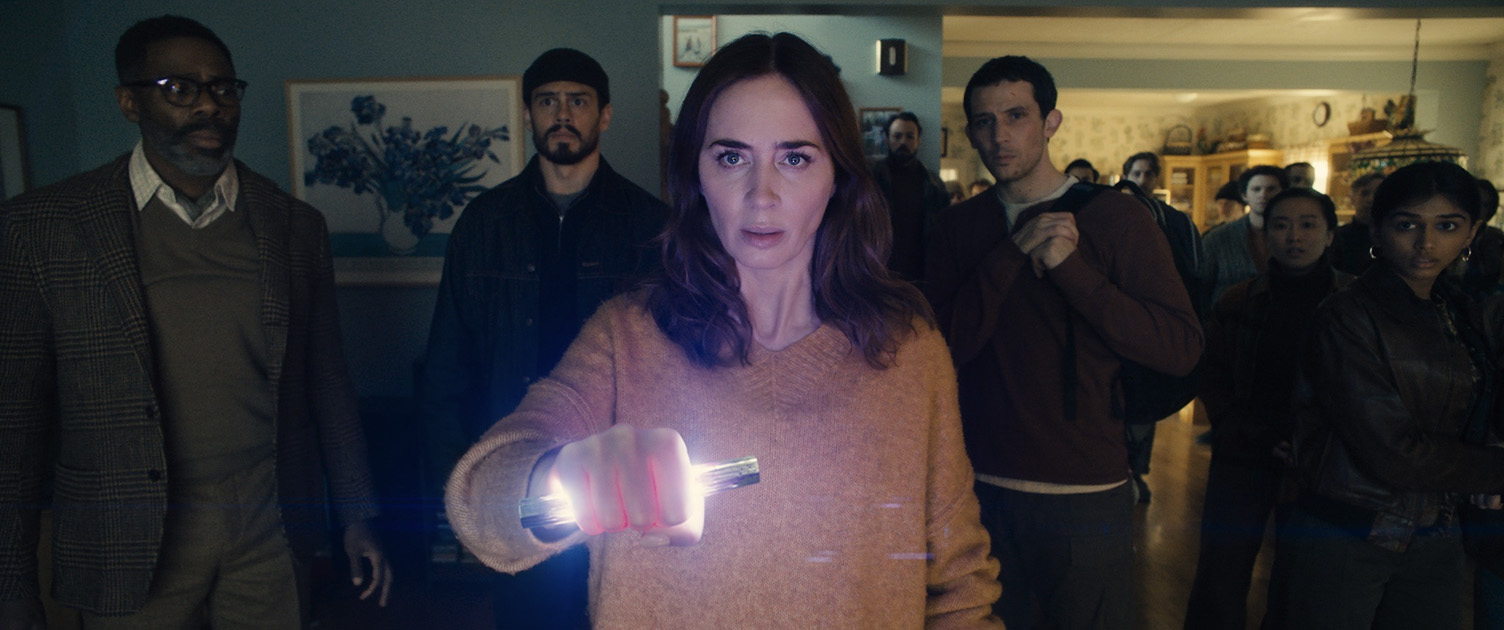
Spielberg’s new sci-fi addition centers around the lives of two people, one being a targeted cybersecurity whistleblower played by Josh O’Connor and a meteorologist played by Emily Blunt. Both characters are connected in unprecedented ways and go on the run together to reveal extraterrestrial life to the entire world. The opposition is a murky government subset led by Colin Firth that does everything in their power to silence them before order is upended across the entire world.
Our movie star here is Josh O’Connor, a favorite of mine for his independent work and erotic indulgence of a churro in my best film of 2024, Challengers. I must say, it was a bit of a surprise to see the usually quietly sexy and confident O’Connor cast in a Spielberg film made for blockbuster consumption, yet, he really transforms his soft presence into a stiff, Harrison Ford-esque performance.
Our main standout, though, is one of Emily’s herself, Emily Blunt — who plays a meteorologist for a local Kansas City NBC affiliate who, after an encounter with a Cardinal, begins to speak Korean and … calculus? Within an hour, I felt this was the strongest Blunt has ever been, especially after a rather mail-it-in legacy sequel returned in The Devil Wears Prada 2. I can’t imagine a better addition to her filmography than this. She’s the emotional, godlike core of a film that can feel a bit messy in its plot mapping at times. Every time she’s on the screen, the picture is radiant.
The film follows a mapping of characters where I couldn’t have been more reminded of another certain film that came out the last time the Knicks made the NBA Finals — that being Paul Thomas Anderson’s sprawling epic, Magnolia. Disclosure Day lacks a prologue (in pure David Koepp fashion) and plops you right into that rigid perfectionist blocking that Steven Spielberg so effortlessly accomplishes.
I’m 25 years old, so I was only a little guy in a cradle as my mother folded clothes in our Rhode Island household when planes struck the Twin Towers on 9/11. Aside from missing something that shook the core of every American, Disclosure Day feels exactly like something that would be categorized as a post-9/11 cinematic expression. Spielberg is not only interested gravely in the community, but something is getting to him right now at the age of 79 (late style wins again).
The film, set in current times, is Spielberg’s ultimate commentary on whatever the hell is going on in our world right now. He’s fearful of A.I., government cover-ups, silencing journalism, and a mass digital age where our heads seem to be down 50% of the time. Spielberg is indulging into the Alan J. Pakula school of paranoia. But, when you lift the veil and get to those last poignant 45 minutes of Disclosure Day, the maestro is actually quite hopeful for a sudden change in history, which the film alludes to several times. This feels like Steven Spielberg moving forward. Whether or not it’s the pandemic or rising gas prices or defaulting mortgages, life in the 2020s can feel bleak. Yet, on a random Monday in June 2026, I can get a chicken caesar wrap while dodging rain, watch a new Steven Spielberg film in theaters with my amethyst water bottle, and then cap it all off by watching the 4th quarter of an NBA Finals game in the most iconic arena in sports with thousands of fans inside and out coming together for 5 guys running around on hardwood. Life moves forward regardless of our surroundings.
Community is not lost, it’s ourselves who are lost in this data center hell-scape we seem to be descending into. With all of that said, in a theatrical movie going climate that can feel a bit “eventized” (butt hurt as I had to pay $40 for a ticket to The Odyssey even though I have Regal Unlimited), Disclosure Day simultaneously plays like something I’ve seen before yet doesn’t feel like its trying to get you to latch onto some blurb of nostalgia. Sure, sometimes the characters can feel a bit flat, but so can we ourselves, especially if said characters have psychic-like powers as a government tries to kill them.
Of course, somewhere in the middle of this madness, my seat-neighbor turned to me and said something along the lines of “I’m not sure about this one,” — that’s okay … who is? Much like the prospect of going to a Bob Dylan concert … yeah, I wanna hear Like a Rolling Stone, which is along the lines of how I feel about Spielberg, and Disclosure Day is a culmination of hits and style.
Photo courtesy of Universal Pictures