This past weekend, I went to my local Regal Cinemas to get another glimpse at Olivia Wilde’s sex-farce comedy, The Invite. This film is amongst my favorite films of the year, mostly because of its bare-bones production that only involves four actors in a historic San Francisco apartment. The sharp, witty screenplay is a muscle in itself. Now, on the contrary, I’m sure you can imagine my sheer appreciation of the use of IMAX 70mm film, thousands of extras, and the towering set pieces inside Christopher Nolan’s highly anticipated follow-up to Oppenheimer, The Odyssey.
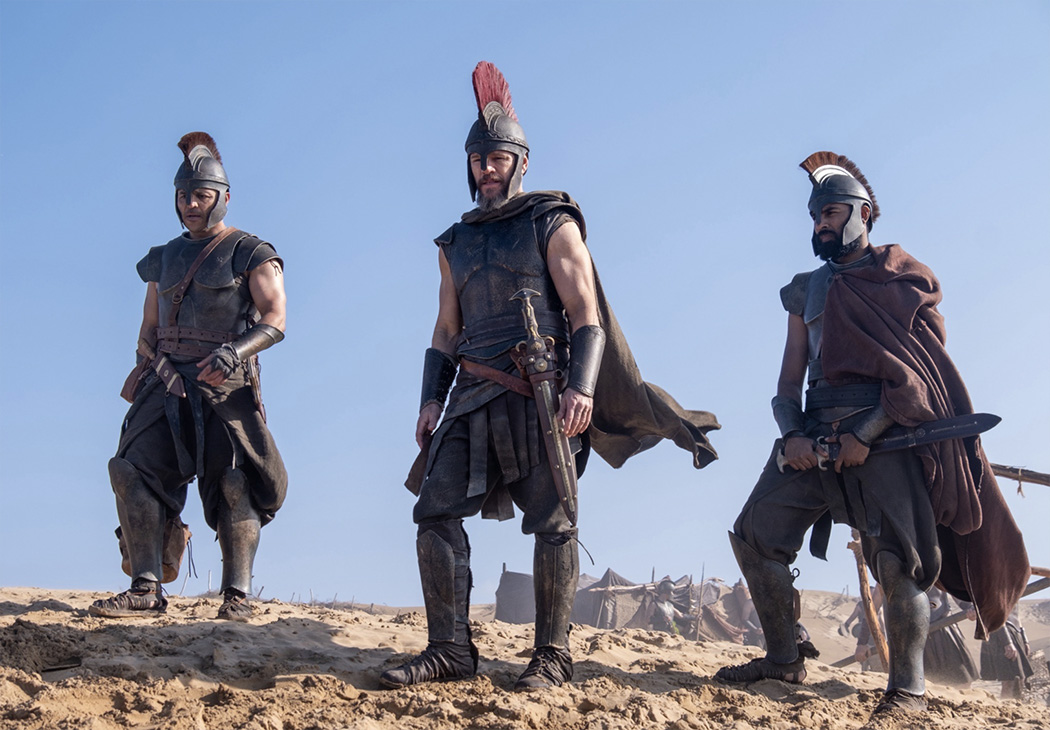
Homer’s The Odyssey was written sometime in the 8th century B.C. — more likely remembered for the time in which I would CliffNotes the assigned pages before a quiz in 9th grade rather than a key work of inspiration for centuries to come. When it was announced that Christopher Nolan’s follow-up to his Oscar-sweeping war drama, Oppenheimer, would be Homer’s tale, it felt like a match made in heaven. Notably becoming the first film to be completely shot on 70mm IMAX film with an expanded aspect ratio of 1.43:1 — forgive the nerd babble — this adaptation is most fit for the grandest filmmaking technician of his generation.
The Odyssey is one of the rare occasions that a film is able to become a physical experience for its audience, which is what makes it so fascinating. It’s set piece after set piece with performances that are visceral, and the music from Ludwig Göransson (soon to be collecting a 4th Oscar) is pulsating, that’ll have you chanting alongside Odysseus and his men.
Nolan’s latest feels like his confrontation with the state of blockbuster filmmaking. This decade, the Oscar-winning director has become the forefront — also president of the Directors Guild — of the yearning for ‘good movies.’ More specifically, a rejection of the cape-wearing heroes that seem to be dwindling, slowly but surely, from the domestic consciousness — which, yes, is a bit ironic considering the guy directed a trilogy of Batman movies. Yet, even those films feel so derivative of what that genre looks like in 2026. In fact, much of The Odyssey sometimes felt like the very best version of a superhero movie. For example, the cast is loaded with A-listers with varying screen-time, sometimes for only a minute and sometimes for more than that. There’s a cameo-like vibe that comes with the film, but it doesn’t feel cheap or possess the need to enact a slew of fan edits.
As my very own odyssey with the nearly 3-hour film went on, it dawned on me that this may be Christopher Nolan’s strongest screenplay work to date. Sure, it’s not an original work or anything, but the themes of Nolan’s adaptation string along beautifully with his particular interest in the performances from his ensemble. Each actor is coinciding the script with their own personal odyssey, as the room to breathe feels just right. The work is personal and emotionally charged to a contemporary setting, which Nolan has not been shy to express, especially in Oppenheimer. It’s all just a big feast and is a great movie for guys who really love their wives.
There’s a lot of discussion about “Zeus’s Law” in the film — a divine law that requires hosts to offer shelter, hydration, and food to strangers and travelers before asking their namesake. It’s an example of xenia (guest-friendship) hospitality. When Odysseus is away, we’re introduced to a crumbling community of suitors who advocate for the societal collapse of Ithaca. A cautionary tale about how fragile a populace is once empathy and civility is thrown out the window in exchange for power will mesh greatly for something that has sold out IMAX screens for the foreseeable future. One may draw their own interpretations, but Nolan’s expression feels overt and timeless.
As for the performances, I noted Matt Damon, Robert Pattinson, and Samantha Morton as standouts. Matt Damon as Odysseus — what a choice! It was refreshing seeing one of the Gen-X greats in something of this scale. His performance is cheerworthy, present, and doesn’t leave a single crumb on the table — except maybe a Dunkin’ Donuts stop in Troy. Robert Pattinson as Antinous strengthens his case as the most interesting actor we have working right now. His script choices are risk-taking, and he loves to do a silly little accent.
The film’s most audacious scene is that of when Odysseus and his men arrive at the island of Aeaea, where Circe (Samantha Morton), a powerful sorceress, resides. While Nolan has toyed with horror sequences before (i.e., the Oppenheimer gymnasium scene), I didn’t expect an overt body-horror flex. Circe is famously known for turning Odysseus’s men into pigs, and watching this play out didn’t disappoint for a second.
It would also be malpractice if I didn’t highlight the score from Ludwig Göransson. The multiple time Oscar winner’s latest compositions takes you to a place you’ll never want to leave. In itself, the music is equally appropriate for this ancient Greek mythology tale as well as an Electronic Dance Music festival where everyone is waiting for the beat to drop. Jogging around Nashville is about to get a lot easier.
All in all, for Christopher Nolan, this is exactly how you cash a blank check. This was truly one of the most visceral filmgoing experiences of my life — forgive my unapologetic hyperbole. The Odyssey is one long siren song, luring you through ambitious imagery until it closes out its final act with one of the best third acts of recent memory. We should all be so lucky.