Naturally enough, the word “adaptation” can fill some theatre-goers with pangs of apprehension and fears of dramatic compromise. That is certainly not the case with Clarence Brown Theatre’s stylish and entertaining production of Dial M for Murder, an ingenious adaptation by Jeffrey Hatcher from Frederick Knott’s classic that became the 1954 Alfred Hitchcock film thriller starring Ray Milland and Grace Kelly. This 2022 adaptation retains the noir-ish premise of the original and the film, keeping the 1950s London milieu, but updating character details and relationships with intriguing twists of relevance for modern audiences.
As in the original, Hatcher’s version runs on layer upon layer of character revelations. For frustrated writer-turned-PR man Tony Wendice (Christopher Joel Onken), his marriage to wealthy wife, Margot (Kat Lee), has become one of convenience. Frustrated by his own compromised career and humiliated by his wife’s secret, same-sex affair with mystery novelist Maxine Hadley (Elise Thayn), Tony devises a plot to have Margot murdered. Tony blackmails an old school acquaintance, Lesgate (Thomas Nash Tetterton), to do the deed in an elaborate scheme that, in true suspense fashion, goes badly wrong—for all involved—in a tangle of deceit, deception, and lies. And, of course, a police inspector, Hubbard (David Brian Alley), is an essential character in the genre, on hand to get it all wrong, before managing to see through those lies and deceptions in the end.

Marston
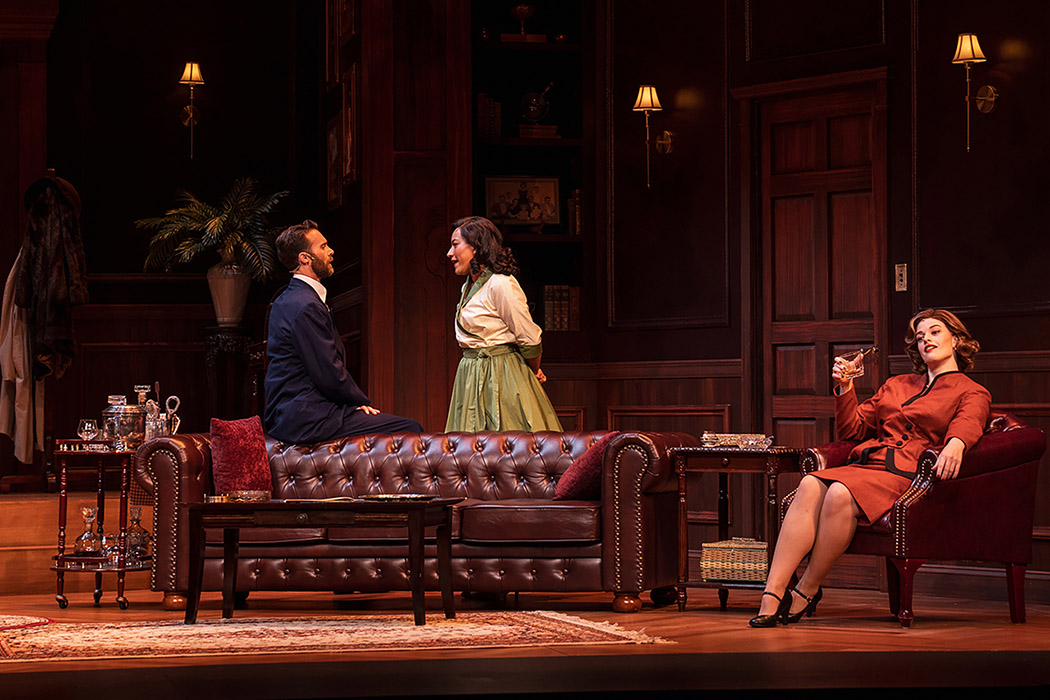
Director Melissa Maxwell, embracing the psychological drama inherent in the work, has given Dial M for Murder the needed ultra-crisp pacing that a suspense thriller requires, at the same time allowing each character an energy level of their own so that the dialogue reveals and defines their character. As a result, these fugue-like reveals pull the audience along on two undulating levels, carrying both plot assumptions and expectations. Backing up this psychology with visual metaphor, Maxwell and her creative team have provided a stunningly gorgeous living room environment, rich with depth and details, that is practically the quintessential space for a mystery/thriller vehicle in which doors, drinks, keys, and telephones are all important.
Kat Lee has taken her character of Margot in an interesting direction—toward the soft, complex, and introspective—removing any suggestion that she is merely the wealthy socialite wife, someone possibly deserving of murder. In contrast, Elise Thayn has not shied away from embracing her Maxine as a strong and dominant figure, giving entertaining, dark-humor depth to what could otherwise be a one-dimensional character.

Brown Theatre; photo by Ella Marston
Christopher Joel Onken was terrific as Tony Wendice, the deceitful, but charming husband. Skillfully balancing straight-faced deceit disguised as compassion with angry desperation, Onken takes his character through layers of disruptive emotion. His ultimate struggle is the essence of tragedy, one in which an individual faces moral choices that define his being.
Thomas Nash Tetterton gave his Lesgate some marvelously tragic depth, recognizing that bad choices have a way of following you in the worst way. And, who else but David Brian Alley could have breathed life into the character of Inspector Hubbard?
As mentioned above, the set by Leilane Bartunes is a marvelously configured 1950s London apartment with all the requisite details, beautifully lit by Dylan Tillery with an emphasis on “noir-ish” atmosphere and focus. Costumes by Matthew Carl seemed to define the characters. Sound design by Elisabeth Dupuy was marvelously realistic.
Dial M for Murder continues at the Clarence Brown Theatre through September 20.
Tickets and Information