A gossip-less exploration of reconciliation between rock n’ roll gods
“Noel tells truths, half-truths, and lies, and in 25 years’ time you really won’t know the real Noel Gallagher,” was something printed by Paolo Hewitt, a rock journalist during the height of the 1990s Britpop boom. Evidently, this is a quote that has stuck with me the most, not only about Noel, but his cheeky counterpart, brother Liam, to effusively describe the mythologizing of a couple of boneheads from Manchester, England, materializing OASIS.
Oasis: Don’t Look Back in Anger is the new, intimate documentary coming from filmmakers Will Lovelace and Dylan Southard of Meet Me in the Bathroom (2022) fame. The film is less interested in the gossip and potentially drunken stories of what may have caused the rift between brothers Liam and Noel that split up their roaring creation, and more interested in what the “Madferit” members mean to each other — but most importantly: to the fans.
We’re first presented with a chaotic montage showing just how crazy the world has gotten since – coincidentally – Oasis split up in 2009. We’re shown brief clips of the January 6th insurrection, Trump and Biden at podiums, and Theresa May doing a little jig on the way to a press conference for some reason. It could be seen as a bit ridiculous to credit the growing division in the world with Oasis ultimately splitting up, but I’d be surprised if anyone didn’t leave this epic with at least 10 percent of a “…hmm, they might be onto something here.”
Like most folks, my relationship with Oasis began with their bonfire serenade track “Wonderwall,” which has been the subject of many ill-fated needle-drops in films I’ve covered before. I was then put onto them by a friend of a friend who mentioned his connection with their music. As my wanting to dive into a rabbit hole-like personality would behold, I burned through the group’s discography quickly. I was instantly hooked. My grasp on Oasis’ music felt like some sort of connective tissue that I’d never discovered before. Something about their rawness, delightfully amateurish choruses, and all-time levels of British swagger was some sort of trailblazer moment for the kind of art that describes me as a person (being a 25 year old boy).
With all of this said, after heading to Toronto in the summer of 2025 to witness my first Oasis gig with one of my closest friends – and what will almost certainly be one of my defining memories from my roaring 20s – yeah, I absolutely loved this and was moved to tears on multiple occasions.
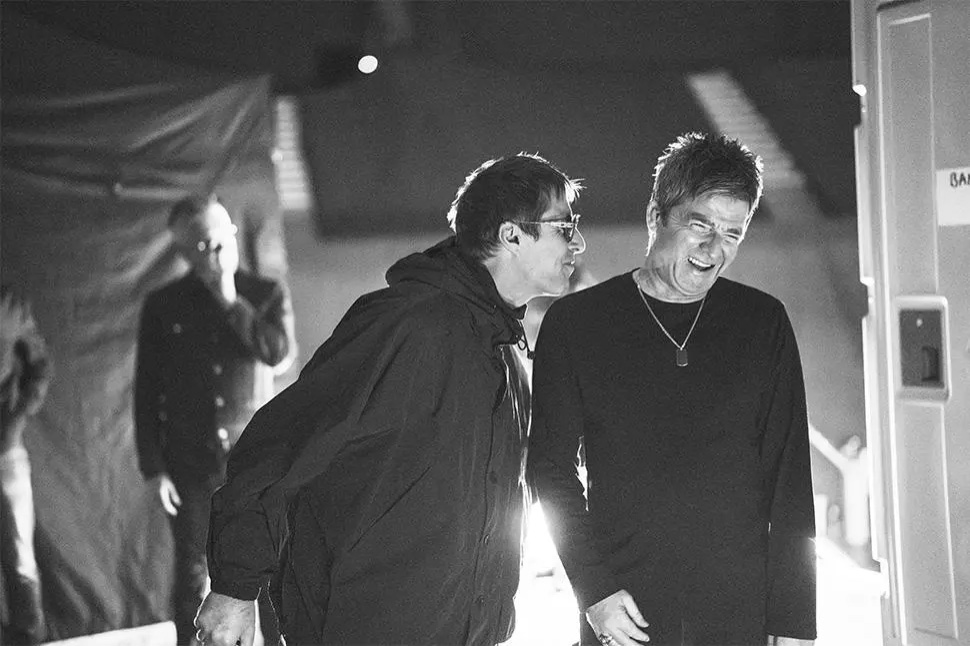
Aside from being a mega-fan, there’s a lot to take away from this documentary even if you just know the words to “Wonderwall.” This is a story about reconciliation, loss, and the pursuit of, in Liam Gallagher’s wise words, “caring the most but still not giving a f*ck.” The film takes you on a journey to the first rehearsal between Liam and Noel, and the look on each other’s faces is priceless. Liam walks into their recording studio while the camera is on Noel, who is trying to hide his smile like someone who’s seeing their long-distance girlfriend for the first time in a year. To put it simply, their chemistry is undeniable, and there’s a radiant energy bursting through each frame of the bits and pieces shown of their rehearsal. It felt like being a fly on the wall in the best way possible.
In one of the more experimental aspects of the film, we’re taken by the filmmakers to a select few shows around the world, each highlighting the atmosphere not only at the show but the festivities outside. The very first show in Cardiff is documented, with near-full-body chills and excitement from everyone inside the building, and especially for Noel. He details the feeling of blacking out after the first few songs and not remembering where he was. We’re then able to hear a few songs in full, which is marvelously shot by a collection of cinematographers on site in truly some of the most stunning photography I’ve seen in any piece of media this year. Notably, Lol Crawley (The Brutalist) was said to be one of them, which became evident because of the overt Nolan-like imagery that is not only towering, but breathtaking.
We’re then taken to destinations like Manchester, Korea, and Brazil, where each city represents a fan’s relationship with the band. Each of these moments are equally absorbing, especially in seeing how each culture confides with Oasis returning, which is always met with tears and gratitude. The second half of the feature is passively told through a sermon by a Catholic priest who relates his ideas of reconciliation and forgiveness with the return of the titular band. There’s something deeply affirming in listening to those words juxtaposed with grown men in Oasis soccer jerseys crying with one another. It seems like Oasis may have contributed to solving the Male Loneliness Epidemic by at least 0.1 percent.
Oasis: Don’t Look Back in Anger is one of the most comforting times at the movies in 2026. The visual language is overwhelming and pulsating, yet at its core, this is a pause for reflection on the reconciliation between Liam and Noel. It’s a testament to how something so silly can become such a stalemate in our lives, when all we need to do is just roll with it. The music is one form of expression, but the para-social relationship fans have with Liam and Noel, as if they’re wanting to resolve the issues themselves, is proof that we’re defined by the things we love and have an interest in, which includes a few knobheads from England.
Wyatt Allison can be found on Twitter/X @wyattartsknox and on Letterboxd @filmwyatt.
Regal Cinebarre West Town Mall
Regal Pinnacle
AMC Foothills 12