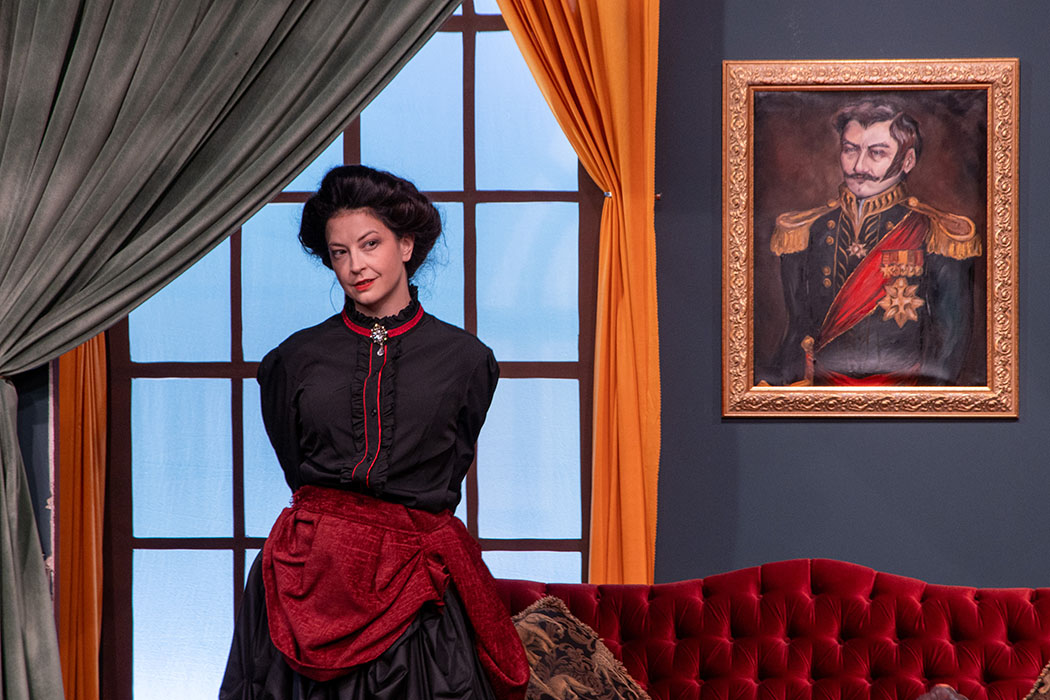
If you find yourself feeling bored, you might find some sort of activity to pass the time: read a book, go to a movie, perhaps attend the theatre for an evening of entertainment. Unfortunately, those activities aren’t scratching that apathetic itch for Hedda Tesman, the main character of Norwegian playwright Henrik Ibsen’s 1891 play Hedda Gabler. Knoxville Theatre Club’s production of Hedda Gabler is entertaining and intense, a dark and devilish tale of boredom and desperation to the extreme. Directors Raine Palmer and JP Schuffman have created an immersive production that showcases Ibsen’s work at its finest through some of the best work that Knoxville Theatre Club has to offer. This production explores, as co-director Palmer so succinctly put, “the immense depth of connection” of ever-changing human relationships. You’ll come out of this experience knowing that knowledge is power, and what you know, who you know, and what you do with that knowledge can transform fate.
Hedda Gabler is the story of Hedda Tesman, nee Gabler, an unstoppable gunslinging force. She’s “mortally bored” and wickedly clever, a tragic combination for a woman in 1890. As the daughter of the late General Gabler, she has inherited a pair of revolvers from her father; they are her playthings, her treasures, and one of the only things she has to fight that boredom. Trapped in a house she doesn’t want, with a husband she can’t stand, and with a former lover back in town, Hedda finds herself in a moment in which she can finally “have the power to mould a human destiny.” Ibsen has said that his “intention in giving [the play] this name was to indicate that Hedda, as a personality, is to be regarded rather as her father’s daughter than as her husband’s wife.” And that she is — and will always be — guns and a grisly girl power that makes Hedda one of the most significant and memorable roles in theatre history.
Stepping into the Borderlands Playhouse, audiences are transported into the parlors of the Tesman villa in Oslo circa 1890. The set, designed by JP Schuffman, is awash in moody blues, draped in velvets, and adorned with the elegant trappings of a genteel Victorian household. While the furnishings are warm and inviting, the cool greyish blues give the set a melancholy tone that suits the play well. This set is one of the most detailed and furnished I have seen from KTC, and I’m impressed. Schuffman is a fantastic carpenter and designer and has a keen knack for creating immersive spaces for both audiences and the cast onstage.
One of Ibsen’s greatest dramatic strengths as a playwright is his characters, and the cast of this production gave the high-quality performances that Hedda Gabler requires. Sara Gaddis as the titular character is brooding and mischievous, cool and calculated. Gaddis does a fantastic job at layering meaning within her delivery, toeing the line between sincerity and sarcasm. She’s bitingly cruel at times, but also intoxicatingly sincere, especially when Hedda is working her manipulative magic. Sienna Wood as Thea, a former schoolmate of Hedda’s, is a standout performance from this well-selected cast; the quiet anxiousness in her voice and her body language is riveting. And once Thea gains her confidence in the latter half of the play, Wood makes the tension and drama of the conflicting human relationships palpable. This is one of the finest performances I’ve seen her give to date.
Caleb Burnham as George Tesman is painfully cheerful, but that is how Hedda views her husband. He’s an eager young academic, and we are able to sympathize with Hedda a bit from seeing and hearing George onstage. But Burnham also lends a bit of sympathy to George’s character in the latter half of the play when he reveals his emotions to Hedda and comes more fully into himself as a character. If the play is all about Hedda, Burnham’s performance lets us see a glimpse into George. Ben Park as Ejlert Lovborg, Hedda’s former lover and George’s former friend, has ruined his reputation with drunken revelry and a lifestyle of depravity; in working with Thea on a new book, he has begun to mend his reputation, creating academic competition with George. Park’s performance is passionate yet insecure, and there’s a waifishness to how he carries himself and delivers his lines that suggests Lovborg’s comeback is built on unstable foundations. He provides the type of performance that builds character and provides backstory and exposition in a subtle and meaningful way.
Rounding out the seven-person cast are Holly Andrew as Berta, the Tesman maid; Susan Jackson as Aunt Julia, George’s aunt; and Steve Trigg as Judge Brack, a friend of the Tesmans whose own pursuit of power rivals Hedda’s. While these are more supportive roles, each actor performed them well. Andrew engages in a humorous bit of pantomime while moving Hedda’s loathed piano, and her performance gives us a few moments of comedic relief in an otherwise intense production. Jackson got off to a rough start in the opening moments of Sunday’s matinee but recovered quite well, and I enjoyed the overbearing mother-in-law quality she brought to her role regarding Hedda and George’s potential future children. And Trigg’s performance finds a balance between companionship and coercion, and flits between the two deftly; however, I do think a bit more physical interaction between Trigg and Gaddis would communicate better the power Brack tried to exert over Hedda. It’s these moments of physicality that contribute greatly to this production. The small gestures each actor employs feel genuine, and add a layer of intentionality that archives dramatic realism. They are the motions of mundane, daily life, and the motions that are central to the boredom and restlessness of Hedda’s world.
Hedda Gabler runs until October 3 with showtimes on Thursdays, Fridays, and Saturdays at 7pm and matinees on Sundays at 2pm. Tickets are available at the Borderlands Playhouse box office at 802 Sevier Avenue or online at https://knoxvilletheatreclub.org/tickets. Knoxville Theatre Club recommends reserving tickets online.